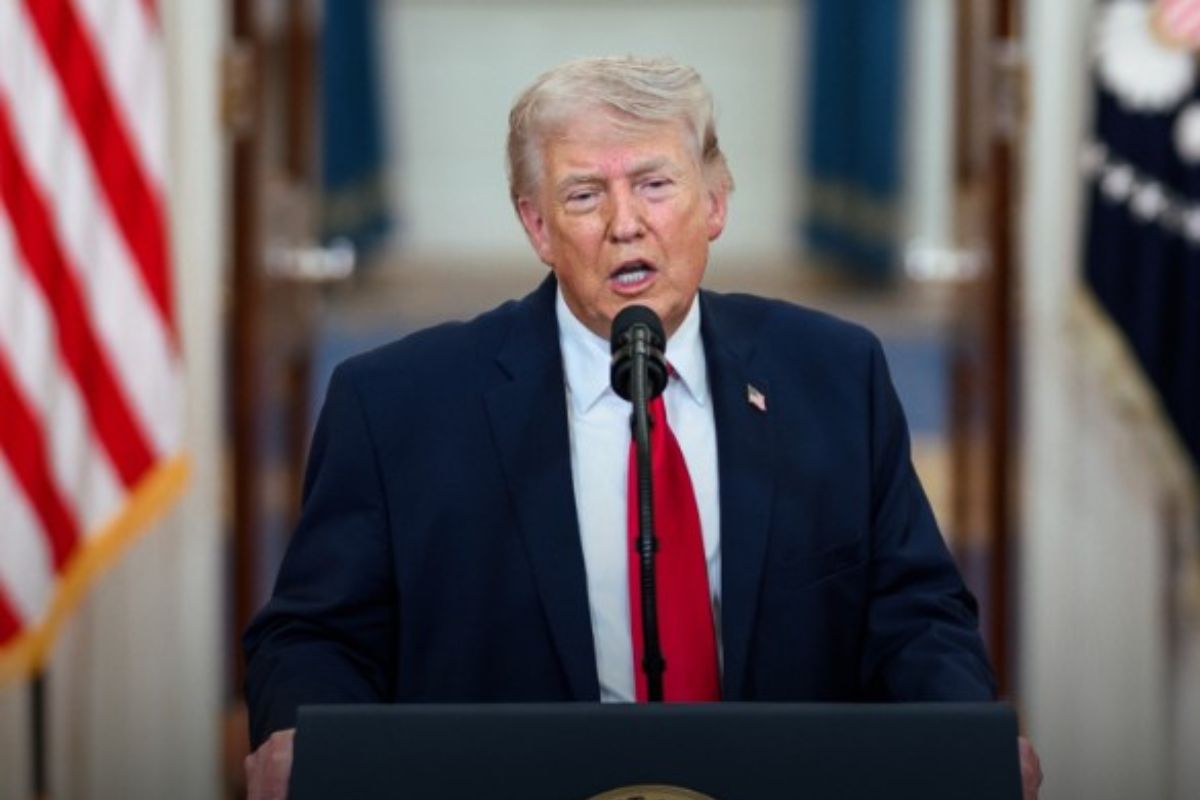
The air inside the United Nations General Assembly hall always smells faintly of old carpet, expensive cologne, and a very specific brand of procedural exhaustion. Delegates shuffle papers that will change no maps. Interpreters lean into their glass booths, their voices flattening the raw fury of world leaders into calm, rhythmic cadence.
Then the rhetoric drops its velvet coating.
When Donald Trump took the rostrum to deliver his blunt message on Iran, the diplomatic corps braced for the familiar thunder. The language was sharp, unvarnished, and designed to rattle the chandeliers. It drew the expected lines in the sand, invoking old ghosts of nuclear ambitions, proxy wars, and economic strangulation. It was theater written in a minor key—heavy, predictable, and loud.
Yet, tucked inside that same diplomatic blitz, something entirely different slipped through the microphone. A pitch for artificial intelligence.
It was a jarring juxtaposition. On one hand, a speech steeped in geopolitical brinkmanship, evoking the ancient arts of statecraft and military deterrence. On the other hand, a sudden detour into algorithmic futures, machine learning, and the cold, silicon architecture of tomorrow. Heads turned in the press gallery. Eyebrows lifted across national delegations.
Consider the sheer surrealism of the moment. We are standing at a historic crossroads where nuclear enrichment centrifuges are being debated in the same breath as large language models and automated data synthesis. It is as if a blacksmith from the early industrial revolution stopped mid-rant about his rival's ironworks to enthusiastically pitch an advanced steam turbine he barely understood, simply because he knew whoever controlled it would win the century.
To understand why that AI pitch caused such a quiet uproar, you have to look past the political posturing and examine the invisible machinery running modern power.
For decades, the currency of global dominance was physical. Oil barrels. Shipping lanes. Uranium deposits. Deep-water ports. If you held the chokepoints of geography, you held the keys to the kingdom. But over the past few years, a silent migration has occurred. The high ground moved from the earth to the cloud. Power is no longer just about who can dig the deepest trench; it is about who can train the smartest model.
When a leader known for industrial-era populism and hard-knuckles nationalism begins talking about artificial intelligence on the world’s most consequential stage, it signals a profound realization. Even the most ardent believers in old-school sovereignty recognize that the next global hegemon will not be crowned by infantry or artillery. They will be crowned by compute power.
Imagine, for a moment, a mid-level intelligence analyst sitting in a windowless room in Tehran or Washington. For years, their job relied on human informants, intercepted radio chatter, and grainy satellite photos that required hours of manual cross-referencing. It was exhausting, messy, and prone to human error.
Now, swap that analyst for an algorithmic network that processes petabytes of telemetry, financial flows, social media sentiment, and radar signatures in real time. It predicts troop movements before the trucks even start their engines. It drafts diplomatic cables, forecasts economic collapses, and simulates retaliatory strikes down to the minute.
This is the hidden theater behind the podium.
When Trump floated his vision for AI integration, he wasn't just tossing out a tech-industry buzzword to pad a speech. He was tapping into a deep, anxious undercurrent shared by every superpower on Earth: the fear of falling behind in the intelligence arms race.
Silicon is the new uranium. And the race to refine it makes the Cold War look like a gentle game of chess.
The irony, of course, is rich. Artificial intelligence is built on collaboration, open-source codebases, global talent pools, and massive supply chains that stretch from Taiwan to the Netherlands to Silicon Valley. It requires millions of lines of code written by engineers who speak different languages and worship different gods. It is the ultimate globalized enterprise.
Yet, it is being weaponized by nationalist impulses.
Every major government wants sovereign AI. They want models trained on their values, guarded by their firewalls, and optimized for their national interests. They look at generative algorithms not as tools for human flourishing, but as digital sovereign borders. If you control the model that shapes public perception, filters news, and automates critical infrastructure, you don't need to conquer a nation. You simply rewrite its operating system.
This brings us back to the UN General Assembly hall.
The blunt warnings about Iran were broadcast in high-definition technicolor, designed for the evening news cycle. But the throwaway lines about AI were the real transmission. They were a signal to the tech titans, venture capitalists, and defense contractors watching from home: The state is waking up.
For years, Silicon Valley operated like a rogue state, moving fast, breaking things, and largely ignoring the archaic edicts of geopolitics. They built chatbots, image generators, and autonomous navigation software while politicians bickered over tax codes. The tech elite fancied themselves above the messy fray of traditional diplomacy.
They were wrong.
When a superpower's leader stands at the global microphone and weaves machine intelligence into the tapestry of national security, the honeymoon phase of unregulated technological expansion officially ends. The state has noticed the power of the algorithm. And whenever the state notices something powerful, it eventually seeks to cage it, tax it, or point it at its enemies.
We are entering a strange era where code is policy and weights and biases carry geopolitical weight. The diplomatic corps at the UN will keep shuffling their papers. Translators will keep speaking in measured tones. But behind the scenes, the real negotiations are happening in server farms humming quietly in the dark, processing the future one token at a time.
The podium is old wood. The microphone is decades-old tech. But the words echoing through the hall are sketching out the contours of a world we are entirely unprepared to inhabit.
Listen closely to the hum. It is getting louder.