The dirt in Juba doesn’t just sit on the ground. It hangs. It clings to the throat, a fine, ochre dust that tastes of charcoal and exhaust. In the dry season, it acts as a veil, softening the edges of a city that has seen too much to ever truly be soft.
For years, that haze has been punctured by a very specific shade of blue. It is the blue of a United Nations helmet—a color so unnaturally bright it feels like a glitch in the landscape. To a mother in a displacement camp outside Malakal, that blue is not a political statement. It is a physical barrier between her children and the sound of gunfire.
But the math of international diplomacy is cold, and it is changing.
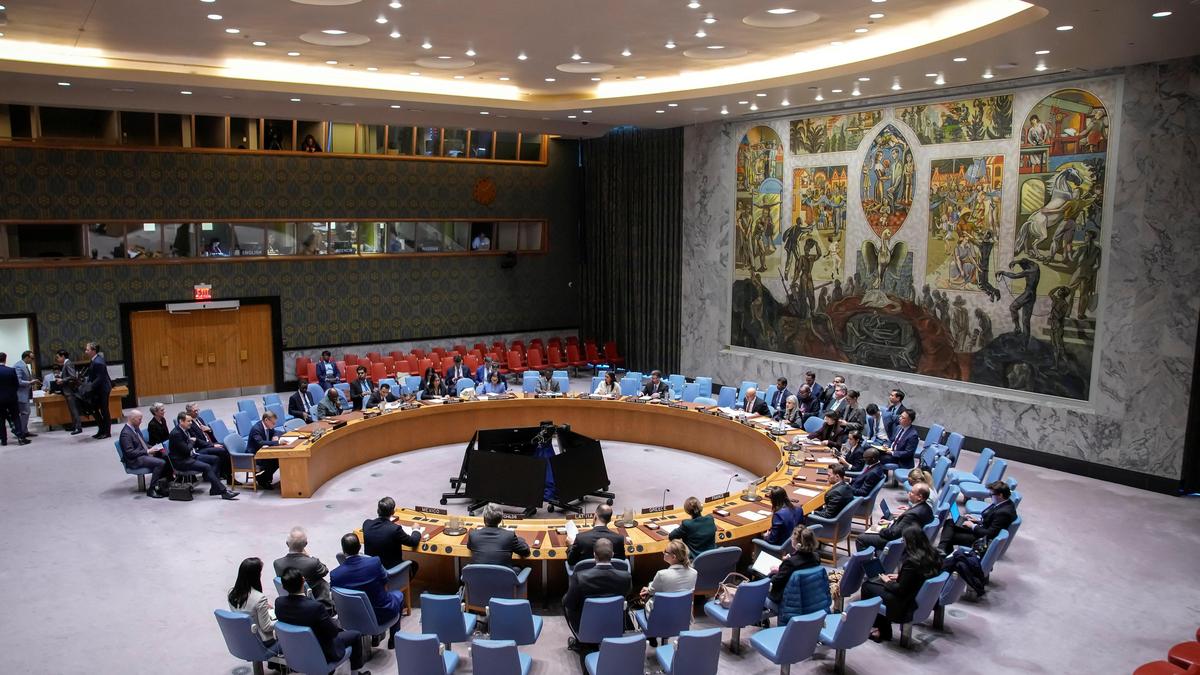
The United Nations Security Council recently put pen to paper, signaling a shift that will be felt not in New York, but in the swaying grass of the Sudd wetlands. They voted to reduce the peacekeeping force in South Sudan (UNMISS) from a ceiling of 17,000 troops down to 12,000. On a ledger, it looks like efficiency. It looks like a "transition toward sovereign responsibility."
On the ground, it looks like a thinning line.
The Weight of Five Thousand
To understand what 5,000 fewer soldiers means, you have to stop thinking about armies and start thinking about patrols. Imagine a single white 4x4 vehicle bouncing along a road that is more crater than gravel. In the back sit four soldiers. They aren't there to fight a war; they are there to be seen. Their presence is a deterrent, a silent reminder that the world’s eyes are open.
When you cut 5,000 people from that equation, you aren't just losing soldiers. You are losing the eyes.
The decision-makers argue that the 2018 peace deal, despite its agonizingly slow implementation, has held long enough to justify a lighter footprint. They point to the "graduated" forces of the South Sudanese national army as the eventual successors to this security burden. It is a logical argument. It is a clean argument. But logic often fails when it meets the reality of a country where trust has been burned to the ground and the ashes are still warm.
Consider a hypothetical village in Jonglei State. We will call it Anyidi. In Anyidi, the arrival of a UN patrol every Tuesday is the heartbeat of the week. It means the market can open. It means the girls can walk to the well without their mothers looking at the horizon every ten seconds. If those 5,000 cuts mean that the patrol now only comes every three weeks, the silence in between grows heavy. Fear doesn't need a massacre to thrive; it only needs an absence.
The Invisible Stakes of "Sovereignty"
There is a word that echoes through the halls of the UN: transition. It is a beautiful word. It implies growth, maturity, and a handoff of power. The goal of any peacekeeping mission is, eventually, to no longer exist. To stay forever is a failure.
But the timing of this exit is a gamble with human lives as the currency. The South Sudanese government is expected to take the lead, yet the integration of former rebel fighters into a unified national army remains a project of fits and starts. Weapons are everywhere. Tensions over cattle, land, and political representation remain coiled like a spring.
When the blue helmets pull back, the space they leave behind is rarely filled by a vacuum. It is filled by local militias, by ethnic tensions, and by the desperate scramble for resources.
The Security Council isn't just cutting numbers; they are testing a theory. The theory is that South Sudan is ready to stand. The fear, whispered in the corridors of NGOs and humanitarian outposts, is that the legs are still too weak to carry the weight.
The Logistics of Life and Death
Peacekeeping is often criticized for being a bloated, expensive bureaucracy. It is. It costs billions to keep 17,000 people fed, fueled, and housed in one of the most logistically challenging environments on Earth.
Critics of the cut argue that the "savings" are a mirage. If the withdrawal leads to a flare-up of violence, the cost of the subsequent humanitarian disaster—feeding millions of newly displaced people—will dwarf the price of keeping those 5,000 soldiers in the field.
It is a classic case of short-term accounting versus long-term stability. The international community is tired. There is "donor fatigue." There are other wars, other headlines, and other fires to put out in Europe and the Middle East. South Sudan, once the darling of the international community during its independence in 2011, has become a "protracted crisis"—a term that essentially means the world has started to look away.
The Human Echo
I remember talking to a man named Gabriel in a camp in Bentiu. He had lost his home, his cattle, and two of his brothers. He lived in a shack made of plastic sheeting and scrap wood. When I asked him what he feared most, he didn't say hunger, even though his ribs were visible. He didn't say disease, even though cholera was a constant threat.
He pointed to the watchtower where a peacekeeper stood with binoculars.
"When they leave," Gabriel said, "the night gets longer."
He wasn't talking about the rotation of the earth. He was talking about the psychological safety that allows a human being to sleep. The UNMISS force provides more than just physical security; it provides a psychological floor. It says to the most vulnerable: You have not been forgotten.
When we reduce that force by nearly thirty percent, we are telling Gabriel that the floor is being partially dismantled. We are telling him that he needs to be ready to run again.
A Gamble in the High Grass
The drawdown is not happening all at once. It is a staggered retreat, a cautious pruning of the mission’s reach. The UN insists that they will maintain their "protection of civilians" (POC) sites and continue to facilitate the delivery of aid.
But logistics have a gravity of their own. Fewer troops mean fewer escorts for food convoys. Fewer escorts mean more "taxation" by local warlords at illegal checkpoints. More taxation means less food reaching the children in the furthest reaches of the Bahr el Ghazal.
The chain of consequence is long and unforgiving.
We often talk about geopolitics as if it were a game of chess played on a polished board. We move the pieces—17,000 to 12,000—and wait for the opponent's move. But in South Sudan, the board is made of mud, and the pieces are people who bleed.
The decision has been made. The votes are counted. The blue line is thinning.
Now, we wait to see if the fragile peace can survive the shadows that grow when the lights are turned down. The true test of this policy won't be found in a report delivered in New York next year. It will be found in the silence of a village like Anyidi, where a mother listens to the wind and wonders if the dust she sees on the horizon is a patrol coming to help, or something else entirely.
The blue helmets are moving out. The sun is setting over the Nile. And for millions of people, the night is about to get much, much longer.



