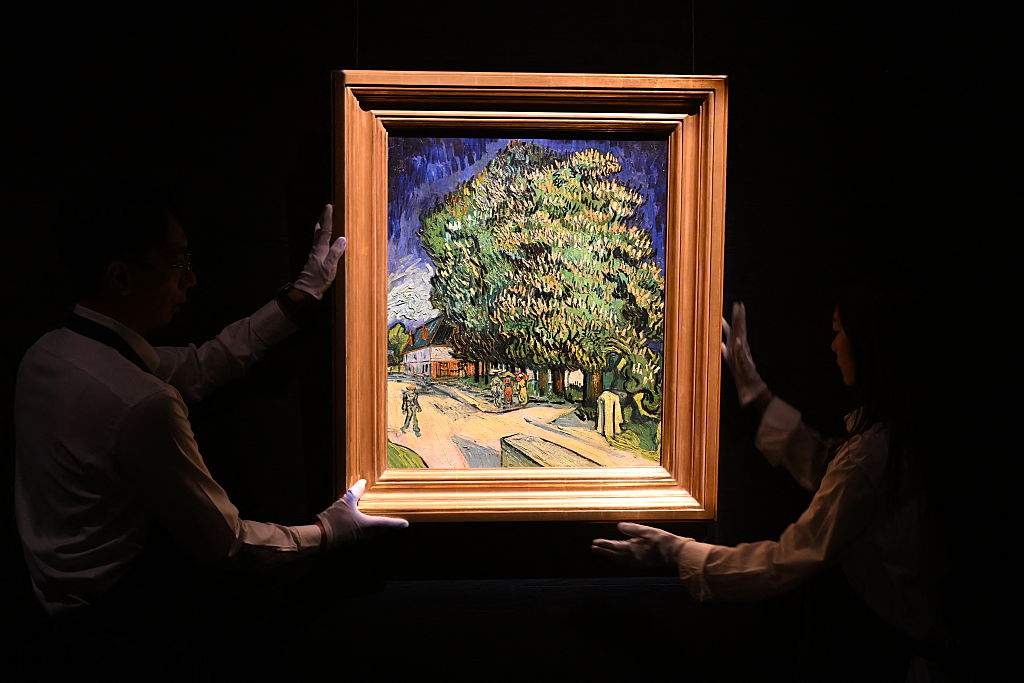
One hundred and ninety million dollars. That's what a single Vincent van Gogh painting with past ties to Nazis just fetched in New York.
Let's be honest about what's happening here. Most headlines treat this like another glitzy auction record, another billionaire trophy hunt on Fifth Avenue. They're missing the real story. When a canvas looted or forced into sale under the Third Reich crosses the block for nearly $200 million, you aren't just looking at art appreciation. You're watching the collision of wartime trauma, decades-long legal battles, and the modern billionaire appetite for "clean" provenance.
If you've ever spent time digging through provenance records—and I've spent years reading the dry, maddeningly incomplete catalogues from European wartime archives—you know that a painting's paper trail is often more dramatic than the brushstrokes on the front. A single gap between 1933 and 1945 can tank a masterpiece's value to zero. Nobody wants to buy a lawsuit. Nobody wants to hang stolen property over their fireplace, no matter how famous the signature in the corner is.
Yet here we are. A Van Gogh with documented Nazi-era entanglement didn't just sell—it obliterated expectations in a New York salesroom.
How Provenance Turns Toxic Assets Into Trophy Art
To understand why buyers were willing to throw $190 million at this canvas, you have to understand how the high-end art market treats history.
In the art world, provenance isn't just a receipt. It's a title deed. For decades after World War II, major auction houses and museums operated on a "don't ask, don't tell" policy regarding where European paintings spent the 1930s and 1940s. If a Dutch or French landscape showed up in a Swiss gallery in 1952, nobody pressed too hard on who owned it in 1938.
That era is dead. Today, a painting with an unexplained gap during the Nazi occupation is radioactive. Major institutions won't touch it. Insurance companies won't underwrite it. Banks won't lend against it.
So how did this Van Gogh reach $190 million? Restitution.
When a painting with Nazi ties goes to auction today and commands nine figures, it almost always means one of two things happened behind closed doors before the gavel ever came down:
- The painting was formally restituted to the heirs of the original Jewish collector, who then consigned it to the auction house.
- The current possessor and the original family's heirs reached a legally binding settlement agreement to split the proceeds, effectively wiping the slate clean for the next buyer.
That legal clearance is pure gold. In fact, it's the only reason the bidding didn't stall out. Once a settlement is signed or a court-backed restitution is finalized, that toxic wartime history transforms from a legal liability into a documented historical pedigree. Buyers love a story, provided the lawyers have already signed off on it.
What People Get Wrong About Nazi-Looted Art at Auction
There's a massive misconception floating around every time one of these sales hits the news. People assume the money goes into the pockets of some shady collector who profited off the Holocaust, or that the auction house is quietly sweeping war crimes under the rug to collect a buyer's premium.
That's rarely how it works anymore. Honestly, the auction houses—Christie's and Sotheby's in particular—have dedicated restitution departments staffed by full-time historians whose entire job is to prevent that exact nightmare. Getting sued by a claimant family three weeks before an evening sale is every auction specialist's worst fear. It ruins marketing campaigns, scares off guarantors, and destroys credibility.
Here's what actually happens when a Van Gogh from that era surfaces:
- The provenance check starts years before the sale. Researchers comb through the Art Looting Investigation Unit (ALIU) Red Flag lists, the Database of Art Objects at the Jeu de Paume, and German Bundesarchiv records.
- Forced sales get treated the same as outright theft. You don't need a stormtrooper kicking down a door for a sale to be tainted. Under the Washington Principles on Nazi-Confiscated Art (established in 1998), if a Jewish collector sold a painting in Germany or occupied territories under duress—to pay punitive "flight taxes" or fund an escape visa—that transaction is recognized as a forced sale.
- The market prices in the certainty. A "restituted" Van Gogh carries a stamp of exhaustive legal vetting. Paradoxically, it often has cleaner title than a painting that sat quietly in a private collection for eighty years without ever being scrutinized by wartime researchers.
I've watched mid-tier Impressionist works sit unsold because of a single murky three-year gap in Munich during the late 1930s. Meanwhile, a fully vetted, settled, or restituted masterpiece attracts every sovereign wealth fund and tech founder in the room. Certainty sells.
Why Van Gogh Commands These Insane Numbers Right Now
Even with spotless paperwork, $190 million puts this painting in rarefied air. Very few artworks in human history have ever crossed that threshold publicly.
Think about the supply problem. Vincent van Gogh only painted for about a decade before his death in 1890. Roughly 900 paintings survived. The vast majority of them—around two-thirds—are locked up forever inside public institutions like the Van Gogh Museum in Amsterdam, the Musée d'Orsay in Paris, and the Museum of Modern Art in New York.
They're never coming back to the market. Ever.
That leaves a shrinking pool of privately held Van Goghs, and most of the best ones are already sitting in the vaults of collectors who have zero need for cash. When a museum-grade canvas from his peak years—especially one tied to his time in Arles, Saint-Rémy, or Auvers-sur-Oise—actually hits the block in New York, collectors treat it like the last lifeboat off the Titanic.
You can't just wait until next season. There might not be another one for ten years.
Look at recent art market history to see the trajectory. In November 2022, Van Gogh's Verger avec cyprès (Orchard with Cypresses), from the collection of Microsoft co-founder Paul Allen, sold at Christie's New York for $117.2 million. Before that, his Portrait of Dr. Gachet famously sold for $82.5 million back in 1990—a number that held the world record for years and still translates to well over $190 million when adjusted for inflation.
This $190 million sale isn't an anomaly. It's the market catching up to decades of inflation and extreme scarcity at the absolute top tier of modern art.
The Dark Irony of Van Gogh and the Third Reich
There's a bitter historical irony embedded in every single Van Gogh sale that touches the Nazi era.
Adolf Hitler and Joseph Goebbels hated Van Gogh. They didn't just dislike his style; they actively campaigned against it. In 1937, the Nazi regime included Van Gogh's work in the infamous Entartete Kunst ("Degenerate Art") exhibition in Munich, holding up his swirling, emotional brushwork as proof of cultural decay and mental illness.
The regime purged his paintings from German state museums.
Yet, despite calling his art "degenerate," Nazi officials weren't stupid about money. Hermann Göring and Hitler's art dealers knew full well that international collectors in Switzerland, Britain, and the United States would pay steep prices in hard foreign currency for Van Gogh canvases. So while they condemned him in public speeches, they quietly confiscated his works from Jewish collectors across Germany, Austria, France, and the Netherlands—either to trade them for Old Masters or to sell them abroad to fund the German war machine.
Famous dealers like Hildebrand Gurlitt and Karl Haberstock built massive networks moving these exact paintings through neutral markets like Zurich and Lucerne.
When a Van Gogh from that pipeline sells in New York for $190 million, it's a direct rebuke to the regime that tried to erase both the artist's legacy and the families who originally championed his work. Jewish collectors in early 20th-century Berlin, Vienna, and Amsterdam were among the earliest, most forward-thinking patrons of post-Impressionism. They bought Van Gogh when traditionalists mocked him.
What Happens to the Money and the Painting Next
A $190 million hammer-and-premium total doesn't mean one person walks away with a wire transfer for $190 million. High-end art deals are messy behind the curtain.
First, the auction house takes its cut—usually a sliding scale buyer's premium that adds tens of millions on top of the hammer price. If a third-party guarantor stepped in before the auction to guarantee a minimum price (which is standard practice for nine-figure lots so the auction house doesn't take on catastrophic risk), that guarantor gets a financing fee or a slice of the upside above the guarantee line.
Second, if the sale was the result of a restitution settlement, the remaining net proceeds are divided according to the private contract signed between the consignor and the original owner's estate. Sometimes it's a 50/50 split. Sometimes the heirs receive the lion's share. Those terms are almost always locked under strict non-disclosure agreements.
As for the painting itself? Don't expect to see it hanging in your local museum next month.
Buyers spending $190 million in New York usually fall into one of three buckets:
- Ultra-high-net-worth private collectors buying for personal residences or private foundations, often in the US, Europe, or Asia.
- Sovereign-backed museum initiatives, particularly in the Middle East, where institutions like Louvre Abu Dhabi or upcoming cultural districts in Qatar and Saudi Arabia are actively building encyclopedic Western collections from scratch.
- Long-term generational trusts treating blue-chip art as a non-correlated asset class that holds value across decades.
Often, these paintings vanish into climate-controlled freeports in Geneva, Luxembourg, or Delaware for a few years before quietly reappearing on loan at a major retrospective.
How to Research Art Provenance Yourself
You don't need $190 million to verify whether an artwork—or even a family heirloom—has a complicated wartime history. If you collect art, work with estates, or just want to see how historians track these paintings, the primary databases are completely free and open to the public:
- The Lost Art Database (Deutsches Zentrum Kulturgutverluste): Run by the German Lost Art Foundation, this is the central registry for cultural property looted or lost during the Nazi era. You can search by artist, title, or former owner.
- The Art Loss Register (ALR): The world's largest private database of stolen and looted art. Auction houses run every significant lot through the ALR before printing a catalogue.
- The Monuments Men and Women Foundation: Offers detailed archival records and object histories on works recovered by Allied forces after 1945.
- The Getty Provenance Index: Essential for tracing sales catalogues and dealer stock books across Europe from the 19th and early 20th centuries.
If you're ever buying European art created before 1945—even at a regional auction for a few thousand dollars—always check the provenance line in the catalogue. Look specifically at the years between 1933 and 1945. If the listing jumps straight from "Private Collection, Berlin, 1928" to "Private Collection, Switzerland, 1951" with nothing in between, ask the specialist for documentation before you raise your paddle.