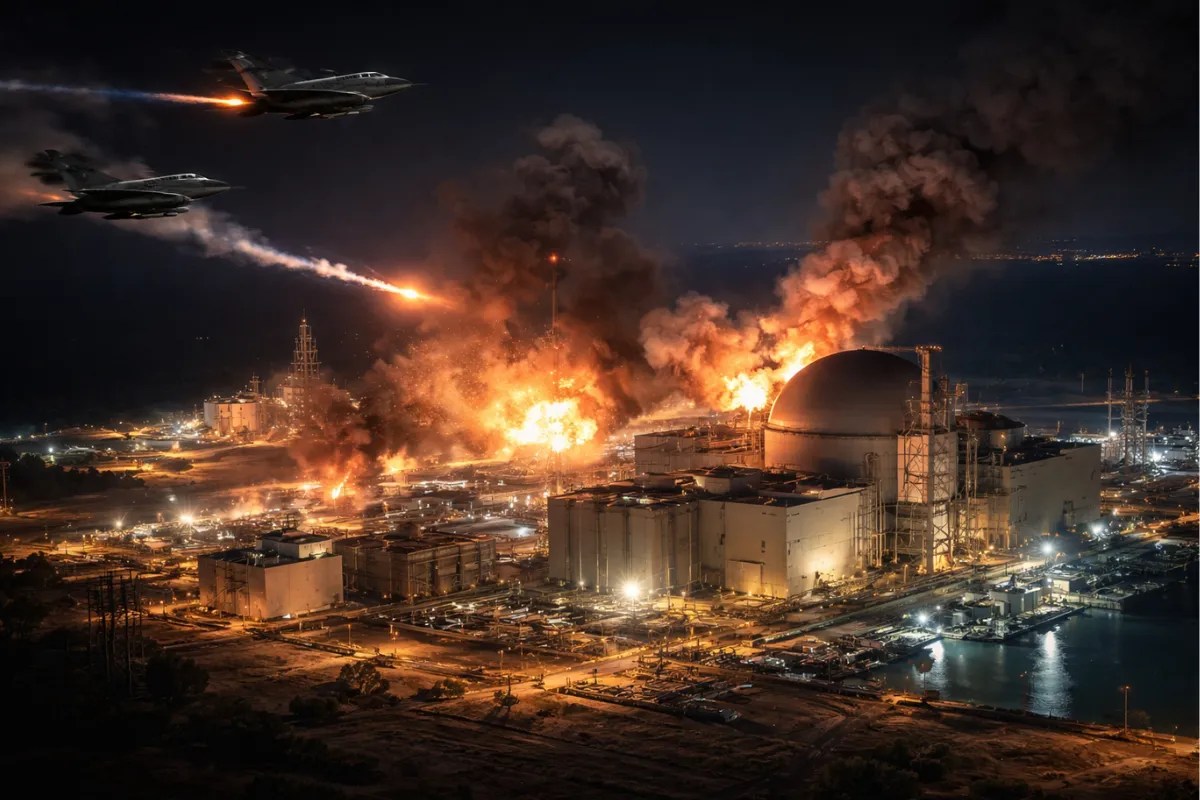
Washington is moving its heavy hitters into position. It isn't just about showing the flag or sending another carrier strike group to sit in the Persian Gulf. The real story lies in the quiet deployment of the AGM-158C LRASM—the Long Range Anti-Ship Missile. This isn't your standard Harpoon from the Cold War era. We’re looking at a fundamental shift in how the US plans to dismantle Iranian naval capabilities if a hot war actually breaks out.
The Pentagon's strategy centers on one specific problem: the Strait of Hormuz. Iran knows it can't win a traditional broadside battle against a US destroyer. Instead, they rely on "swarming" tactics and anti-access/area-denial (A2/AD) zones. By flooding the theater with stealthy, autonomous missiles that can think for themselves, the US is effectively telling Tehran that their coastal defenses are already obsolete.
The Tech Behind the Stealth Shift
Most people think of missiles as "dumb" rockets that follow a radar beam. That’s old thinking. The LRASM is different because it’s designed to operate in "blind" environments. If Iran jams GPS or knocks out satellite links, the LRASM doesn't care. It uses an onboard multi-mode sensor suite to find its target without needing a constant hand-hold from a human operator.
It’s basically a flying robot with a 1,000-pound warhead.
The stealth aspect is what makes this deployment so aggressive. This missile has a very low radar cross-section. By the time an Iranian frigate's radar picks up the incoming threat, the crew has seconds, not minutes, to react. The US is betting that the sheer volume of these missiles now in the region can overwhelm any point-defense system Iran currently operates.
Why Bulk Matters Right Now
Military analysts often talk about "magazines." It’s a simple concept: how many shots do you have before you’re empty? For years, the US had a limited inventory of these high-end stealth munitions. They were expensive boutique items. That’s changed. Production has ramped up, and the "bulk" nature of this deployment suggests the US is ready for a prolonged high-intensity conflict rather than a one-off strike.
Sending a few missiles is a warning. Sending hundreds is a preparation for a campaign.
The US Air Force and Navy are integrating these onto B-1B Lancers and F/A-18 Super Hornets across bases in the Middle East and surrounding hubs like Diego Garcia. A single B-1B can carry 24 of these missiles. Do the math. Two bombers can theoretically wipe out an entire regional fleet in one pass. It’s a terrifying level of concentrated firepower that changes the math for Iranian planners.
Bypassing the S-300 and Beyond
Iran has spent billions on Russian-made air defense systems like the S-300. These systems are great at spotting high-flying jets. They aren't nearly as good at spotting a missile that skims the waves and hides its heat signature. The LRASM is designed to weave through these defensive "bubbles."
I've seen how these simulations play out. The goal isn't just to hit a ship; it's to hit the right ship. The LRASM can distinguish between a civilian tanker and a military corvette in a crowded shipping lane. This reduces the risk of accidental escalations—something that’s always a nightmare in the congested waters of the Gulf.
The Tactical Reality of a Gulf Conflict
If you’re sitting in Tehran, this deployment looks like a checkmate move. The US is addressing its biggest vulnerability: the risk to its carriers. If the US can sink the Iranian navy from 200 miles away using stealth missiles, they don't have to put their multi-billion dollar carriers within range of Iran’s coastal silk-worm missiles.
It’s a lopsided advantage.
We also have to look at the psychological impact. Modern warfare is as much about perception as it is about kinetic energy. By making this deployment public—or at least "leaking" the scale of it—the US is attempting to deter Iran without firing a shot. It's the "speak softly and carry a big stick" approach, but the stick is now invisible to radar and guided by artificial intelligence.
What This Means for Global Oil Stability
The Strait of Hormuz is the world's most important oil chokepoint. About 20% of the world's liquid petroleum passes through it. Any conflict there sends gas prices through the roof instantly.
By deploying the LRASM in bulk, the US aims to keep the strait open by force. The logic is simple: if Iran tries to mine the strait or use their "swarm" boats to harass tankers, the US can pick them off with surgical precision.
- Precision over Power: It’s not about carpet-bombing; it’s about hitting the engine room of a specific vessel.
- Autonomy: These missiles can talk to each other to coordinate which one hits which target.
- Range: Staying out of the "kill zone" keeps American sailors safe while still exerting control.
The Risks of High-Tech Brinkmanship
Don't think for a second that this is a risk-free strategy. When you rely on autonomous systems and "stealthy" deployments, there's always the danger of a miscalculation. If an Iranian commander feels they have a "use it or lose it" scenario with their fleet, they might strike first.
The US is walking a thin line. On one hand, you want to be so powerful that the other side is too scared to move. On the other hand, if you look like you’re preparing for an imminent invasion, you might trigger the very war you’re trying to prevent.
The sheer volume of long-range stealth weaponry now circling Iran suggests the US has moved past simple deterrence. They’re building a framework for total sea control.
Practical Realities to Watch
Keep an eye on the flight patterns of B-1B bombers moving toward the CENTCOM area of responsibility. When those heavy lifters start showing up in theater, they aren't there for exercises. They are the primary trucks for the LRASM.
Also, watch for Iranian naval exercises. If they start moving their larger assets back into protected harbors or further up the coast, it’s a sign they’re acknowledging the threat. They know their surface fleet is vulnerable.
For the average person, this might seem like distant military maneuvering. But the reality is that the stability of the global economy is currently resting on the wings of these stealth missiles. If they work as advertised, they prevent a total blockade of the world's energy supply. If they fail, or if their presence triggers a desperate response, we’re looking at a very different world by next week.
Monitor the official DOD briefing transcripts for mentions of "precision maritime capability." That’s the code for these types of deployments. Don't wait for a formal declaration of hostilities; the hardware is already on the ground, and the mission parameters are set. The next step is seeing if Tehran takes the hint or decides to test the tech. It’s a high-stakes game of poker where the US just pushed a massive pile of chips into the center of the table.