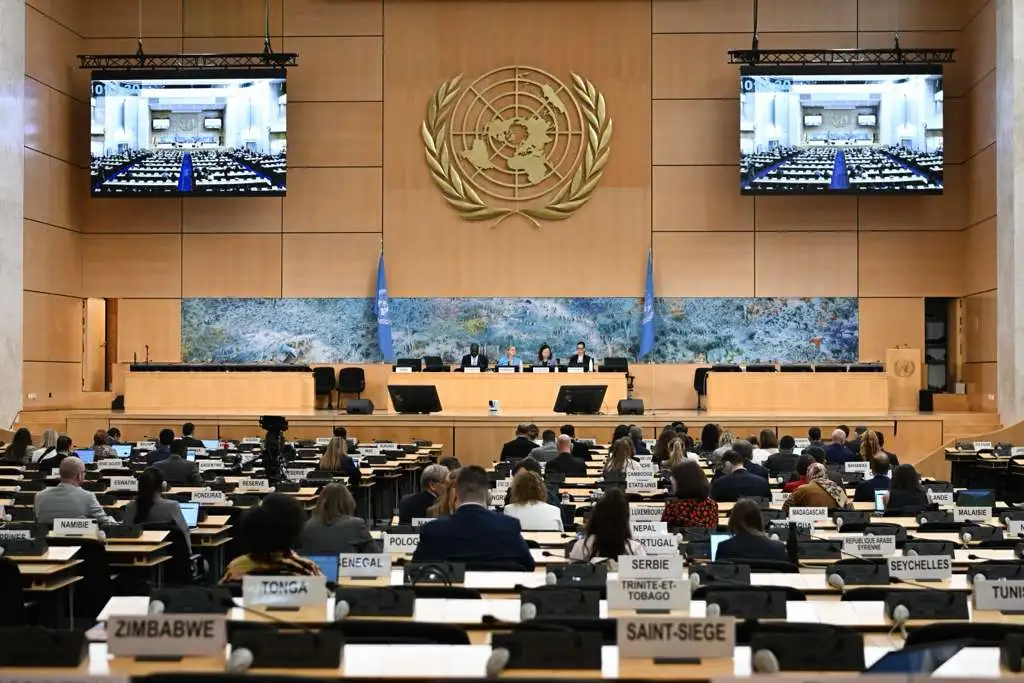
Walk into Room XX at the Palais des Nations in Geneva during a Universal Periodic Review, and you'll feel a specific kind of diplomatic tension. Usually, the room is packed. Translators murmur in glass booths while diplomats from dozens of nations line up to grill a fellow UN member state on its human rights record.
Except when the United States decides not to show up.
For the second year running, the U.S. boycotted its scheduled United Nations human rights review, leaving an empty chair where the American delegation should have been sitting. Most mainstream coverage treats this like another routine diplomatic spat in Geneva. That misses the bigger picture entirely. When the world's most powerful democracy refuses to participate in the UN's flagship peer-review mechanism, it doesn't just snub a committee—it rewrites the rules for every authoritarian regime looking for an excuse to dodge accountability.
What the Universal Periodic Review Actually Is
If you don't spend your days tracking international law, the Universal Periodic Review (UPR) sounds like bureaucratic white noise. It's not. Created in 2006 alongside the UN Human Rights Council, the UPR is the only mechanism on earth that forces every single UN member state—all 193 of them—to submit their human rights records to public scrutiny every four-and-a-half years.
There's no opt-out clause. North Korea shows up. China shows up. Russia, Iran, and Venezuela all send delegations to Geneva to sit in that chair and listen to other countries criticize their prisons, their courts, and their treatment of minorities.
They don't do it out of the goodness of their hearts. They do it because the system relies on universal participation. Once a major power breaks that norm, the entire architecture starts to wobble.
The U.S. has a notoriously rocky relationship with the UN Human Rights Council. Under the George W. Bush administration, Washington refused to join the body when it launched in 2006, arguing it was packed with serial rights abusers. The Obama administration reversed course in 2009, joined the council, and participated in the first U.S. review in 2010. Then came the Trump administration, which withdrew from the council in 2018 over what it called chronic bias against Israel and a failure to reform. Even after the Biden administration rejoined in 2021, the underlying friction never really disappeared, and shifting political winds in Washington have once again pushed the U.S. out the door.
Why Washington Walked Away Again
Ask a State Department official why the U.S. skipped the review, and you'll hear familiar talking points. Washington argues the Human Rights Council lacks credibility when countries like China, Cuba, and Eritrea hold seats at the table while using the forum to shield themselves and attack democracies.
There's a kernel of truth there. Anyone who has watched a UPR session knows how the game gets played. Authoritarian governments routinely flood the speakers' list with friendly allies who praise their "remarkable progress" on poverty reduction while ignoring mass detentions or censored press. When Western democracies bring up political prisoners, those same regimes dismiss the criticism as Western interference.
Washington's frustration isn't invented out of thin air. Paying millions in UN dues only to watch dictatorships lecture democracies on civil liberties gets old fast.
Still, walking out of your own review is a terrible strategy. Skipping the UPR doesn't fix the council's hypocrisy. It just hands authoritarian governments a massive propaganda victory on a silver platter.
The Real Damage of an Empty Chair
Think about what happens in Beijing, Moscow, or Tehran the morning after the U.S. boycotts a UN review. State media doesn't report the nuances of American legislative debates over UN reform. They run a simple headline: The United States refuses to answer for its own human rights record.
When Washington participates in the UPR, American diplomats get to look the world in the eye and say, "Yes, we have flaws—racial disparities, police violence, immigration challenges—and we're willing to discuss them openly in front of the international community. Now, let's talk about your labor camps."
That moral contrast is diplomatic gold. You lose it the second you stay home.
I've watched diplomats from smaller democracies wrestle with this exact dilemma behind closed doors in Geneva. Many of them share Washington's disgust with the council's double standards. Yet they show up every single cycle because they know that if the UPR collapses, smaller nations lose one of the few platforms where they can hold larger powers to account. When the U.S. bails, those allies are left twisting in the wind, forced to defend a system that Washington itself is actively undermining.
Even worse, a U.S. boycott creates a precedent that other countries will inevitably copy. Right now, universal participation is the UPR's superpower. If the U.S. can skip its review two years in a row without facing real consequences, what stops another major power from doing the exact same thing the next time it faces uncomfortable questions about a crackdown on protesters? Nothing.
What Happens Inside the Room Without the US
A UPR session without the country under review is an awkward, hollow affair. Normally, the process runs on a strict three-and-a-half-hour clock. The country being reviewed presents its national report, other UN members offer recommendations, and the delegation responds.
When the U.S. boycotts, the council is forced to either postpone the session or hold an empty-chair meeting where member states read their recommendations into the void. Civil society groups—American ACLU lawyers, indigenous rights advocates, criminal justice reformers—often travel to Geneva at their own expense to lobby diplomats ahead of these sessions. They spend months compiling shadow reports on everything from voting rights to solitary confinement.
When Washington doesn't show up, those grassroots advocates are left talking to an empty desk. The State Department isn't there to hear them, respond to their data, or commit to reviewing their recommendations. For human rights defenders around the world, watching the U.S. brush off domestic civil society groups sends a chilling message: if Washington won't listen to its own citizens at the UN, why should anyone else?
Why Domestic Politics Keep Driving Foreign Policy
To understand why the U.S. keeps oscillating between engagement and boycott, you have to look at Washington, not Geneva. UN human rights mechanisms have become a domestic political football.
For one political camp, engaging with the UN proves America's commitment to international law and multilateralism. For the other, participating in a review where countries like Russia or China get to critique American policing or gun laws is seen as an unacceptable surrender of national sovereignty.
Both arguments miss how the UPR actually works. The recommendations issued during a review are completely non-binding. Nobody in Geneva can force Congress to pass a law, overturn a Supreme Court ruling, or alter the U.S. Constitution. During previous reviews, the U.S. routinely accepted recommendations that aligned with existing American law—like combating human trafficking or improving disability access—and politely rejected those that conflicted with the First or Second Amendments.
Participating doesn't cost the U.S. a shred of sovereignty. It simply requires showing up, stating American principles clearly, and refusing to let authoritarian regimes monopolize the microphone.
How to Track What Happens Next
If you want to look past the partisan spin and see how this boycott plays out in real time, skip the cable news commentary and go straight to the primary sources in Geneva.
- Check the UN OHCHR UPR database: The Office of the High Commissioner for Human Rights publishes every single national report, stakeholder submission, and state recommendation online. You can read exactly what other countries planned to ask the U.S. and what domestic groups submitted.
- Follow Geneva-based watchdogs: Organizations like the International Service for Human Rights (ISHR) and Universal Rights Group track council votes and attendance closely. Their reporting cuts through diplomatic jargon and shows which countries are exploiting the U.S. absence.
- Watch the next council election cycle: Keep an eye on how regional blocs vote in the upcoming Human Rights Council elections. When the U.S. steps back, countries with dismal rights records often run unopposed on clean slates, quietly tightening their grip on the body's agenda.
Diplomacy isn't about only showing up when the room is friendly. It's about holding your ground when the room is hostile. Until Washington remembers that distinction, that empty chair in Geneva will keep doing the heavy lifting for America's adversaries.


