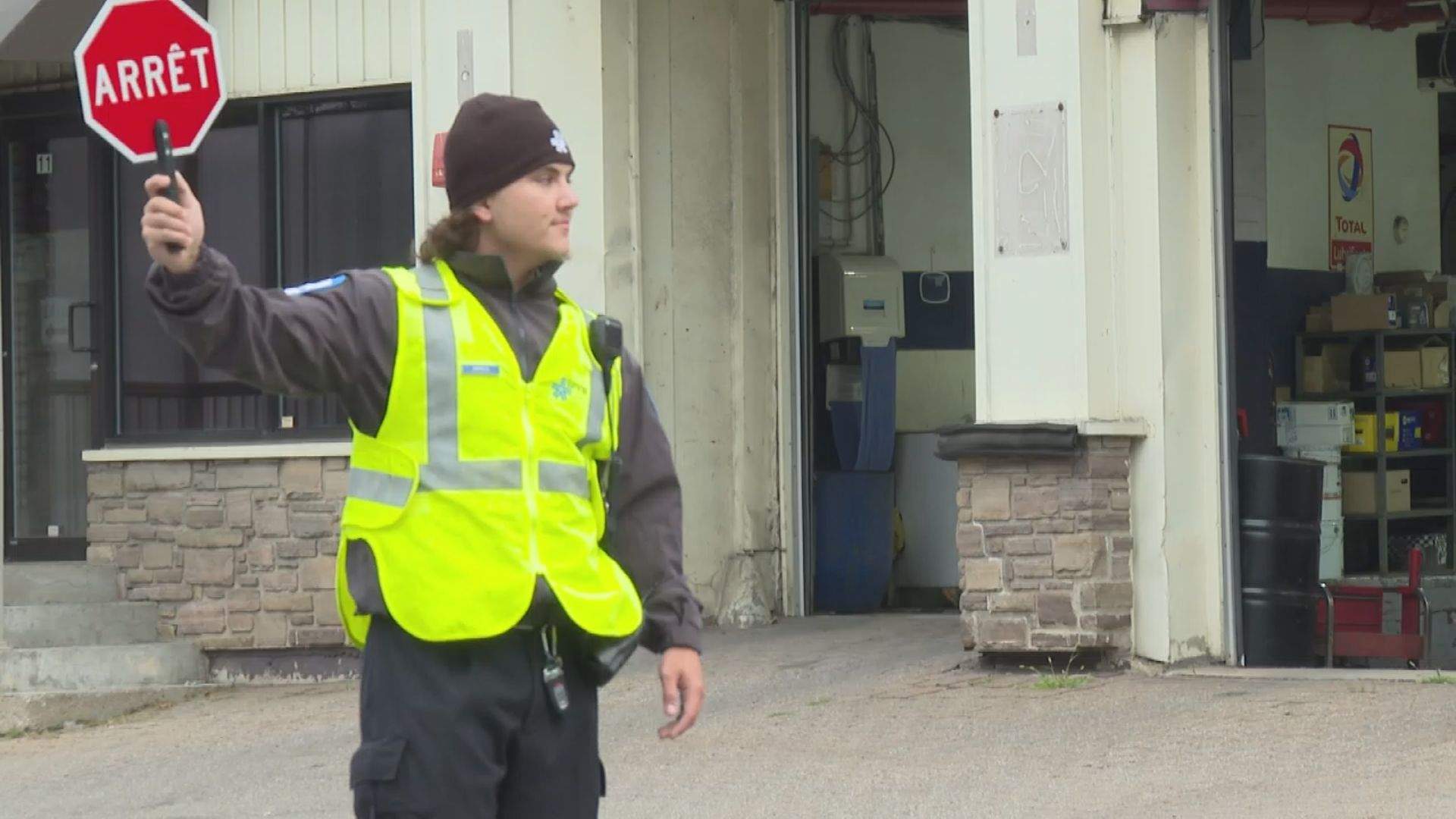
Urban infrastructure interventions frequently falter when municipalities treat physical design changes and active supervision as interchangeable tools rather than complementary layers of a safety system. The temporary reinstatement of a police crossing guard at the intersection of Westminster Avenue and Ainslie Road in Montreal West, adjacent to Royal West Academy, highlights a recurring systemic failure. Three student pedestrian strikes over a two-year period at a single junction indicate that minor operational patches cannot substitute for comprehensive structural redesign. When municipal capital works schedules collide with administrative friction, the resulting safety vacuum exposes vulnerable users to high-consequence risks, forcing advocacy groups to repeatedly lobby for short-term mitigation.
The Mechanics of Structural Vulnerability
The intersection design prior to intervention incorporates several compounding risk factors that elevate the probability of pedestrian-vehicle conflicts. Westminster Avenue operates as a wide thoroughfare featuring four traffic lanes, creating an extended exposure window for crossing pedestrians. Wider road cross-sections directly correlate with higher vehicle speeds because driver perception of hazard diminishes on roads with expansive lateral clearances.
Proximity to the Montreal West level train crossing introduces a secondary variable: periodic traffic surges and queue compression. When railway activations halt traffic, subsequent release phases trigger aggressive driving behavior as motorists attempt to compensate for lost time. This localized congestion combines with heavy morning and afternoon rush-hour flows, producing high-stress environments where driver attention is divided between railway signals, complex turning movements, and pedestrian traffic.
The absence of protected phases for left-hand turns across four lanes of opposing traffic generates persistent conflict points. Motorists turning from Westminster Avenue onto intersecting routes must judge gaps in multiple streams of oncoming traffic while simultaneously scanning for pedestrians stepping off the curb. When infrastructure design forces road users to manage excessive cognitive load, error rates inevitably increase.
The Policy Gap in Secondary Education Infrastructure
Municipal and provincial deployment criteria for active traffic supervision traditionally favor elementary school zones, creating an institutional blind spot for secondary institutions like Royal West Academy. This administrative categorization relies on a flawed heuristic: that adolescent pedestrians possess the equivalent risk-assessment capabilities and spatial awareness of adults.
Traffic safety data invalidates this assumption. High school students navigate urban corridors during peak commuter hours, often carrying heavy equipment, operating within peer groups that reduce situational awareness, and facing complex multi-modal transit transfers. Restricting crossing guard allocations based solely on school grade levels ignores the empirical reality of traffic volume and road geometry.
When parents initiated safety campaigns following the initial collisions, the municipal response relied on a provisional fix. The Montreal Police Service (SPVM) assigned a crossing guard through the spring term, conditioned on the explicit expectation that the Town of Montreal West would execute capital works during the summer months to permanently alter the intersection's geometry.
Capital Project Delays and the Cost of Slippage
The foundational premise of the spring crossing guard assignment was temporal bridging: the human safety intervention would manage risk until engineering controls could be installed. The planned engineering intervention—reducing the roadway from four lanes to two and eliminating left-turn lanes—serves as a permanent traffic-calming measure designed to physically constrain vehicle speed and shorten pedestrian crossing distances.
External shocks, including labor disruptions among rail signal workers, delayed the execution of these municipal upgrades over the summer. Because the capital project slipped past its scheduled timeline, the intersection entered the new academic year stripped of its engineering modifications and bereft of its temporary crossing guard. This sequence demonstrates a failure in risk management continuity. Municipalities frequently treat capital projects and operational safety measures as independent budget lines rather than interdependent safety buffers. When construction timelines slip, contingency protocols must automatically extend operational mitigations to prevent unprotected exposure windows.
Evaluating the Transition Risk Phase
The Town of Montreal West has scheduled the intersection reconfiguration to begin in late September and conclude by October. Mayor Jonathan Cha has stated that the resulting physical changes will create necessary calming effects and expanded space for pedestrian transit. However, community stakeholders correctly identify an intermediate hazard phase that occurs immediately following infrastructure alteration.
Altering a four-lane corridor to two lanes introduces driver friction and behavioral adaptation loops. Commuters accustomed to high-capacity throughput frequently exhibit increased frustration and erratic driving patterns during the initial weeks following lane reductions, occasionally seeking alternative bypasses or executing high-risk maneuvers to circumvent congestion.
Relying entirely on physical construction to solve behavioral safety deficits ignores the transition window. Physical changes alter the environment, but user habits take time to recalibrate. Removing active supervision simultaneously with the introduction of altered traffic patterns creates a high-vulnerability window precisely when predictability is lowest.
Strategic Deployment of Hybrid Safety Frameworks
To permanently eliminate high-incidence conflict at complex urban intersections near educational facilities, municipal authorities must abandon binary choices between engineering and enforcement. Safety optimization requires a tiered, multi-variable framework:
- Geometry-First Traffic Constriction: Permanent lane reductions, bulb-outs, and shortened crosswalk spans physically enforce speed limits without relying on driver compliance.
- Dynamic Operational Phasing: Human supervision, whether via police cadets or municipal guards, must be mandated for any intersection experiencing a threshold volume of pedestrian-vehicle conflicts, decoupled from arbitrary school-level classifications.
- Contingency-Linked Interventions: Operational safety assets like crossing guards must operate under contractual triggers tied to capital project completion milestones rather than arbitrary academic calendar boundaries.
The reinstatement of the crossing guard for the initial weeks of the autumn term is an operational necessity, but treating it as a final victory misdiagnoses the structural deficit. True systemic resolution requires the municipality to execute the planned roadway narrowing while maintaining active supervision through the entire behavioral adaptation phase, followed by an empirical audit of pedestrian safety metrics before any permanent reduction of human assets is authorized.