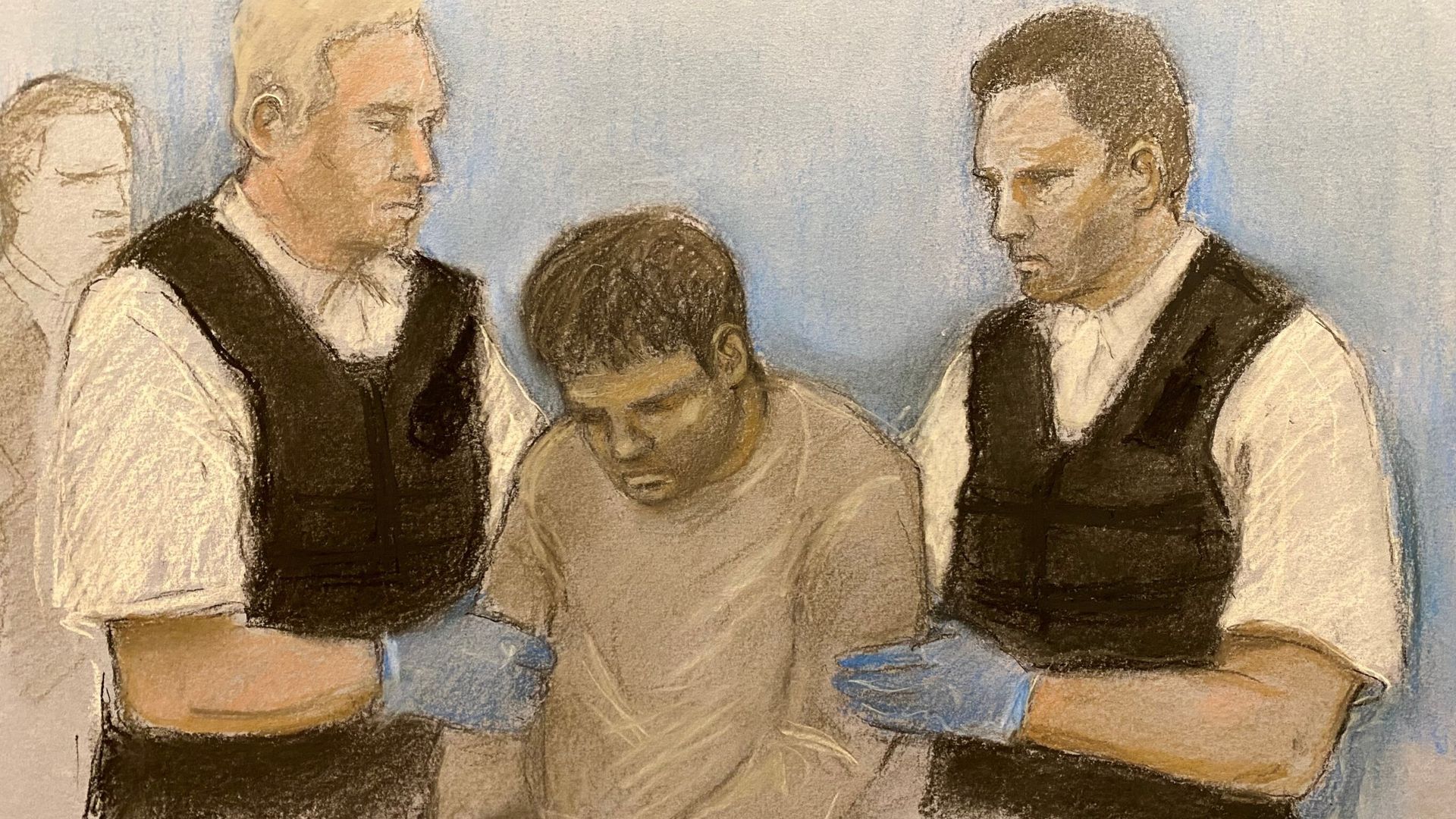
The heavy wooden doors of Courtroom Three do not swing; they click. It is a precise, mechanical sound that signals either the beginning of certainty or the prolongation of agony. For days, twelve ordinary citizens sat in a windowless room, breathing in stale air and sipping lukewarm water from paper cups, tasked with an impossible burden. They were asked to look into the soul of a young man—an Afghan refugee who had fled one war only to find himself at the center of another violent storm—and decide exactly what drove his hand during a flashpoint of terrible violence.
They couldn't do it.
When the foreperson stood up, the air in the room thinned. The words came out not with a bang, but with a tired sigh. No verdict. The judge thanked them, discharged them, and just like that, the machinery of state justice ground to a sudden, shuddering halt.
A hung jury is often reported as a technicality, a line item in a legal ledger. But inside the room, it feels like a tear in the fabric of reality. On one side of the ledger sits a defendant, a man whose life story spans continents, trauma, and deep displacement. On the other sits a victim, or the memory of one, demanding an accounting. In the middle lies a profound, empty silence. The law demands a binary answer—guilty or not guilty—but human tragedy rarely fits into such neat boxes.
The Silence Inside the Deliberation Room
To understand how twelve people arrive at an unbreakable deadlock, you have to look past the sterile language of the indictment. The charge was attempted murder. It was the second such charge this specific defendant faced, a detail that added layers of complication to an already fraught trial.
Imagine sitting in that room. Let us assume a hypothetical juror, someone we will call Sarah, a schoolteacher who took three weeks off work to serve her civic duty. Sarah entered the courthouse believing the truth is a solid thing, like a brick or a piece of oak. You look at the evidence, you weigh the testimonies, and you find the truth.
But inside the deliberation room, the brick turns to sand.
The prosecution presented its case with clinical precision. There were timelines, medical reports, and police testimonies. They painted a picture of intent, of a deliberate choice to cross a line from survival to aggression. They argued that the defendant, despite his status as a vulnerable refugee fleeing a collapsed homeland, was responsible for a calculated act of violence.
Then came the defense, peeling back the layers of a life defined by displacement. They spoke of a mind warped by the echoes of explosions in Kabul, of a young man navigating a cold, unfamiliar society with the hyper-vigilance of someone who has spent years expecting death around every corner. They asked a fundamental question: Was this the action of a cold-blooded assailant, or the frantic, terrified lashing out of a deeply traumatized human being?
For hours, the jurors debated. The argument shifted from the legal definitions of intent to the messy realities of human psychology. Some jurors saw a clear-cut case of societal betrayal—a man given sanctuary who brought violence to his host country. Others saw a tragedy of compounding failures, an individual broken long before he ever reached these shores.
The clock ticked. The room grew warm. Arguments turned into pleas, and pleas turned into stubborn, dug-in silence. When the final vote was taken, the division was unyielding. They were stuck.
The Limbo of the Accused and the Accuser
When a jury fails to reach a verdict, the immediate result is a strange, suspended animation. The trial is over, but the case is not. The legal system calls it a mistrial, but for the human beings involved, it feels more like a purgatory.
Consider what happens next to a defendant in this position. The handcuffs go back on. The guard guides him down the concrete stairs back to the holding cells. He does not go home, nor does he begin serving a definitive sentence. He returns to a cell to wait for the prosecution to decide whether to mount the enormous expense of a retrial. His life remains on pause, a terrifying question mark hanging over his head.
For the community and the victims, the frustration is equally acute. Justice delayed is not just a cliché; it is a physical weight. The individuals affected by the violence must steel themselves once again. They must prepare to recount their worst moments on a witness stand, to be cross-examined, to have their credibility picked apart by defense attorneys all over again.
This is the hidden cost of our legal system's insistence on unanimity or near-unanimity. We design the system this way to protect the innocent, operating under the ancient principle that it is better for ninety-nine guilty people to go free than for one innocent person to suffer. But when the system produces a blank space instead of an answer, everyone suffers a little bit.
The Friction of Two Colliding Worlds
At the heart of this specific trial is a cultural and psychological friction that our institutions are ill-equipped to handle. The court operates on logic, precedent, and objective standards of behavior. It asks: What would a reasonable person do in this situation?
But what happens when the person in question has never known a reasonable world?
The journey of an Afghan refugee is rarely a straight line from danger to safety. It is a chaotic scramble through border crossings, detention centers, and bureaucratic labyrinths. By the time many arrive, their internal compasses are shattered. The fight-or-flight response is not a temporary state of mind; it is a permanent neurological setting.
This does not excuse violence. A society cannot function if it allows trauma to become a blank check for harm. The victims of crimes have a right to safety and restitution, regardless of who their attacker is or what that attacker has suffered in the past. This is the intractable knot that the jury was forced to try and untie. They were being asked to balance the scales of justice when both sides of the scale were loaded with immense, heavy pain.
One juror might look at the evidence and see a pattern of behavior that poses an ongoing threat to the public. Another might look at the exact same evidence and see a cry for help from a mind fractured by war. Both perspectives are rooted in a desire to do the right thing, yet they lead to completely opposite conclusions.
The Broken Machinery of Certainty
We look to courtrooms to provide us with endings. We want the gavel to fall so we can turn the page, confident that the bad guy has been punished or the innocent man has been vindicated. We want clarity.
A hung jury denies us that luxury. It forces us to confront the uncomfortable truth that sometimes, twelve honest people looking at the exact same set of facts cannot agree on what the truth is. It reminds us that our laws are human constructs applied to messy, unpredictable human lives.
The prosecutors will now retreat to their offices to look at budgets, witness availability, and the likelihood of a different outcome next time. The defense attorneys will visit their client in a secure facility, trying to explain through an interpreter why he is still behind bars despite not being convicted.
The courtroom is empty now. The papers have been cleared from the desks, and the public gallery is dark. But the question that divided those twelve citizens remains completely unanswered, hanging in the air like dust motes in the afternoon light. No one won. No one lost. Everyone simply walked away a little more tired, a little more cynical, and entirely unresolved.