Seventy-five years ago, the concept of a computer was completely alien to the average person. If people knew anything at all, they thought of monstrous, military-funded calculation machines meant for dropping bombs or designing atomic weaponry. That changed when a single commercial machine stepped out of the research lab and entered the public consciousness.
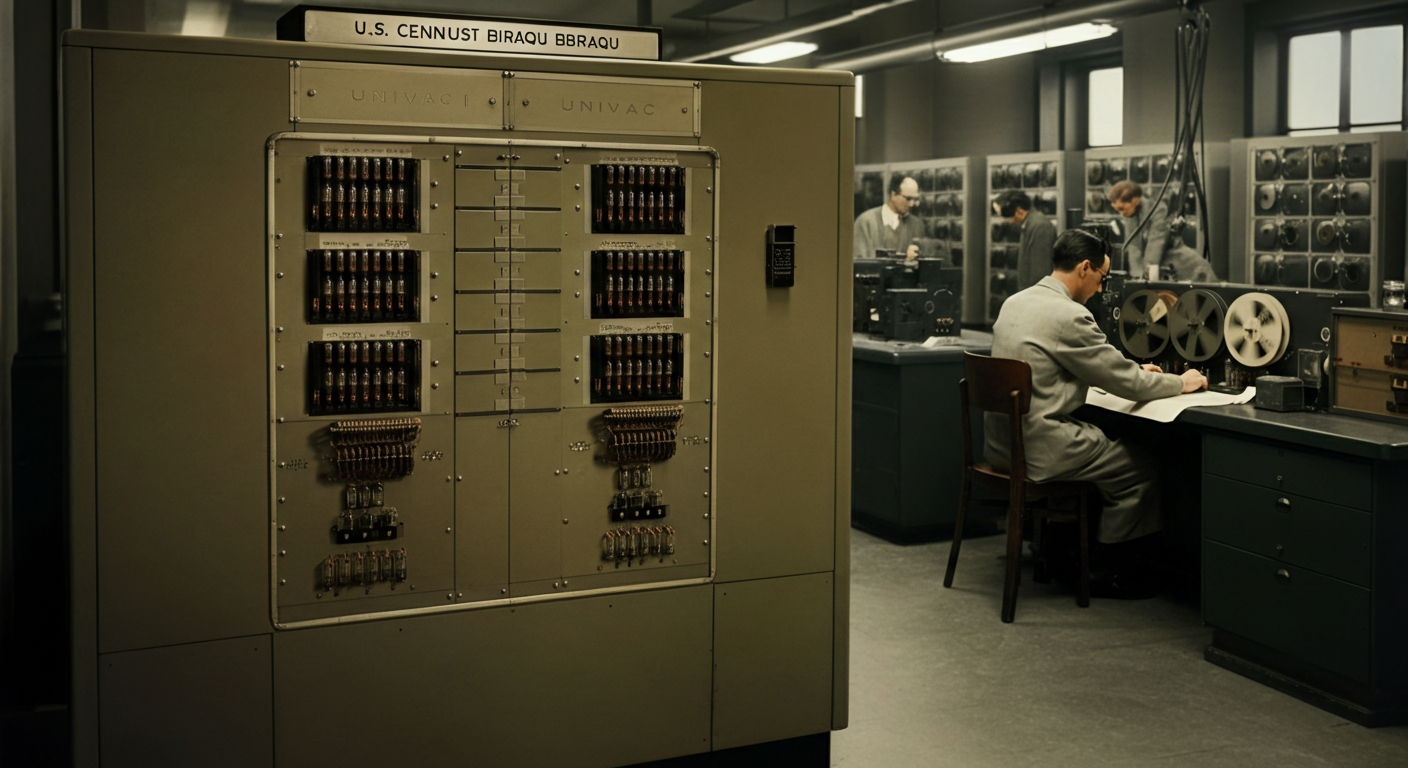
The machine was the UNIVAC I. Short for Universal Automatic Computer, it was officially dedicated at the U.S. Census Bureau on June 14, 1951. Built by engineering legends J. Presper Eckert and John Mauchly—the team behind the wartime ENIAC—this machine was different. It wasn't just a military tool. It was the first American computer built explicitly for business and administration.
Understanding this machine isn't just a dry history lesson. The architectural gambles made by its creators established the blueprint for corporate data processing. Look around your office today. The way we store data, process payroll, and trust corporate analytics traces directly back to this room-sized array of vacuum tubes and liquid mercury.
The Founders Who Risked It All
Most people think early computing history is a story of smooth academic progression. It wasn't. The creation of the UNIVAC I was born out of a bitter corporate divorce and massive financial risk.
After completing the ENIAC at the University of Pennsylvania, Eckert and Mauchly clashed with the university over patent rights. The school insisted that any technology invented on its campus belonged to the institution. The duo refused to sign away their intellectual property. They walked out.
They started the world's first commercial computer firm, the Electronic Control Company, which later became the Eckert-Mauchly Computer Corporation (EMCC). It was a terrifying gamble. Experts at the time openly scoffed at the venture, predicting that the entire United States would only ever need about six computers. Finding investors was nearly impossible. Eckert’s father had to chip in $25,000 of his own money just to keep the lights on.
The U.S. Census Bureau stepped in as their first major buyer. The Bureau was desperate. They had been using punch-card tabulators based on Herman Hollerith's 1890 designs, but the sheer volume of data from the upcoming 1950 census was threatening to break the system. They signed a contract for $350,270.
Building the machine nearly bankrupted the inventors. The project ran massively over budget and behind schedule. Facing financial ruin, Eckert and Mauchly sold their company to typewriter giant Remington Rand in 1950. The engineering team stayed intact, and on March 31, 1951, the Census Bureau officially accepted delivery of the first unit.
Inside the Room Sized Iron Monster
The UNIVAC I was not a sleek piece of consumer electronics. It was a physical monolith, occupying a footprint of 25 feet by 50 feet. It weighed more than 16,000 pounds and swallowed electricity like a small factory, relying on 5,600 vacuum tubes, 18,000 crystal diodes, and 300 relays to function.
The tech specs sound laughably primitive today, but they were revolutionary for 1951:
- Bit Rate: 2.25 MHz
- Processing Power: Roughly 1,905 operations per second
- Memory Capacity: 1,000 words (equivalent to 12,000 characters)
What made the machine a masterpiece wasn't raw processing speed. It was how it handled data. Before this, computers were strictly number-crunchers. They processed complex scientific equations for ballistics or physics. The UNIVAC I changed that by processing numbers and alphabetic characters equally well.
Eckert and Mauchly realized that corporate data processing required moving massive amounts of text and simple numbers quickly, rather than computing complex calculus slowly. To do this, they abandoned traditional punch cards for the primary storage medium. Instead, they invented the UNISERVO magnetic tape drive.
These heavy metal tapes could read and write data at 12,800 characters per second. That was roughly ten times faster than contemporary punch-card systems. Because the input and output operations were buffered, the tape drives could feed data into the computer while the central processor was working on something else. This separation of input, output, and calculation is arguably the team's greatest contribution to modern system architecture.
The main memory system was equally wild. It used acoustic mercury delay lines. Long steel tanks filled with liquid mercury circulated data in the form of sound waves. Pulses traveled through the liquid, were picked up by a receiver, amplified, and sent back to the beginning of the tank. It was bizarre, temperature-sensitive, and delicate, but it worked.
The Night a Computer Stole the Election
While the Census Bureau used its unit quietly, the general public still had no idea what a computer actually did. That changed on the night of November 4, 1952.
To boost sales, Remington Rand partnered with CBS to use UNIVAC I Serial 5 to predict the outcome of the presidential election between General Dwight D. Eisenhower and Illinois Governor Adlai Stevenson. Traditional opinion polls, including the final Gallup poll, predicted a tight race favoring Stevenson.
Computer pioneer Grace Hopper and a team of programmers spent weeks feeding historical election data into the machine. On election night, statistician Max Woodbury sat at the computer's terminal in Philadelphia, feeding in early voting returns. The computer was connected via teletype to the CBS studios in New York, where Walter Cronkite and Charles Collingwood stood by.
At 9:00 PM, with just 7% of the votes counted, the machine issued its first prediction. It calculated that Eisenhower had a 100-to-1 chance of winning. It predicted he would sweep the Electoral College with 438 votes to Stevenson's 93.
UNIVAC ELECTION PREDICTION (9:00 PM, NOV 4, 1952)
------------------------------------------------
EISENHOWER ELECTORAL VOTES: 438
STEVENSON ELECTORAL VOTES:  93
ODDS FOR EISENHOWER WIN:    100 to 1
The CBS news executives panicked. The prediction flew in the face of every human expert. Convinced the machine was malfunctioning or broken, Siegfried Mickelson, the boss of CBS News, refused to let Cronkite read the results. The crew even staged some theatrics on air, claiming the machine was simply unresponsive, and instead reported a safe, human-made prediction of 8-to-7 odds for an Eisenhower victory.
Behind the scenes, they forced Woodbury to alter the algorithm to tone down the landslide. Woodbury complied, but accidentally missed entering a zero in the modified data, causing the machine to spit out a closer race.
As the night wore on, the actual votes flooded in. It became clear that Eisenhower wasn't just winning; he was destroying Stevenson. When the final tallies were settled, Eisenhower won 442 electoral votes to Stevenson's 89. The computer's initial 9:00 PM prediction had been less than 1% off the popular vote and within four votes of the exact Electoral College total.
At the end of the broadcast, a humbled Charles Collingwood had to go on air and confess the cover-up to millions of viewers. He admitted that the machine had been right all along, and the humans simply lacked the courage to believe it.
The public was utterly mesmerized. Almost overnight, "UNIVAC" became a generic trademark. People used it as a catch-all word for any computer, much like we use "Google" as a verb today. It sparked intense conversations about "giant brains" and whether machines could think.
How the Pioneer Lost Its Lead
You'd think a PR victory that massive would guarantee total market dominance. It didn't. Remington Rand eventually lost the computer wars to a rival that everyone in 1951 completely overlooked: IBM.
The UNIVAC I was a technical triumph but a commercial bottleneck. Because it used magnetic tape, it clashed with the existing business infrastructure of the early 1950s. Almost every major corporation already ran on millions of IBM-manufactured punch cards. Buying a UNIVAC meant manually converting mountains of physical cards into magnetic tape. Many businesses blinked at the switching costs.
IBM capitalised on this hesitation. They entered the market with machines that natively supported punch cards, making the transition seamless for existing corporate clients.
Worse, corporate mismanagement hobbled the UNIVAC team. After Remington Rand merged with the Sperry Corporation in 1955 to form Sperry Rand, executive infighting and a failure to properly fund research and development caused key engineers to jump ship. In 1957, a core group of employees walked out to form the Control Data Corporation. IBM surged ahead, leaving the original pioneers in the dust. Only 46 units of the original UNIVAC I were ever built.
Why This 75 Year Old Legacy Matters Right Now
We often treat old technology as ancient history, but the core design choices of the UNIVAC I still dictate how we operate today.
It proved that computing wasn't just for military ballistics or academic physics. It shifted the focus of technology toward data management, corporate logistics, and predictive analytics. When you look at modern predictive AI models handling financial forecasting or market trends, you're looking at the direct descendants of the algorithm Max Woodbury ran on election night in 1952.
If you want to understand how tech infrastructure evolves, stop looking exclusively at current trends. Spend an hour reading through the early corporate histories of companies like Sperry Rand and early IBM. Look at how switching costs and infrastructure lock-in killed the most advanced machine of its day. You'll quickly see the exact same patterns playing out in today's cloud computing and enterprise software markets.