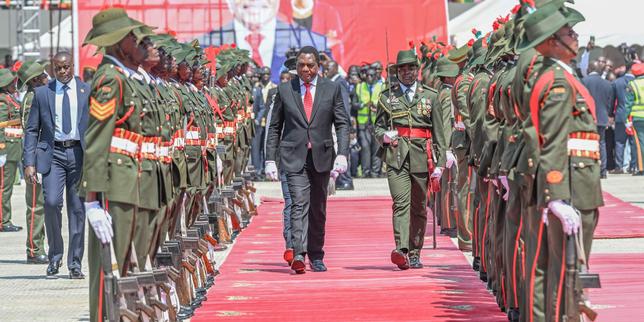
The standard human rights playbook runs on autopilot. A United Nations official swoops into an African capital, issues a solemn warning about the criminalization of political dissidence, demands an immediate halt to state overreach, and boards a flight back to Geneva before the dust settles. When Gina Romero, the UN special rapporteur on the rights to freedom of peaceful assembly and of association, targeted Zambia recently, the commentary machine spun up instantly. The lazy consensus followed its usual script: authoritarian creeping, shrinking civic space, and the eternal cry for institutional purity.
Everybody is looking at the symptom while ignoring the structural plumbing underneath. For a deeper dive into similar topics, we recommend: this related article.
I have watched international observers hand-wring over political friction in emerging democracies for over a decade. They treat state crackdowns as purely malicious aberrations driven by mustache-twirling dictators who woke up one morning and decided to hate democracy. That framework is not just naive; it is dangerously unhelpful. When a government reaches for the penal code to neutralize political rivals, it is rarely operating in a vacuum of pure tyranny. It is usually reacting to a systemic failure of state capacity, institutional legitimacy, and the weaponization of informal patronage networks disguised as grassroots activism.
Let us look past the press releases and interrogate what is actually happening on the ground. For broader details on the matter, extensive reporting can be read at The Washington Post.
The Myth Of The Pure Dissident
The primary flaw in the standard human rights narrative is the assumption that anyone labeled a political dissident by a regime is automatically a pro-democracy saint fighting for the public good.
Reality is messier. In many developing jurisdictions, particularly across Southern Africa, political opposition is not a refined ideological contest between competing visions of economic policy. It is often a high-stakes corporate scramble for access to state rents. When the ruling party locks down the public square, it is frequently responding to movements that are financed by external extraction interests or domestic oligarchs looking to swap out the management team at the treasury without changing the underlying extraction machinery.
When Ms. Romero calls for an end to the criminalization of dissent, she is speaking the universal language of international law. But international law assumes a functioning, neutral arbiter—an independent judiciary, a professionalized police force, and a separation of powers that exists on paper and in practice. Drop that assumption into a state struggling with fiscal deficits, fragmented ethnic coalitions, and weak institutional tissue, and the law ceases to be a shield. It becomes a blunt instrument for whoever holds the keys to the treasury.
Telling a weak state to stop prosecuting political actors without first fixing the economic incentives that make political capture the only viable wealth-creation strategy is like telling a leaky submarine to stop worrying about the water pressure.
Why Zambia Is The Wrong Battleground For Simple Narratives
Zambia makes a fascinating case study precisely because it refuses to fit the neat boxes that international NGOs like to draw. When the country transitioned power peacefully in 2021, global commentators declared a triumphant return to democratic norms. Investors cheered. The international community breathed a collective sigh of relief and checked the "Africa Democracy" box for another cycle.
That optimism ignored the brutal economic constraints facing any administration in Lusaka. A nation choked by external debt burdens, volatile copper prices, and immediate IMF structural adjustment demands does not have the luxury of soft, Scandinavian-style political tolerance. When every policy decision threatens to spark urban riots over the price of fuel or mealie meal, the margin for political opposition messaging shrinks to zero.
Governments under severe macroeconomic stress become hyper-paranoid. They see foreign interference, subversion, and existential threats behind every labor strike and student protest because, frankly, those protests are often weaponized by political elites who lost the last election and want back on the payroll.
To frame this purely as a crackdown on peaceful assembly is to miss the operational reality of governance under duress. The law is invoked not because leaders hate freedom of speech, but because they are terrified of losing control of a fragile state apparatus that is holding together by macroeconomic spit and a prayer.
+-----------------------------------+-----------------------------------+
| The International NGO View        | The Structural Reality            |
+-----------------------------------+-----------------------------------+
| Dissent is suppressed out of pure | Crackdowns are driven by acute    |
| authoritarian malice.             | state fragility and fiscal panic. |
+-----------------------------------+-----------------------------------+
| Laws are neutral tools abused by  | Legal frameworks are weak, making |
| bad actors.                       | law a weapon for survival.        |
+-----------------------------------+-----------------------------------+
| The solution is moral pressure    | The solution is economic stability|
| and rhetorical compliance.        | and institutional hardening.      |
+-----------------------------------+-----------------------------------+
The Dangerous Fallacy Of Legalistic Solutions
Ask any legal scholar what the antidote to state repression is, and they will recite a predictable catechism: constitutional protections, judicial independence, and international conventions.
This is comforting nonsense. Pieces of paper do not stop secret police when the elite pact collapses.
Imagine a scenario where a regime completely opens the floodgates to unrestricted political organizing, foreign-funded advocacy networks, and unvetted populist mobilization in an environment where 60 percent of the youth population is unemployed and radicalized by economic despair. Within six months, the state dissolves into ethnic factionalism or corporate capture. The illusion of order is shattered, and the resulting vacuum invites something far worse than the imperfect stability of a cautious executive branch.
Rights do not exist in a vacuum. They are downstream of state capacity and economic security. When a country lacks the tax base to pay its civil service reliably, or the institutional depth to process grievances through administrative channels, every political disagreement becomes an existential war for survival. In that environment, demanding that leaders respect the niceties of peaceful assembly without addressing the underlying poverty and structural weakness is worse than useless. It is an invitation to instability.
Real Reform Requires Uncomfortable Trade-Offs
If we want to stop the cycle of repression and hollow international hand-wringing, we have to abandon the comforting fiction that virtue signaling from Geneva changes local power dynamics.
True reform starts with ruthlessly cutting off the illicit financial flows that fund political agitation in the global south. As long as external actors can bankroll proxy political movements to secure mining concessions or policy favors, governments will use national security laws to crush them. You cannot separate the repression of political dissidence from the geopolitics of resource extraction.
Furthermore, domestic opposition movements need to professionalize. They have to move past grievance-peddling and ethnic mobilization toward substantive, technocratic governance proposals that can survive contact with an empty treasury. When opposition groups act like shadow mafias waiting for their turn at the trough, they forfeit the moral high ground that international rapporteurs try so desperately to assign to them.
The human rights establishment wants simple heroes and clear villains. They want a world where a well-crafted UN resolution rights every wrong and restores harmony to the civic space.
That world does not exist. Zambia does not need another scolding from a special rapporteur with a clipboard. It needs fiscal breathing room, institutional plumbing that works, and an honest reckoning with the fact that freedom of expression without economic sovereignty is just an invitation to chaos.
Stop treating symptoms. Fix the plumbing.