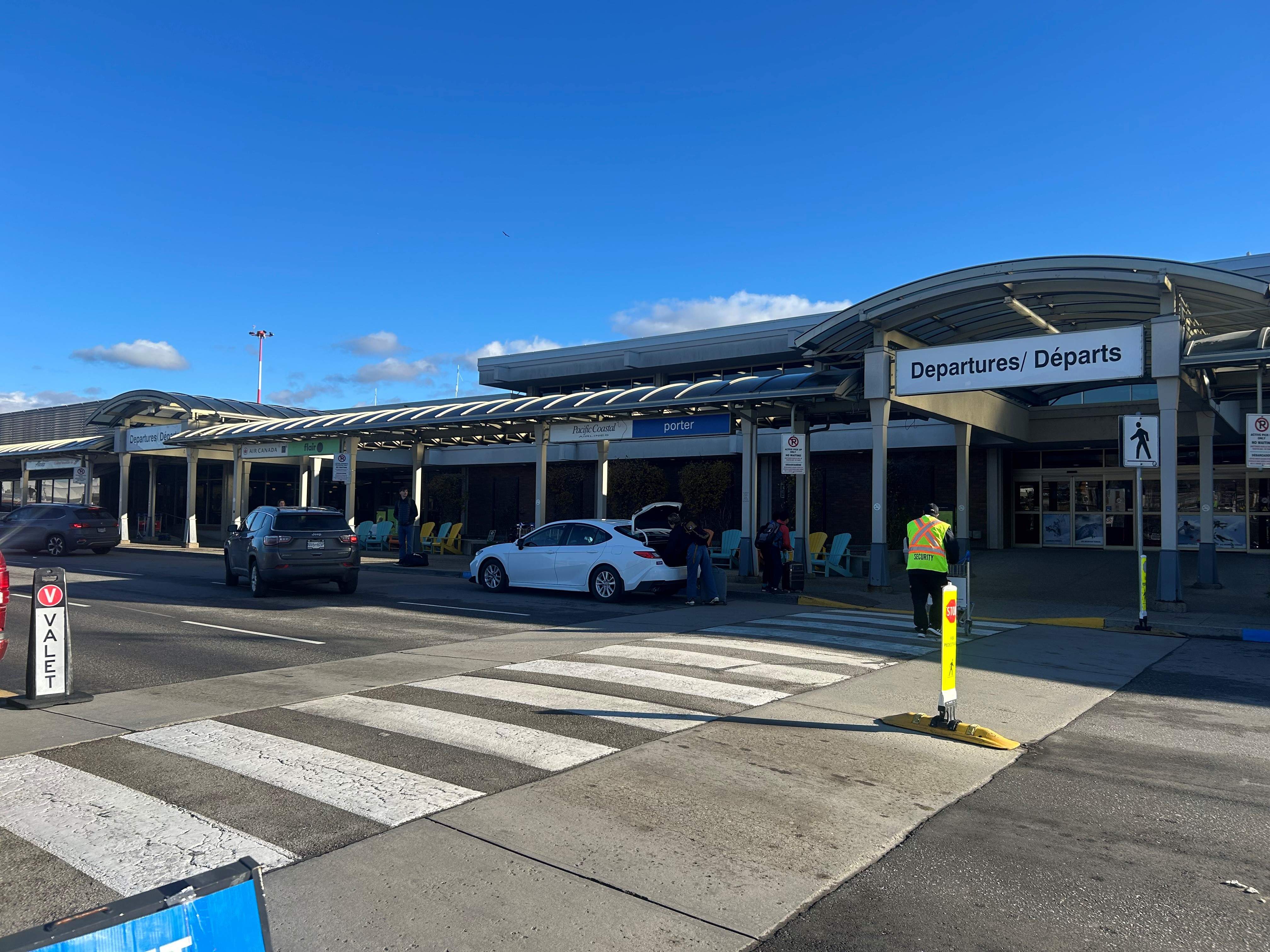
Airline ticket pricing at regional hubs operates on a fixed-cost recovery model where infrastructure capital expenditures are passed directly to departing passengers via non-negotiable statutory surcharges. When Kelowna International Airport (YLW) adjusts its fee structure upward, the price hike is neither an arbitrary tax nor an airline margin expansion; it is the direct mechanical consequence of municipal airport authority financing, debt-service coverage ratios, and the high fixed-cost operating reality of Canadian aviation infrastructure.
To understand why departing from the Okanagan Valley becomes measurably more expensive, one must separate base airfare from the multi-layered stack of mandatory pass-through fees. While the carrier sets the base fare dynamically based on load factors, competitive capacity, and yield management algorithms, the terminal infrastructure charges remain static per enplaned passenger.
The Anatomy of a Regional Airfare
A commercial airline ticket issued for departure from Kelowna consists of two distinct financial mechanisms: carrier-controlled revenue and third-party statutory collections. Airlines act merely as collection agents for the latter, remitting the funds directly to airport authorities, federal security agencies, and navigation providers.
The total passenger outlay $P$ is defined by the following cost function:
$$P = B(1 + \tau) + F_{AIF} + F_{ATSC} + F_{NAV} + \tau(F_{AIF} + F_{ATSC} + F_{NAV})$$
Where:
- $B$ represents the dynamic base fare controlled by the airline's revenue management system.
- $F_{AIF}$ denotes the Airport Improvement Fee levied directly by the Kelowna International Airport authority.
- $F_{ATSC}$ represents the Air Travellers Security Charge remitted to the federal government to fund the Canadian Air Transport Security Authority (CATSA).
- $F_{NAV}$ reflects the Nav Canada air navigation surcharge applied by the carrier to recover air traffic control costs.
- $\tau$ represents the applicable federal and provincial sales tax rate (Goods and Services Tax in British Columbia), which compounds on top of both the base fare and the infrastructure fees.
The Airport Improvement Fee Mechanism
The primary variable driving localized cost increases at Kelowna is the Airport Improvement Fee (AIF). Unlike major international gateways in the United States, which rely heavily on federal Airport Improvement Program grants and tax-exempt municipal bonds backed by broader tax bases, Canadian regional airports operate under a user-pay model established by the National Airports Policy.
Municipalities like the City of Kelowna own the airport assets and operate them on a self-sustaining financial basis. Capital projects—such as terminal expansion, apron strengthening, baggage handling automation, and runway resurfacing—cannot be funded through municipal property taxes. Instead, the airport authority must issue debt or draw down capital reserves, servicing those obligations exclusively through aeronautical fees (landing and terminal fees charged to airlines) and non-aeronautical revenue (parking, retail concessions, car rentals), with the AIF serving as the primary dedicated capital recovery tool.
When YLW initiates a major terminal expansion phase to alleviate peak-hour congestion at security checkpoints and departure lounges, the debt-service obligations hit the balance sheet immediately, long before the concrete cures or additional gate capacity generates new passenger volume. Raising the AIF is the standard financial lever pulled to maintain the airport’s debt-service coverage ratio within covenants required by institutional lenders.
Asymmetric Price Elasticity and Ticket Distortion
A flat-dollar fee increase does not affect all ticket classes equally. Because the AIF is a fixed unit cost per departing passenger rather than an ad valorem (percentage-based) tax, it creates severe price distortion on short-haul routes.
Consider two passengers departing Kelowna:
- The Short-Haul Regional Commuter: Booking a basic economy seat from Kelowna (YLW) to Vancouver (YVR) or Calgary (YYC) on a regional turboprop. The carrier's base fare during a competitive seat sale might sit at $45.00 CAD.
- The Transcontinental Leisure Traveler: Booking a multi-leg itinerary from Kelowna to Toronto (YYZ) or an international connection via Seattle (SEA), carrying a base fare of $450.00 CAD.
An upward adjustment of $5.00 to $10.00 in the AIF represents a negligible 1% to 2% variance on the transcontinental ticket, falling well within the noise of daily dynamic pricing fluctuations. For the short-haul commuter, that identical flat fee represents an 11% to 22% spike in the pre-tax price of the ticket.
In microeconomic terms, short-haul regional routes exhibit high price elasticity of demand because viable modal substitutes exist. When the total out-of-pocket cost of a 55-minute flight to Vancouver crosses a psychological threshold, price-sensitive travelers substitute air travel with a four-hour drive along Highway 97C and Highway 1. The airport authority captures higher revenue per remaining passenger, while the airline absorbs the demand destruction through reduced load factors on regional feeders.
The Structural Vulnerability of Non-Hub Airports
The financial mechanics governing Kelowna International Airport differ sharply from those of primary Tier-1 hubs like Vancouver or Toronto Pearson. Understanding this structural divergence explains why regional fee hikes occur in lumpy, step-change increments rather than smooth annual adjustments.
- Lack of Connecting Passenger Volume: Tier-1 hubs generate massive AIF and concession revenues from connecting passengers who transit the terminal without originating in the local market. Kelowna functions primarily as an Origin and Destination (O&D) airport. Nearly every dollar of AIF revenue must be extracted directly from the local Okanagan population and inbound tourists.
- Lower Non-Aeronautical Revenue Per Enplanement: Major international hubs subsidize aeronautical infrastructure through high-margin luxury retail, duty-free concessions, and multi-tiered structured parking. Regional airports have shorter passenger dwell times—travelers arrive 60 to 90 minutes before departure rather than three hours prior—limiting retail spend per passenger.
- Narrower Carrier Base: When a single carrier or duopoly dominates seat capacity at a regional airport, the airport authority faces significant counterparty risk. If an ultra-low-cost carrier (ULCC) withdraws capacity due to fleet reallocation or margin compression, the airport's passenger volume drops instantly, forcing the remaining passenger base to shoulder the fixed debt load of the terminal infrastructure.
The ULCC Friction Point
Ultra-low-cost carriers rely on stimulating latent demand through ultra-low base fares—often pricing seats below actual operating cost and recovering margin through ancillary fees (carry-on bags, seat selection, priority boarding). High fixed airport fees break the ULCC unit-economic model.
When a carrier advertises a $19 base fare out of Kelowna, mandatory taxes and airport fees frequently push the final checkout price above $85 or $95. This sticker shock suppresses conversion rates at the payment screen. In network planning departments, routes with high fixed-fee burdens are the first to lose frequency during shoulder seasons (October–November and April–May) when carriers redeploy aircraft to sun destinations or lower-cost jurisdictions.
Compounding Cost Pressures Across the Aviation Value Chain
The localized fee adjustment in Kelowna coincides with broader systemic cost inflation across the Canadian aviation sector, creating a compounding effect on final ticket prices.
- Aeronautical Landing and Terminal Fees: Separate from the AIF paid directly by the passenger, airlines pay landing fees based on maximum takeoff weight (MTOW) and terminal fees based on aircraft seat capacity. When airport operating expenses rise due to municipal utility rates, snow removal contracts, and security compliance mandates, these airline-facing charges increase. Carriers embed these costs directly into the base fare $B$.
- Nav Canada Rate Adjustments: Canada’s privatized air navigation service provider operates on a cost-recovery basis. Following traffic volume contractions and ongoing air traffic controller staffing investments, Nav Canada has implemented rate increases that airlines pass through as flat surcharges on every domestic and transborder segment.
- Security Screening Charges: Federally mandated adjustments to the Air Travellers Security Charge (ATSC) add another non-negotiable layer to the ticket stack, particularly impacting itineraries that involve domestic-to-international connections.
Limitations of Passenger Mitigation Strategies
Travelers attempting to bypass regional airport fee structures face strict operational constraints. Unlike in dense metropolitan regions—such as the Greater Toronto Area or the San Francisco Bay Area, where travelers can easily arbitrage fees between multiple competing airports within a 60-minute drive—the Okanagan Valley presents severe geographic isolation.
- Ground Transfer Arbitrage (Kamloops or Penticton): Driving to Penticton Regional Airport (YYF) or Kamloops Airport (YKA) rarely yields net savings. Both facilities maintain smaller route networks, lower flight frequencies, and their own respective AIF structures. Once fuel, vehicle depreciation ($0.50 to $0.70 per kilometer), and the opportunity cost of two to three hours of additional transit time are factored into the total trip cost, the arbitrage evaporates.
- Cross-Border Leakage (Spokane International Airport): Driving south across the US border to Spokane (GEG) remains a viable strategy for families traveling to US domestic destinations, where lower US Passenger Facility Charges (capped federally at $4.50 USD per segment) and lower aviation fuel taxes create substantial fare differentials. This tactic fails for domestic Canadian travel due to cabotage laws prohibiting foreign carriers from operating domestic Canadian routes, as well as the four-to-five-hour driving distance from Kelowna to Spokane.
- Loyalty Program Redemptions: Redeeming airline miles or credit card points does not shield the traveler from airport fee increases. Frequent flyer programs cover the dynamic base fare $B$, but mandatory third-party taxes, AIFs, and security charges must still be paid in cash at the time of booking. As airport fees rise, the cash co-pay on "free" reward flights increases dollar-for-dollar.
Tactical Execution for Frequent Flyers and Corporate Travel Managers
Because statutory airport fees cannot be negotiated away or bypassed through standard booking hacks, cost containment requires structural adjustments to how itineraries are constructed and timed.
1. Eliminate Multi-Segment Domestic Connections on Short Trips
Airport Improvement Fees in Canada are generally levied at the point of origin, meaning a passenger flying Kelowna–Vancouver–Victoria pays the YLW AIF, while connecting passengers transiting YVR within a strict window (typically four hours for domestic flights) are exempt from paying a second AIF at the connecting hub. However, if a traveler books separate tickets ("self-connecting") to save money on base fares, the system treats the second leg as a new origin, triggering a second full AIF and security charge. Always book multi-leg itineraries on a single Passenger Name Record (PNR) to preserve connecting-passenger fee exemptions.
2. Audit Round-Trip vs. Open-Jaw Itineraries
For corporate travelers visiting multiple cities in Western Canada (e.g., Kelowna to Calgary, then Edmonton, then home), booking a single multi-city open-jaw ticket minimizes the number of distinct origin points compared to booking sequential one-way segments.
3. Shift Regional Travel Thresholds
Corporate travel policies covering Okanagan-based staff should recalibrate their air-versus-ground decision matrices. For single-occupancy business travel between Kelowna and the Lower Mainland (Vancouver/Fraser Valley), the total door-to-door time—factoring in 90 minutes pre-departure at YLW, a 55-minute flight, deplaning, and ground transit from YVR to downtown—averages 4.5 hours. Driving the Coquihalla Highway takes approximately 4 hours door-to-door. With higher fixed airport fees inflating the floor price of short-haul tickets, mandating ground transport or rental vehicles for single-day regional trips under 400 kilometers yields immediate, measurable T&E (Travel and Expense) budget reductions without sacrificing productive working hours.