Commercial solar deployment faces a terminal bottleneck in land acquisition, local zoning friction, and ongoing maintenance expense. Traditional utility-scale photovoltaic installations treat the underlying real estate as a sterile footprint. Operators spray herbicides or run heavy mowing machinery to suppress vegetation, transforming vast acreages into dead capital that incurs recurring operational expenditure without yielding secondary output.
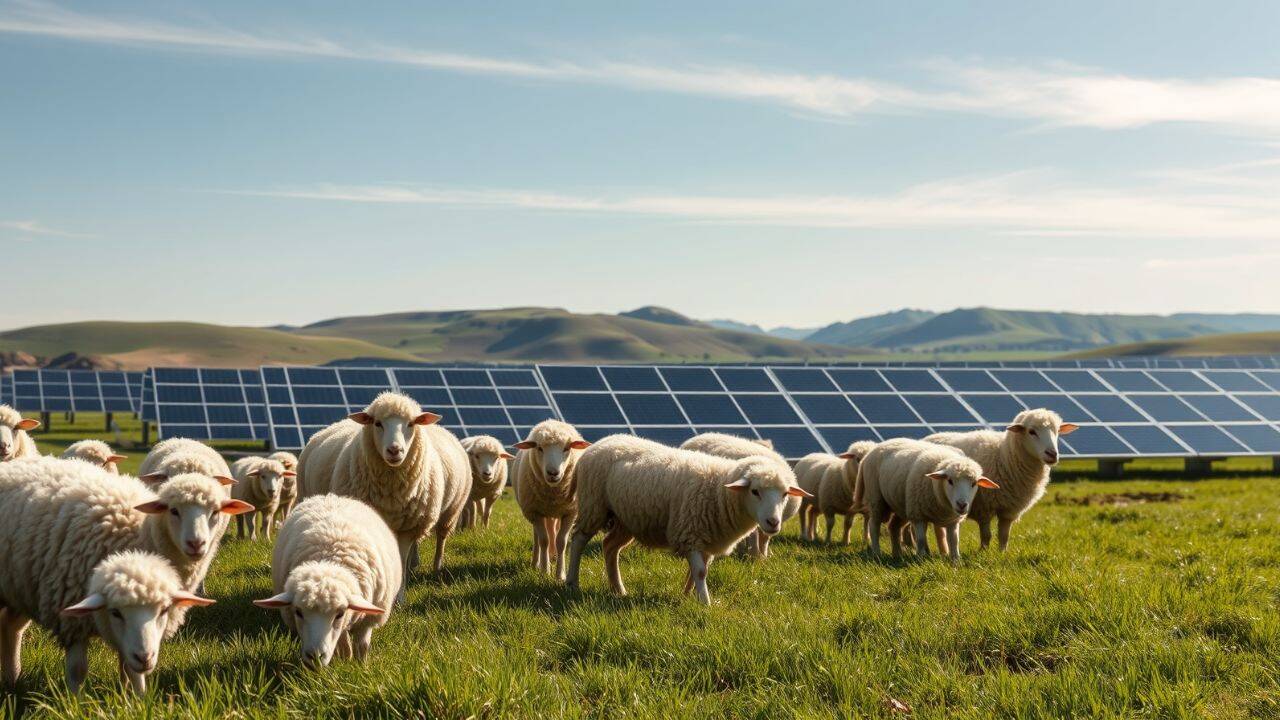
Integrating livestock production into photovoltaic arrays, specifically through commercial sheep grazing, alters this operational model. By substituting mechanical vegetation management with biological asset management, operators convert an operational cost center into an auxiliary revenue stream while simultaneously optimizing the thermal efficiency of the solar panels themselves.
The Dual-Yield Economic Model
Utility-scale solar assets generate revenue via power purchase agreements or wholesale market clearance. Their capital expenditure model accounts for land leasing, civil engineering, panel procurement, and long-term operations and maintenance. Vegetation control typically consumes up to 20% of annual operating budgets for solar sites situated in temperate or humid regions.
When an operator contracts with a livestock producer or internalizes a flock management program, the cost function shifts. The operator eliminates herbicide procurement and mechanical mowing labor. Simultaneously, the landowner extracts secondary yield from the same square footage.
The economic mechanism operates on two distinct ledgers. On the primary ledger, operations and maintenance expenditures drop due to biological weed suppression. On the secondary ledger, the land yields marketable animal protein, wool, or specialized breeding stock. This dual-yield configuration improves internal rate of return metrics by compressing operating costs while diversifying revenue exposure away from pure energy commodities.
The Microclimate Feedback Loop
Vegetation height directly threatens photovoltaic yield through panel shading. Left unmanaged, native grasses and woody species create localized hotspots and structural impedance. However, standard turfgrass maintenance creates bare patches of earth susceptible to dust lofting. Dust accumulation on photovoltaic glass reduces light transmittance, degrading energy output across the array.
Sheep grazing maintains a tight, uniform forage height without denuding the soil profile. The living root mass remains intact, anchoring the topsoil and preventing particulate suspension during high-wind events. Furthermore, transpirational cooling from low-lying vegetation reduces ambient temperatures directly beneath and around the photovoltaic modules.
Photovoltaic efficiency degrades as cell temperature rises. By maintaining a vegetative ground cover kept short by grazing livestock, the immediate microclimate experiences lower ambient heat retention compared to bare gravel or scorched earth. Lower panel temperatures translate directly to higher conversion efficiency during peak solar irradiance windows.
Structural and Engineering Constraints
Retrofitting or designing a solar installation for livestock grazing requires deliberate engineering choices that deviate from standard utility-scale deployment practices.
Low-clearance racking systems designed to minimize structural steel costs will fail in a grazed environment. Sheep require sufficient vertical clearance to move beneath the low edge of tilted panels without damaging wiring harnesses or structural supports. Standard engineering parameters must shift from a 12-inch minimum clearance to a minimum of 24 to 36 inches at the lowest point of rotation.
Electrical infrastructure hardening represents another mandatory design parameter. In standard installations, direct current home runs and inverter station cabling are frequently routed near ground level with minimal protective conduit. Livestock present a physical chewing and rubbing hazard. Hardening a site requires elevating home runs, encasing exposed conduit in rigid steel, and protecting string inverters behind secure enclosures or elevated platforms.
Water access logistics dictate the scale and economic viability of the operation. Unlike fixed-location feedlots, solar arrays span hundreds or thousands of acres across irregular terrain. Supplying continuous water to rotational grazing sectors requires either permanent subterranean water lines with strategically placed quick-connect hydrants or automated mobile delivery trailers. Without automated water infrastructure, labor costs associated with manual hauling erode the operational savings gained from reduced mowing.
Regulatory, Zoning, and Insurance Friction
Deploying livestock across industrial energy infrastructure introduces regulatory intersections that standard real estate portfolios rarely encounter. Local county zoning boards frequently classify utility-scale solar installations strictly under industrial or commercial energy codes. Introducing agricultural activity onto an industrial parcel can trigger conflicting zoning definitions, forcing operators to seek conditional use permits or tax classification adjustments.
Property tax assessments in many jurisdictions offer preferential rates for agricultural land use. When a parcel transitions to solar generation, local tax authorities often revoke the agricultural exemption, spiking the baseline carrying cost of the land. By maintaining active agricultural production underneath the panels through sheep grazing, operators can mount a legal and administrative defense to retain partial agricultural tax status, preserving baseline margins.
Insurance underwriting presents a distinct operational hurdle. Carriers evaluate liability exposure based on historical loss data. Introducing live animals into a high-voltage industrial asset introduces novel risk variables, including livestock damage to grounding systems, fence breaches leading to public road hazards, and vehicular collisions with transport trailers during herd rotation. Mitigating these risks requires specific policy riders, comprehensive biosecurity protocols, and rigorous fencing engineering that separates grazing zones from high-voltage step-and-touch potential zones.
Scalability Bottlenecks
The primary limiting factor in scaling solar grazing across millions of acres is not engineering design, but human capital and livestock availability.
The agricultural workforce skilled in managing commercial sheep flocks at industrial scale is shrinking. Modern livestock production relies on traditional farm management intuition, yet operating within a utility-scale solar facility demands strict adherence to industrial safety protocols, lockout-tagout procedures, and electronic gate management.
Furthermore, the regional distribution of sheep populations does not match the geographic density of solar development. The American Southwest contains vast solar installations situated in arid environments where carrying capacity for sheep is extremely low due to sparse forage. Conversely, regions with dense forage growth often lack the localized flock sizes required to service multi-thousand-acre installations efficiently. Solving this mismatch requires developing localized breeding hubs, seasonal migration logistics, and standardized training frameworks that bridge the gap between traditional agriculture and corporate energy management.
Strategic Asset Allocation
Deploying capital into agricultural-energy integration requires a fundamental shift in asset underwriting. Real estate acquisition teams must evaluate land parcels not merely on solar resource availability and grid interconnection queue status, but on soil hydrology, perimeter topography, and local agricultural labor availability.
Operators who treat livestock management as an afterthought will encounter high mortality rates, damaged electrical infrastructure, and failed vegetation compliance audits. Conversely, treating the biological layer as an engineered subsystem of the power plant transforms a compliance burden into a distinct competitive advantage.
Implement phased grazing integration starting with pilot blocks comprising less than 5% of total site acreage to calibrate stocking densities against local forage growth rates. Secure long-term service agreements with experienced livestock operators before commissioning civil construction to ensure structural parameters match real-world biological demands. Align electrical infrastructure hardening with the expected lifecycle of the animal rotation schedule to eliminate retrofit friction and protect baseline capital expenditure.