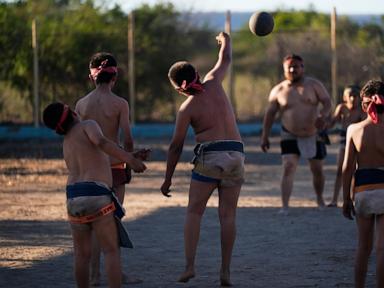
The survival of Ulama—the modern descendant of the 3,400-year-old Mesoamerican ballgame—defies standard athletic lifecycle models which typically see folk sports succumb to institutionalized competition or cultural erasure. Its persistence is not a matter of luck, but the result of a specific socio-economic and ritualistic feedback loop that has transitioned from a state-sponsored religious necessity to a decentralized grassroots resistance movement. To understand how this game persists, one must analyze the structural tension between its ceremonial origins, the physical physics of the solid rubber ball, and the modern localized governance that maintains its play.
The Kinematic Constraint and the Physics of the Solid Rubber Ball
The fundamental differentiator of Ulama from any Western sport is the ball itself. In contemporary sports, balls are hollow and pressurized or made of lightweight synthetic composites. An Ulama ball is a solid mass of natural latex, weighing between 3 and 4 kilograms. Also making news in related news: The McLean Methodology and the Industrialization of Junior Hockey.
This creates a specific set of physical constraints that dictate the entire mechanical framework of the game:
- Mass-to-Surface Area Ratio: Because the ball is solid, it possesses immense kinetic energy. A 4kg projectile moving at high velocity cannot be caught or struck with the hands without risking bone fractures. This physical reality necessitates the "hip-strike" technique—using the largest, most muscular part of the human anatomy to absorb and redistribute force.
- The Vulcanization Paradox: Ancient players utilized juice from the Ipomoea alba (morning glory vine) to cross-link the polymer chains in the Castilla elastica latex. This was chemical engineering performed centuries before Charles Goodyear. The survival of the game depends entirely on the survival of this specific botanical knowledge. Without the correct chemical ratio, the ball is either too brittle (shattering on impact) or too soft (lacking the necessary coefficient of restitution).
The game’s survival is therefore tethered to a specific ecological niche. If the Castilla elastica tree disappears, the sport loses its primary technological component, as synthetic rubber does not replicate the specific bounce and density required for hip-play. More insights regarding the matter are detailed by FOX Sports.
The Tripartite Model of Cultural Resilience
The longevity of Ulama is categorized by three distinct pillars: Ritual Continuity, Regional Isolation, and Identity Branding. While Western observers often focus on the "mystery" of the game, the actual mechanism of its survival is found in how these pillars interact.
Pillar 1: Ritual Continuity as a Governance Structure
In its original form, the ballgame functioned as a proxy for warfare and a cosmological reenactment of the sun's journey through the underworld. Today, while the overt human sacrifice is absent, the game maintains a "sacred" status in Sinaloa and other Mexican states. This status serves as a protective barrier. When a sport is categorized as a sacred tradition rather than a commercial entertainment product, it is shielded from market forces that would otherwise demand it be modernized, shortened, or altered for television.
Pillar 2: Strategic Regional Isolation
Ulama survived the Spanish Inquisition specifically because it moved to the periphery. The "patios" (dirt courts) are often located in rural areas where central colonial and later federal authority was thin. This isolation created a bottleneck for cultural diffusion, preventing the game from being "diluted" by European sports like football or baseball until the mid-20th century.
Pillar 3: Identity Branding and the "Indigenous Premium"
In the last three decades, the Mexican government and local communities have recognized the value of "cultural capital." Ulama has transitioned from a hidden rural pastime to a symbol of pre-Hispanic identity. This shift provides a financial incentive for survival—tourism, government grants, and cultural exhibitions. However, this creates a dependency on external validation which may eventually undermine the game’s authentic rules in favor of "spectacle."
The Economic Cost of Participation
The barriers to entry for Ulama are significantly higher than for association football, which contributes to its low participation rate but high practitioner loyalty.
- Manufacturing Costs: A high-quality solid rubber ball can cost several hundred dollars and requires weeks of manual labor to produce. Unlike a $20 mass-produced soccer ball, the entry cost for an Ulama "team" is a significant capital investment for a rural village.
- Physical Risk Assessment: The injury profile of Ulama is severe. Practitioners often deal with massive hematomas on the hips, which eventually turn into permanent callouses or "leathering" of the skin. The cost of participation includes a physical toll that limits the player pool to those with high pain tolerance and a deep commitment to the communal aspect of the game.
Structural Deviations from Modern Sports Logic
Most modern sports operate on a logic of expansion and standardization. Ulama operates on a logic of preservation and variation. There are three primary versions of the game still played today:
- Ulama de Cadera (Hip Ulama): The most famous and physically demanding version, played primarily in Sinaloa.
- Ulama de Antebrazo (Forearm Ulama): Played on a smaller court with a smaller ball, allowing for more frequent play and lower injury risk.
- Ulama de Mazo (Paddle Ulama): A variation using a heavy wooden club to strike the ball, which changes the physics of the game from a test of body endurance to a test of mechanical leverage.
The coexistence of these variants suggests that Ulama is not a monolithic "fossil" but an adaptive system. By having multiple versions, the culture ensures that if one version becomes too expensive or physically taxing to maintain, the lighter variants act as a "cultural backup."
The Bottleneck of Oral Tradition
The primary risk to Ulama is not a lack of interest, but the fragility of the knowledge transfer. Because the rules, ball-making techniques, and ritual chants are largely uncodified in formal textbooks, the game relies on a "Master-Apprentice" model.
The death of a single "tahero" (ball-maker) in a specific region can effectively end the sport in that area. This creates a high-sensitivity dependency on a very small number of individuals. Unlike globalized sports where the rules are maintained by a central federation (like FIFA), Ulama is governed by local consensus. This lack of a central authority is both a strength (allowing for regional resilience) and a catastrophic weakness (making it vulnerable to the localized loss of expertise).
Quantifying the "Resurrection" Narrative
Media portrayals often claim Ulama is "returning from the brink." A data-driven analysis suggests a more nuanced reality. While the number of exhibition matches in tourist hubs like Xcaret or Teotihuacán has increased by over 300% in the last twenty years, the number of "organic" village games has remained stagnant or declined.
This suggests a bifurcation of the sport:
- The Performance Layer: High-visibility, choreographed games designed for cultural consumption.
- The Authentic Layer: Low-visibility, high-stakes games played in rural Sinaloa for community pride.
The "Performance Layer" provides the funding and political protection for the "Authentic Layer" to exist. Without the revenue from tourism and government-backed "Indigenous Olympics," the rural taheros would struggle to justify the time and expense of ball production.
Theoretical Framework: The Institutionalization of Folk Memory
The survival of Ulama is a case study in what sociologists call "Cultural Scaffolding." The game survives because it has integrated itself into the modern Mexican state's narrative of heritage. By becoming "the ancestors' game," it has gained a form of immunity. However, this immunity comes at the cost of being frozen in time.
In a standard competitive evolution, a sport changes its rules to become faster or more appealing to audiences. Ulama is forbidden from significant change by the very nature of its appeal. If it became "modernized," it would lose its status as a 3,400-year-old relic and be forced to compete directly with soccer or baseball—a competition it would lose on every commercial metric.
Mapping the Cause and Effect of Survival
The causal chain of Ulama's persistence can be mapped as follows:
- Chemical/Physical Uniqueness: The solid rubber ball creates a playstyle that cannot be replicated by modern materials.
- Societal Niche: The game occupies the space of "sacred ritual," exempting it from typical sports commodification.
- Geographic Shelter: Rural Sinaloa acts as a laboratory where the game was preserved in a vacuum.
- Modern Utility: The game now serves as a tool for political and cultural identity, securing state protection.
This chain is only as strong as its weakest link. The most significant threat is currently the "Decoupling of the Ball." As natural latex sources are threatened by climate change and land use shifts, the transition to synthetic balls is being discussed. If Ulama moves to synthetic rubber, it will fundamentally change the physics of the hip-strike, likely leading to a softening of the game and a loss of its "warrior" identity.
The strategic play for the preservation of Ulama is not simply "more funding," but the formal protection of the Castilla elastica groves and the establishment of a formal apprenticeship program for ball-makers. Without the physical technology of the ball, the rules of the game are merely theory. To save the sport, one must save the chemistry.