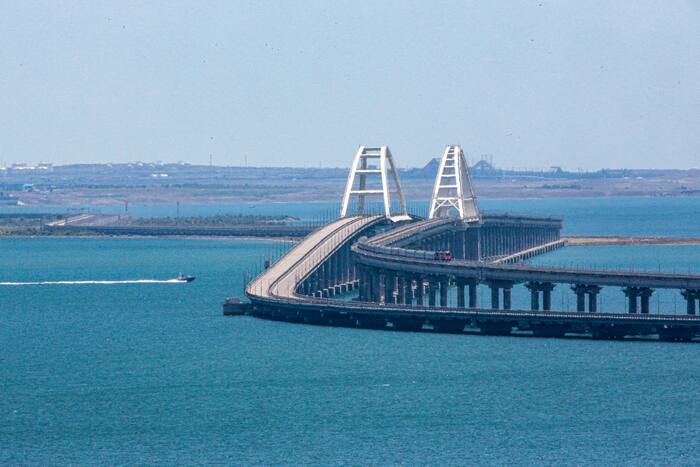
Blowing up a concrete bridge isn't easy. You can't just drop a standard bomb on a reinforced highway span and expect it to crumble into the river below. Yet Ukraine keeps throwing waves of long-range drones and Western-supplied missiles at major Russian crossings anyway.
Most casual observers look at the smoke rising from a damaged span, see traffic resume a few days later, and assume the attack failed. That's a massive misreading of modern warfare. When Ukraine strikes a major Russian bridge with drones and missiles, the goal isn't always total collapse—it's economic and logistical strangulation.
Aerial attacks across the border and inside occupied territories have escalated dramatically because Kyiv figured out a simple mathematical truth. Russia's military relies heavily on rail and heavy road networks to move shells, fuel, and armored vehicles. Disrupting those arteries forces Moscow into ugly, expensive choices.
The Hard Physics of Destroying Reinforced Concrete
If you've ever watched demolition crews take down an old overpass, you know it takes weeks of drilling and carefully placed shaped charges inside the support columns. Hitting a bridge from the sky is completely different.
Explosions in the open air take the path of least resistance. Most of the blast energy vents upward and outward into the sky rather than downward into the steel-reinforced concrete deck. Even a heavy warhead—like the 450-kilogram BROACH warhead on a British Storm Shadow or French SCALP missile—often leaves a neat circular hole in the asphalt without snapping the structural girders underneath.
That's why Ukrainian planners rarely rely on a single munition anymore. Instead, they use coordinated saturation tactics. Cheap, long-range one-way attack drones fly in first to overwhelm local air defense radars and force Russian Pantsir or S-400 batteries to burn through expensive interceptor missiles. Once the radar screens are cluttered and reload cycles begin, precision ballistic or cruise missiles streak in behind them.
It's a brute-force solution to an engineering problem. You punch enough holes in the same load-bearing section, and eventually, the rebar bends, the concrete spalls away, and heavy tanks can no longer cross safely.
Why Logistics Matter More Than Headlines
Military analysts like Phillips O'Brien and researchers at the Institute for the Study of War (ISW) have pointed out for years that modern wars of attrition aren't won by capturing empty fields. They're won by breaking the opponent's supply chain.
Russia's army is uniquely dependent on railways. Unlike NATO forces, which use massive fleets of palletized logistics trucks, Russian doctrine moves bulk artillery shells and fuel via train until the absolute last mile. When Ukrainian drones and missiles hit major Russian bridges—whether it's the Kerch Strait Bridge linking Crimea to mainland Russia, the Chonhar crossings, or spans across the Seym River in the Kursk region—they sever those rail and heavy-truck lifelines.
Even temporary closures create immediate chaos. Consider what happens when a primary bridge goes down for two weeks of emergency repairs:
- Rerouting bottlenecks. Thousands of military supply trucks get forced onto secondary, single-lane roads that weren't built for 60-ton loads.
- Increased vulnerability. Slow-moving convoys bunched up at pontoon crossings or ferry terminals become sitting ducks for follow-up HIMARS strikes and reconnaissance drones.
- Civilian friction. Major bridges carry commuters, food, and commercial freight. Shutting them down brings the reality of the war directly into the daily lives of Russian citizens who would rather ignore it.
When Ukraine targeted bridges over the Seym River during its Kursk incursion, the objective wasn't merely theatrical. By dropping those spans, Ukrainian forces trapped Russian units between the river and the border, forcing them to rely on vulnerable floating pontoon bridges that could be tracked and hit daily.
How Russia Adapts—And Why It Still Costs Them
Let's be honest about Moscow's response. Russian combat engineers are genuinely good at rapid repair work and pontoon bridging. Dismissing their engineering corps is a mistake plenty of armchair commentators make.
Whenever a major bridge takes a hit, Russian crews deploy heavy barges, submerged anti-drone nets, radar-reflecting decoys, and smoke generators within hours. They've ringed key crossings with dense layers of electronic warfare jammers designed to spoof GPS signals and blind incoming drone cameras.
Those defenses work sometimes. Plenty of Ukrainian drones get knocked off course or chewed up by anti-aircraft fire before reaching their targets.
Yet every layer of protection Russia adds to a stationary bridge represents an asset pulled away from the front lines. An S-300 air defense battery guarding a bridge in Crimea or Rostov can't protect an ammunition depot in Donetsk. A specialized electronic warfare unit stationed next to a railway crossing isn't jamming Ukrainian reconnaissance drones over the trenches. By threatening high-value infrastructure deep in the rear, Ukraine forces Russia to stretch its air defense umbrella until it tears.
What Escalating Aerial Attacks Actually Signal
The steady uptick in combined drone and missile strikes tells us two critical things about where this conflict stands.
First, domestic Ukrainian drone production has matured from a desperate, ad-hoc garage industry into a mass-manufacturing pipeline. Swarms of long-range unmanned aircraft can now routinely travel hundreds of kilometers into Russian airspace, hitting oil refineries, airfields, and transport hubs simultaneously.
Second, Western restrictions on deep strikes have become the central political battleground of the war. While Ukraine uses its own homegrown drones to hit targets deep inside Russia, the heavy bunker-busting punch needed to actually collapse major bridge piers still largely resides in Western missiles like ATACMS, Storm Shadow, and SCALP. Every major bridge strike triggers a fresh round of debate in Washington, London, and Berlin over how far Kyiv should be allowed to reach.
If you want to understand the real impact of the next major bridge strike you see on the news, ignore the dramatic fireball videos for a second. Look at the satellite imagery 48 hours later. Check whether rail traffic is moving, watch where Russian air defenses are being relocated, and pay attention to how long the detours stay backed up. Follow open-source intelligence trackers like Oryx, Frontelligence Insight, or the ISW daily maps to see whether a strike actually severed a supply line or just scorched the pavement.