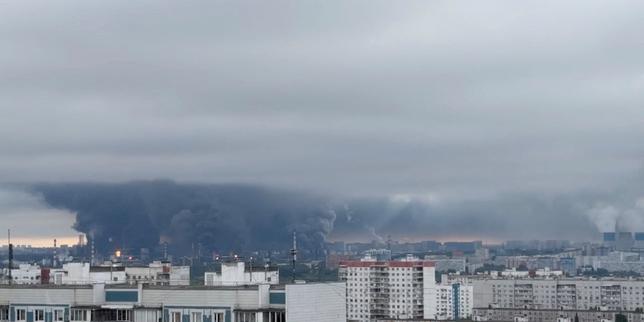
Ukraine just hit another oil pumping station right outside Moscow. It isn't a one-off incident anymore, and it certainly isn't a fluke. Kiev is systematically dismantling the energy backbone that funds Russia's war machine, and they're doing it deep inside Russian territory. If you've been following the updates, you know this strategy has been building for months. But this latest strike proves that Russia cannot protect its most vital assets even within spitting distance of the Kremlin.
The target wasn't selected at random. Pumping stations are the choke points of the oil network. You can repair a damaged pipeline fairly quickly, but a specialized pumping facility or a distillation column at a refinery is a different story entirely. Those require complex machinery that Russia can't easily replace under current international sanctions. By focusing long-range drone strikes on these specific nodes, Ukraine is forcing a massive logistical crisis inside Russia. It’s an asymmetric strategy that forces Moscow to make impossible choices about where to deploy its limited air defense systems.
Let's look at what actually happened and why the location matters so much.
The tactical shift hitting Russia where it hurts
For the first couple years of the conflict, drone warfare was largely confined to the front lines or regions immediately bordering Ukraine like Belgorod and Kursk. That era is officially over. Ukrainian forces have expanded their operational reach significantly, regularly sending fixed-wing attack drones hundreds of miles deep into the Russian interior.
Hitting an oil pumping station near Moscow is a massive psychological and tactical statement. It tells the Russian public that the war isn't something happening far away in the Donbas. It's happening right here, down the road from where they live. The smoke columns rising from energy infrastructure are highly visible receipts of defense failures.
More importantly, it directly impacts the flow of crude. Think of the Russian oil network like a human circulatory system. The refineries and wells are the organs, but the pumping stations are the heart chambers forcing the fluid through the tubes. When a drone strikes a pumping station, the pressure drops across the entire line. The oil stops moving. Refineries upstream have to slow down production because they have nowhere to store the excess crude, and export terminals downstream run dry.
Military analysts from organizations like the Institute for the Study of War have pointed out that these strikes create a compounding bottleneck. Russia can claim they shot down most of the drones, but it only takes one or two getting through to knock a facility offline for weeks or even months.
Why Russian air defenses keep failing to stop the drones
You might wonder how a slow, loud drone can fly hundreds of miles through supposedly heavily defended airspace to hit a target near Moscow. The answer lies in the sheer math of geographic defense and the specific design of Ukrainian hardware.
Russia is the largest country on earth by landmass. It's physically impossible to blanket every square mile with radar and surface-to-air missile batteries. Moscow has concentrated its best systems, like the S-400, around high-value political targets and active military zones. This leaves massive gaps in coverage across the vast Russian interior.
Ukraine is exploiting these gaps beautifully. They aren't flying drones in a straight line toward their targets. Instead, flight paths are carefully mapped out using electronic intelligence to skirt around known Russian radar installations. The drones fly incredibly low, often just above the tree line, to blend into the ground clutter and avoid detection by long-range radar.
- Low radar cross-section: Many of these modern Ukrainian attack drones are made of composite materials like fiberglass or compressed wood rather than metal, making them incredibly difficult for older radar systems to track.
- Cheap vs expensive asymmetry: Russia is forced to use million-dollar missiles from Pantsir or Tor systems to shoot down drones that cost a few thousand dollars to build. That's a losing economic equation.
- Saturated defenses: Launching drones in waves overwhelms local defense teams, ensuring that even if five are shot down, the sixth hits the target.
It’s a classic saturation tactic. If you throw enough cheap targets at a defense grid, you will eventually find the breaking point. And right now, Russia’s breaking point is on full display.
The economic fallout inside the Kremlin budget
We need to talk about the money because that’s the real objective here. Russia relies on oil and gas revenue to finance its military operations, pay its soldiers, and keep its domestic economy from collapsing under the weight of Western sanctions. By choking off domestic processing capacity, Ukraine is squeezing the Kremlin’s primary wallet.
When a refinery or pumping station gets hit, Russia loses two things simultaneously. First, they lose the immediate value of the destroyed infrastructure and product. Second, they lose future export revenue while the facility is down. Because of sanctions, Russia can't just buy replacement parts from European or American manufacturers. They have to rely on grey-market smuggling or inferior domestic substitutes, delaying repairs significantly.
We're already seeing the cracks in the system. Russia has had to implement temporary bans on gasoline exports at various points over the last year just to ensure their own domestic market doesn't run out of fuel. When a country that is supposedly an energy superpower has to ban fuel exports to keep its own gas stations running, you know the strategy is working.
It also creates a massive headache for Russian logistics on the front line. Tanks, armored personnel carriers, and supply trucks require an immense amount of fuel. If local supply lines are disrupted because a terminal near Moscow is burning, the friction ripples all the way down to the trenches in southern and eastern Ukraine.
How Ukraine engineered its long-range drone fleet
This campaign didn't happen overnight. It is the result of a massive, decentralized domestic defense manufacturing push inside Ukraine. Lacking a traditional long-range missile arsenal due to restrictions on using Western weapons inside Russia, Kiev had to build its own solution from scratch.
They turned to a network of private companies, startup hubs, and state-backed initiatives to rapidly iterate drone designs. The results are weapons like the Lyutyi drone, which features a distinct twin-boom tail design and can carry a payload of over 70 pounds of explosives across distances exceeding 600 miles.
These aren't the small quadcopters you see dropping grenades on individual soldiers. These are essentially cheap, slow cruise missiles powered by simple internal combustion engines. They are loud, but they are precise. They use a combination of satellite navigation and visual terrain mapping to guide themselves directly into high-value targets like oil storage tanks and pumping regulators.
By manufacturing these entirely within Ukraine, Kiev completely bypasses the political restrictions imposed by Washington or Berlin. They don't need permission to strike targets near Moscow because they own the tech. It gives them complete operational freedom to escalate the economic cost of the war for Vladimir Putin.
Tracking the geographical expansion of the campaign
If you map out the strikes over the past twelve months, a clear pattern emerges. The radius of danger for Russian infrastructure is expanding exponentially.
It started with facilities along the Black Sea and the Sea of Azov. Then the strikes shifted toward St. Petersburg and the Baltic oil terminals. Now, the bullseye is firmly on the central industrial region surrounding Moscow. This geographical creep means that Russia can no longer assume any facility west of the Urals is safe.
The implications for global energy markets are complicated. While Washington has occasionally expressed nervousness about strikes on Russian energy infrastructure due to fears of spiking global oil prices, Ukraine has maintained that these targets are completely legitimate. They are targeting processed products and internal distribution loops rather than raw crude exports, specifically trying to starve the Russian war machine without causing a global economic shockwave.
What to watch for in the coming weeks
The drone war is entering a critical phase of escalation. As Ukraine refines its manufacturing and navigation software, the frequency of these attacks will likely increase. Russia will be forced to pull air defense units away from the front lines to guard oil refineries and pumping stations deep in the rear, creating vulnerabilities that Ukrainian ground forces can exploit.
If you are tracking this conflict, keep your eyes on the Russian domestic fuel prices and export volumes. Those metrics tell the true story of how effective this campaign is, far better than any official press release from either ministry of defense. Watch for whether Russia is forced to divert more military resources to domestic security, as that will give a clear indication of how desperate the situation is becoming for the Kremlin's energy sector.