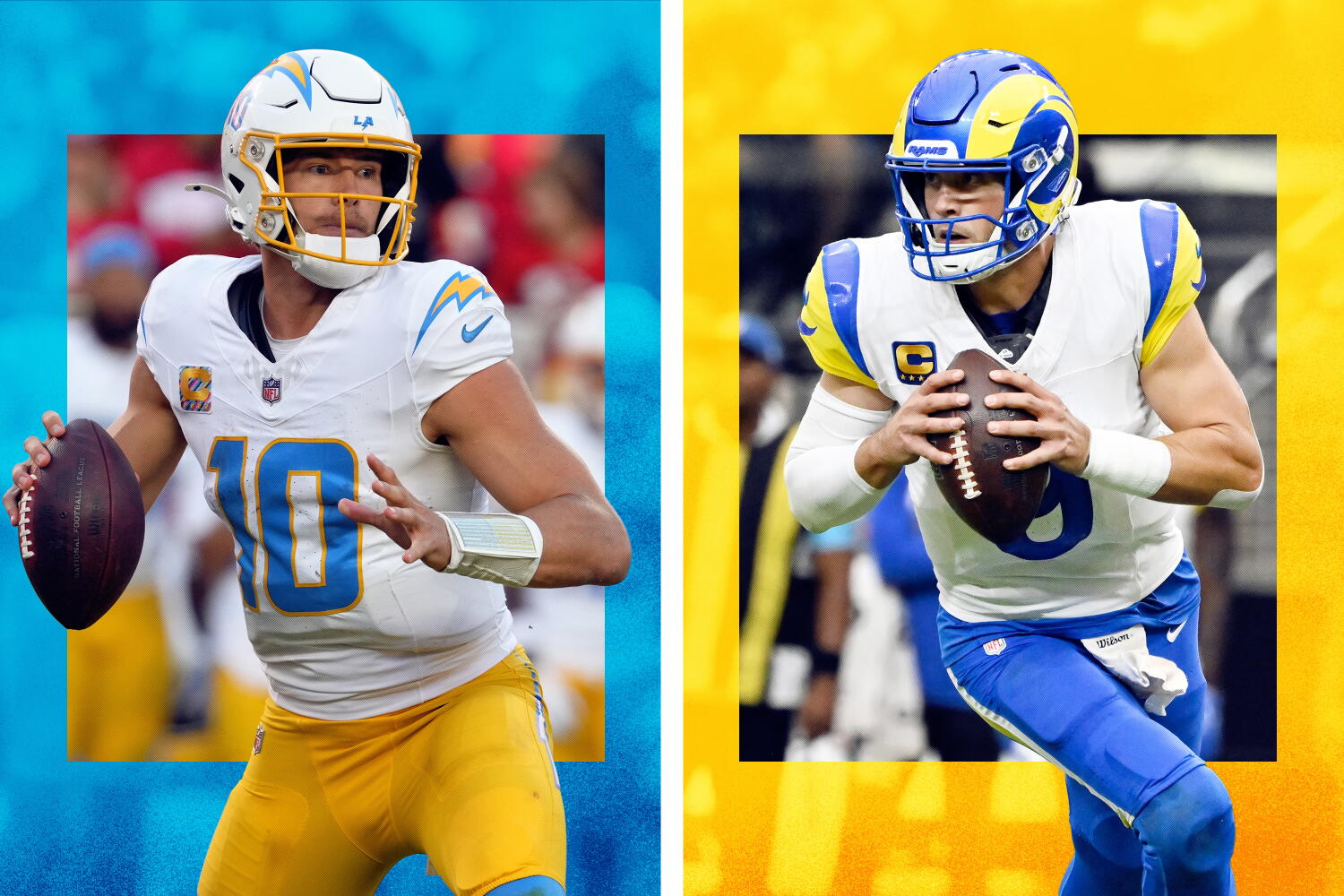
The concrete around SoFi Stadium still smells faintly of wet paint and expensive ambition when the sun drops behind the San Gabriel Mountains.
If you stand near the artificial lake outside the main gate three hours before kickoff, you can watch a peculiar sociological experiment unfold in real time. A man in a powder-blue Justin Herbert jersey walks past a woman wearing a royal-blue Aaron Donald throwback. Neither flinches. Neither shouts. They simply nod, two commuters sharing the same crowded subway car who happen to work on different floors of the exact same skyscraper.
This is the quiet absurdity of modern professional football in Southern California.
For decades, the sports media industry has conditioned us to consume matchups like Chargers vs. Rams through the sterile lens of broadcast schedules, point spreads, and injury reports. You type the teams into a search bar, and you get a spreadsheet disguised as journalism. Kickoff time. Television channel. Moneyline odds. A sterile prediction spit out by an algorithm that has never felt the damp chill of an Inglewood evening or heard seventy thousand people hold their breath at the exact same second.
Strip away the corporate sheen, however, and what you actually have is one of the strangest domestic arrangements in American sports. Two franchises. One five-billion-dollar architectural marvel. Zero shared history of genuine hatred, yet an endless, gnawing anxiety over who actually owns the heart of a sprawling metropolis that already has too many distractions.
Let us talk about what is really happening when these two teams share the turf, how you can witness it unfold, and why the numbers oddsmakers slap onto this collision rarely tell the whole story.
The Architecture of a Rented Rivalry
To understand the tension between the Los Angeles Chargers and the Los Angeles Rams, you have to picture a hypothetical fan named Marcus.
Marcus grew up in Downey in the nineties, a kid without a local NFL team to call his own. For twenty years, his Sundays were a patchwork quilt of distant loyalties. When the Rams returned from St. Louis in 2016, Marcus bought a hat. A year later, when the Chargers packed their bags in San Diego and crept north up Interstate 5, Marcus felt less like a suitor being wooed and more like a bystander watching two estranged cousins argue over his living room furniture.
That emotional ambivalence is the invisible third opponent on the field every time these franchises collide.
In New York, when the Giants and Jets meet, decades of blue-collar scar tissue separate their fanbases. In Los Angeles, the divide is generational, geographic, and deeply aesthetic. The Rams carry the weight of a Super Bowl LVI championship banner hanging from the rafters, a golden validation of Stan Kroenke’s massive real estate gamble and Sean McVay’s boy-wonder offensive choreography. They are the landlords. They hold the deed to the building.
The Chargers, by contrast, operate like the brilliant, perpetually star-crossed tenant who pays rent on time, throws incredible parties, yet somehow always locks themselves out of the apartment during the fourth quarter.
When they face each other at SoFi Stadium—whether in the heat of a late-August preseason tune-up where starters watch from the sidelines in baseball caps, or in a high-stakes regular-season clash where playoff seeding hangs by a thread—the stadium transforms into a mirror. Even when one team is designated as the home side, the crowd splits down the middle like a bruised peach. Powder blue bleeds into royal blue. The noise does not favor one offense over the other; it hums with a nervous, chaotic static.
Finding the Signal Through the Broadcast Noise
Watching this collision requires navigating the modern labyrinth of sports media rights, a puzzle that frustrates casual fans far more than a third-and-long screen pass.
Because the Chargers reside in the American Football Conference and the Rams anchor the National Football Conference, their regular-season meetings only occur once every four years under the NFL’s standard scheduling rotation, with an occasional fifth crossover added by the league's seventeen-game formula. Every August, however, they almost always stage a preseason exhibition—a dress rehearsal where fringe roster players fight for their professional lives while coaches guard their playbooks like state secrets.
If you are tuning in from the greater Los Angeles market, local network affiliates carry the weight. Preseason matchups typically land on local over-the-air stations like KCBS or KABC, giving anyone with a digital antenna a clear window into the action without paying a dime to a cable conglomerate. Out-of-market viewers, meanwhile, are routed through NFL Network for national exhibition broadcasts or NFL+ for mobile streaming.
When the calendar flips to games that count in the standings, the broadcast muscle scales up dramatically. Depending on whether the NFL schedules the game for the traditional Sunday afternoon window—usually kicking off at 1:05 p.m. or 1:25 p.m. Pacific Time—or elevates it to a prime-time showcase at 5:20 p.m. Pacific, the viewing map shifts. Fox typically claims the broadcast when the Chargers are the designated road team, while CBS takes the reins when the Rams travel across the hallway. Streaming platforms like YouTube TV via NFL Sunday Ticket, Paramount+, and Peacock fill the gaps for cord-cutters who refuse to tether themselves to a coaxial cable.
The ritual of finding the game has become an endurance sport of its own. You check the local listings. You verify your login credentials. You pour a drink before the opening kickoff, hoping the stream does not buffer right as the ball leaves the quarterback’s hand.
What the Oddsmakers Actually See
Vegas does not care about civic pride. Sportsbooks are cold, ruthless engines designed to exploit human bias, and nowhere is bias thicker than in a cross-town matchup.
When oddsmakers set the line for Chargers vs. Rams, they are weighing two starkly different organizational philosophies. Let us use an analogy from the kitchen to make sense of how these rosters are built. Sean McVay’s Rams often resemble a high-end French restaurant operating with a tiny, elite brigade of chefs—heavy on star power at the top of the roster, aggressive with draft capital, and utterly reliant on timing, pre-snap motion, and spatial deception to overwhelm defenses.
Jim Harbaugh’s Chargers, shaped by a brutalist, trench-obsessed ethos, look far more like a cast-iron foundry. The emphasis shifts away from delicate perimeter timing toward physical dominance at the line of scrimmage, punishing ground attacks, and suffocating clock control.
In a regular-season setting where both starting lineups are healthy, point spreads between these two rarely balloon past a field goal or four points. Oddsmakers respect the quarterback pedigree on both sides—the effortless, whip-cracking velocity of Justin Herbert trading haymakers with the veteran poise and no-look audacity of Matthew Stafford. Over/under totals tend to hover in the high forties, tempting bettors with the promise of fireworks under the translucent roof of SoFi Stadium, where wind and rain never interfere with a deep spiral.
Preseason odds, however, are an entirely different beast.
If you are looking at a betting board in August, throw your knowledge of star quarterbacks straight out the window. Oddsmakers set preseason lines—usually tight spreads hovering between one and three points, with totals depressed into the mid-thirties—based almost entirely on coaching tendencies and backup quarterback depth. Harbaugh treats preseason reps like sacred scripture, demanding physicality from the third-string offensive line well into the fourth quarter. McVay, conversely, has famously treated August games as an inconvenience to be survived without tearing an ACL, resting nearly every starter and handing the keys to developmental passers.
Betting on a preseason game between these two is less about evaluating talent and more about reading the mind of two head coaches who view exhibition football through opposite ends of a telescope.
The Invisible Stakes on the Turf
Numbers tell you who is favored. They never tell you what it feels like to stand on that turf when the whistle blows.
I remember standing near the tunnel at SoFi during an August evening a few years back, watching a fourth-string wide receiver for the Chargers—a kid from a Division II school whose name barely registered on the roster sheet—take a slant route across the middle. A Rams safety, fighting for the final spot on the practice squad, hit him so hard the sound echoed off the upper deck like a gunshot.
Both men lay motionless for two agonizing seconds.
In the press box eighty feet above, writers barely looked up from their laptops. To them, it was an incomplete pass in a meaningless exhibition game. Down on the grass, you could see the terror in the receiver’s eyes as he checked his fingers to make sure they still moved, and the fierce, desperate relief on the safety’s face as he jogged back to the huddle, knowing that single collision might buy him another week of paychecks.
That is the heartbeat the dry previews miss.
Whether it is a late-season clash with division titles hanging in the balance or a humid summer night where fifty young men are auditioning for their livelihoods, the collision between the Chargers and the Rams strips away the glamour of Los Angeles. Behind the Hollywood billboards and the luxury suites stocked with sushi and tequila, football remains an uncompromising trade.
How the Matchup Tilts When the Whistle Blows
If you want to predict who walks out of the tunnel victorious when these two franchises lock horns, ignore the hype videos and watch the trenches during the first two drives.
Everything starts with how the Rams handle interior pressure. Throughout the McVay era, Los Angeles has thrived when its offensive line can wall off the interior gaps, allowing receivers to run deep crossers that stretch safeties to their breaking point. When Stafford has a clean pocket and two and a half seconds to survey the field, he dissects zone coverage with surgical cruelty.
Yet the Chargers, hardened by a defensive scheme designed to muddy throwing lanes and collapse the pocket from the inside out, specialize in ruining that exact rhythm. If the Chargers’ front four can generate pressure without blitzing—forcing the Rams into third-and-eight situations where play-action loses its bite—the entire geometry of the game tilts toward powder blue.
On the flip side, watch how the Rams' defense tests Justin Herbert’s patience. Herbert possesses the arm strength to throw a football through a hurricane, a gift that occasionally tempts him into forcing throws into tight windows when the run game stalls. A disciplined, shell-coverage defense that takes away the deep post and forces the Chargers to execute twelve-play drives without a holding penalty or a dropped pass is the surest blueprint for a Rams victory.
Prediction, in a rivalry this tightly wound, comes down to situational execution in the final four minutes.
In a full-strength regular-season showdown, the slight edge leans toward the Chargers by a razor-thin margin—call it 24-21—driven by a punishing ground game that keeps the Rams' offense standing on the sideline watching the clock bleed out. In an August preseason contest, where depth charts rule the night and Harbaugh’s relentless emphasis on physical trench play clashes against McVay’s cautious preservation of starters, the Chargers again hold the structural advantage, grinding out a low-scoring 17-13 decision where third-stringers decide the cover in the final two minutes.
Beyond the Final Whistle
When the stadium lights finally dim and the seventy thousand fans spill back out into the Inglewood night, the scoreboard resets to zero.
The Rams retreat to their side of the facility, polish their championship memories, and prepare for the next challenger. The Chargers pack their gear, nurse their bruises, and continue their relentless march to prove they belong on the marquee.
And out by the artificial lake, two fans wearing different shades of blue walk back toward the parking lot together, arguing about a holding call in the third quarter, already waiting for the next time they get to share the house.