The shipping container smells like wet cardboard and machine oil.
Stand on the docks of Long Beach, California, at four in the morning, and you can hear the metallic groan of cranes lifting forty-foot steel boxes off vessels that crossed the Pacific in twelve days. Now travel six thousand miles west to a factory floor in Shenzhen, where a twenty-four-year-old engineer named Wei—a hypothetical composite of the thousands of young graduates pouring into China’s industrial heartland—stares at a glowing monitor, calibrating the robotic arms that weld battery casings for electric vehicles.
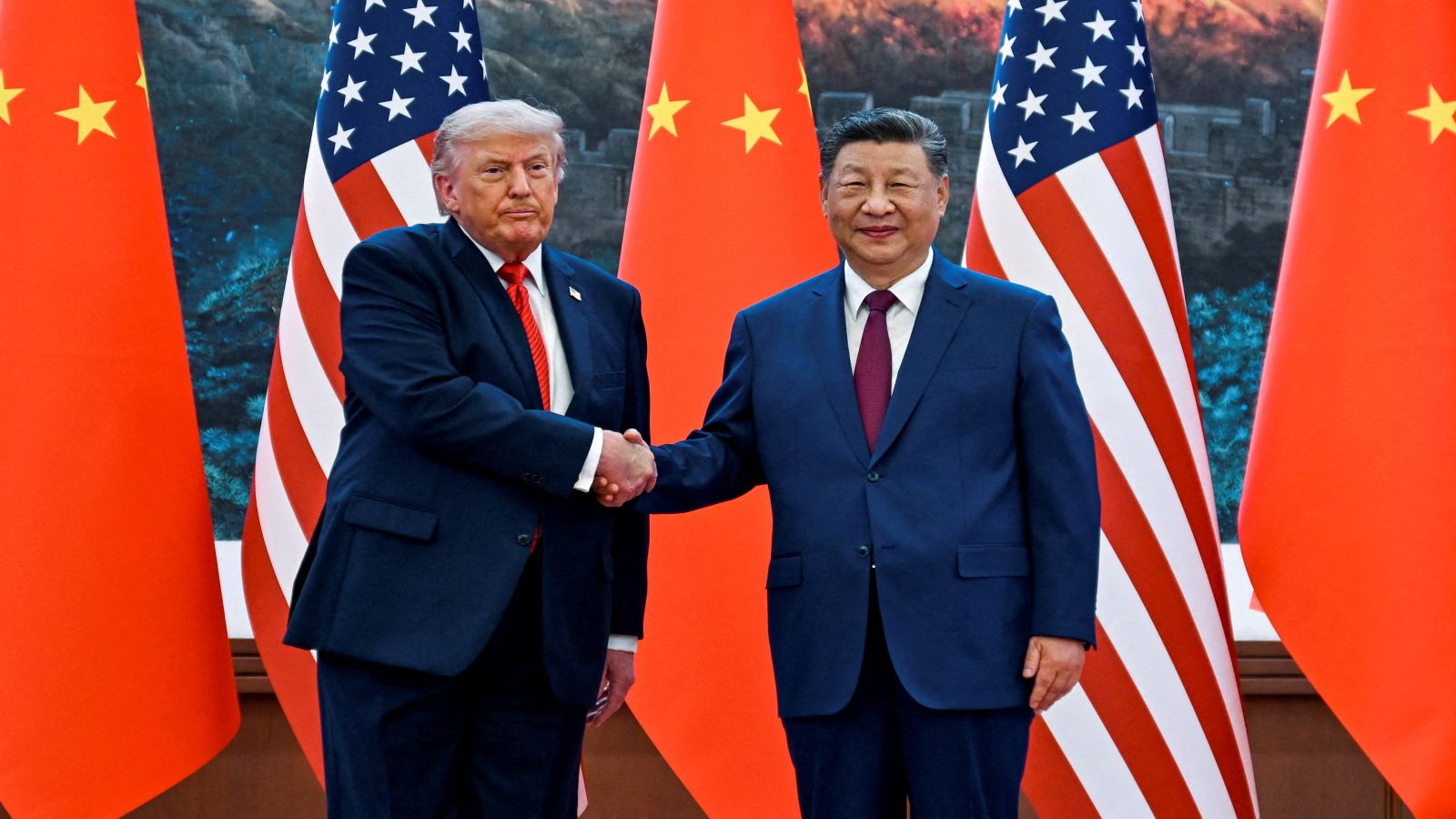
Between the dockworker in California and the engineer in Shenzhen sits an invisible wire. Every time Donald Trump and Xi Jinping sit down across a polished mahogany table, they are holding pliers over that wire.
Most coverage of a Trump-Xi summit reads like an actuarial table. Pundits trade acronyms—GDP, tariffs, semiconductors, rare earths—as if these things existed in a vacuum, floating serenely above our heads. They do not. When two leaders negotiate the architecture of the twenty-first century, the fallout lands directly on your kitchen table, inside your retirement account, and inside the glowing glass rectangle in your pocket.
To understand what happens behind closed doors when Washington meets Beijing, we have to look past the handshakes and examine the three levers currently under the table: China’s massive economic gravity, its relentless export engine, and the high-stakes race to build artificial intelligence that thinks faster than human beings.
The Weight of a Second Superpower
For decades, American negotiators walked into trade talks holding almost all the cards. If Washington threatened to close its markets, foreign economies trembled. That era is gone.
Consider a hypothetical scenario to visualize the shift. Imagine two neighbors, Arthur and Chen, who have traded tools and groceries over a backyard fence for thirty years. Early on, Arthur owned the only hardware store in town, so Chen had to accept whatever prices Arthur set. Over time, however, Chen built his own workshops, bought up the local timber yards, and became the primary customer for half the farms in the county. When Arthur threatens to lock his gate today, Chen does not panic. He simply walks down the street to trade with the neighbors Arthur ignored.
This is the reality of China’s economic clout. According to World Bank data and analyses by the Peterson Institute for International Economics, China remains the world's largest manufacturer, accounting for roughly thirty percent of global manufacturing output—more than the United States, Japan, and Germany combined. Even as China’s domestic property sector has stumbled and youth unemployment has tested Beijing’s planners, the sheer scale of its industrial base acts as a shock absorber.
When Trump arrives at the negotiating table, he brings the blunt instrument of tariffs—taxes on imported goods designed to force companies to bring factories back to American soil. Trump and his economic advisors argue that tariffs protect American workers from unfair state subsidies and currency manipulation. Critics, including many mainstream economists cited by the Council on Foreign Relations, counter that tariffs act largely as a tax paid by American importers and consumers, raising the price of everything from washing machines to winter coats.
Xi Jinping knows this. He also knows that China holds leverage over supply chains that cannot be rebuilt overnight. Refine a rare earth mineral—the exotic metals required to make fighter jets, wind turbines, and smartphone speakers—and there is an overwhelming chance that chemical processing happened inside China. According to the International Energy Agency, China controls nearly ninety percent of global rare earth refining capacity.
Negotiating with an economy that size is not like imposing sanctions on a small nation. It is like trying to reroute a river while standing knee-deep in the current.
The Factory Floor of the World
Walk into any big-box store in Ohio, and look at the tiny ink stamped on the bottom of a ceramic mug, a cordless drill, or a child’s bicycle. The geography is unmistakable. Yet the nature of what China makes has undergone a radical transformation over the last decade, creating the central friction point of any Trump-Xi dialogue.
Ten years ago, China exported cheap textiles, plastic toys, and low-end electronics. Today, Beijing has poured hundreds of billions of dollars in state-backed loans and tax breaks into what Chinese planners call the "new three" growth drivers: electric vehicles, lithium-ion batteries, and solar panels.
Think of China’s export model like a massive hydraulic press. When domestic consumers in Shanghai and Chengdu stopped buying apartments during China’s real estate slump, factories didn't shut down. Instead, Beijing kept the credit flowing to manufacturers. Unable to sell all those goods at home, Chinese companies flooded global markets with high-quality, remarkably inexpensive green technology.
For a family in Munich or São Paulo, a twenty-thousand-dollar Chinese electric vehicle with software rivaling a luxury sedan looks like a bargain. For an autoworker in Michigan or a solar panel manufacturer in Pennsylvania, it looks like an extinction event.
Trade analysts at the Rhodium Group and the Center for Strategic and International Studies have documented how this wave of exports—often referred to by Western officials as "industrial overcapacity"—has forced Washington and Brussels onto the defensive. During talks, Trump’s team frames this as an existential threat to American industrial survival, demanding structural changes to how Beijing subsidizes its industries.
Xi’s perspective, shaped by decades of Communist Party doctrine and historical memory of nineteenth-century foreign domination, is entirely different. To Beijing, high-tech manufacturing is not a trade distortion; it is national survival. Having watched the United States restrict China’s access to advanced Western technology, Xi views total self-reliance—and global dominance in clean energy and advanced manufacturing—as the only guarantee against foreign containment.
Neither man can easily back down. If Trump softens his stance on tariffs without securing massive, verifiable commitments from Beijing to buy American farm goods and curb state subsidies, he faces backlash from the industrial heartland voters who powered his political rise. If Xi dismantles the state-led industrial model that keeps millions of Chinese factory workers employed, he risks domestic instability at home.
The Ghost in the Silicon
Beneath the arguments over steel, soybeans, and electric cars lies a quieter, far more consequential struggle. It happens in sterile cleanrooms where workers wear full-body bunny suits and breathe air filtered a thousand times cleaner than a hospital operating room.
Artificial intelligence is the new nuclear physics. Whoever builds the most capable AI systems will likely command insurmountable advantages in drug discovery, autonomous warfare, financial modeling, and cybersecurity. And right now, the entire AI revolution rests on a tiny, fingernail-sized piece of silicon: the advanced semiconductor.
To understand the AI race between Washington and Beijing, imagine two marathon runners sprinting toward a finish line in the dark. One runner—the United States—has spent decades building the best running shoes on earth, designed in California, etched with Dutch lithography machines, and manufactured in Taiwan. The other runner—China—has immense stamina, millions of brilliant engineers, and oceans of data, but lacks the specialized equipment needed to make the lightest, fastest shoes.
Over the past several years, Washington has tried to slow China down by cutting off its access to top-tier AI chips from companies like Nvidia, alongside the ultraviolet lithography machines built by the Dutch firm ASML. The strategy, often described by U.S. officials as a "small yard, high fence" approach, aims to keep the most sensitive technologies out of Beijing’s hands while allowing ordinary trade to continue.
At a Trump-Xi summit, this fence is constantly tested. Xi’s negotiators view American export controls not as defensive security measures, but as a technological blockade meant to strangle China’s development. Meanwhile, U.S. intelligence assessments and defense analysts warn that advanced AI chips sold commercially to Chinese tech giants could easily be diverted to modernize the People’s Liberation Army, powering autonomous drone swarms or hypersonic missile guidance systems.
Yet prohibition has a funny way of breeding invention. Denied access to the world’s fastest chips, Chinese engineers have been forced to innovate around the blockade. Companies like Huawei have poured billions into domestic chip design, while Chinese AI labs—such as DeepSeek—have stunned Silicon Valley by training remarkably efficient models using less computing power and older hardware.
This creates an agonizing dilemma for any American president sitting across from Xi. Tighten the screws too much, and you accelerate China’s drive to build a completely independent, sanctions-proof tech ecosystem that eventually competes with American firms globally. Loosen the screws in exchange for trade concessions, and you risk handing a strategic rival the very tools it needs to surpass American military and economic supremacy.
The Invisible Toll on Ordinary Lives
It is easy to get lost in the chess match of grand strategy and forget who pays for the pieces.
I remember standing inside a mid-sized metal stamping plant in the American Midwest a few years ago, watching sparks shower off a hydraulic press. The owner, a third-generation manufacturer whose grandfather had built parts for post-war appliances, pulled a crumpled invoice from his shirt pocket. The steel he needed had jumped thirty percent in price overnight due to cascading tariff adjustments, while his biggest buyer was threatening to move the contract to a supplier in Vietnam—a supplier who, as it turned out, was quietly importing raw components from China anyway.
"I don't care about geopolitics," he told me over the rhythmic thud of the machines. "I just want to know what my materials will cost next Tuesday so I don't have to lay off four guys who have kids in little league."
Across the ocean, the uncertainty cuts just as deeply. In coastal Chinese cities like Dongguan and Ningbo, family-owned factories that spent twenty years making furniture, lighting fixtures, and auto parts for American retailers have watched orders evaporate or shift to Southeast Asia. Profit margins have thinned to razor edges. Young graduates who studied computer science expecting six-figure salaries in booming tech hubs now compete fiercely for civil service jobs, opting for stability over ambition.
Even the global financial markets feel the tremor every time a summit is announced. Pension funds in Texas, sovereign wealth funds in Oslo, and everyday investors checking their 401(k) balances on a Tuesday afternoon are all tethered to the outcome of these talks. A single offhand remark at a press conference—a hint that tariffs might rise to sixty percent, or a sudden breakthrough on agricultural purchases—can send currencies swinging and wipe out or create hundreds of billions of dollars in market value before the closing bell rings.
Where Compromise Lives—and Where It Dies
When Trump and Xi actually sit down, the theatrics are carefully choreographed. Translators lean in, pens poised over yellow legal pads. Cameras click for ninety seconds before security ushers the press pool out of the room. Then the real work begins.
Diplomats who have participated in previous U.S.-China negotiations often describe the process not as a single grand bargain, but as a constant exercise in crisis management. Neither country can afford a total, abrupt decoupling. A sudden severing of trade between the world’s two largest economies would trigger a global recession, empty store shelves in North America, and spark mass factory closures across coastal China.
Instead, talks tend to orbit around specific, transactional pressure points.
Washington pushes for concrete steps: stricter Chinese crackdowns on the precursor chemicals used to manufacture illicit fentanyl, massive purchases of American soybeans, corn, and liquefied natural gas, and stronger protections for American intellectual property. Beijing pushes back with its own demands: the lifting of punitive tariffs, an easing of technology blacklists against Chinese firms, and predictable guardrails around Taiwan—the self-governing democratic island that Beijing claims as its own territory and Washington is committed to helping defend.
Sometimes, tactical truces emerge. A tariff hike gets delayed by ninety days. A working group is formed to discuss AI safety and nuclear risk reduction. Soybeans begin moving across the Pacific again, and stock markets breathe a collective sigh of relief.
Yet the underlying structural rivalry remains untouched. Because the conflict is no longer just about the price of shoes or the balance of trade. It is a clash between two fundamentally different visions of how the modern world should be organized: one built around market-driven capitalism and democratic alliances, the other anchored in state-directed industrial power and authoritarian control.
The Wire Across the Ocean
Night falls over the Pacific. Far above the dark water, cargo planes trace faint white lines through the stratosphere, ferrying microchips, pharmaceuticals, and high-value electronics between Shanghai and Anchorage. Below them, container ships churn steadily toward Los Angeles and Savannah, their hulls stacked high with the physical stuff of modern life.
In Shenzhen, Wei shuts down his workstation and steps out into the humid evening air, buying a bowl of noodles from a street vendor using a QR code on his phone. In Long Beach, a crane operator climbs down from his cab at the end of a twelve-hour shift, climbs into his pickup truck, and drives home past illuminated billboards advertising the latest smartphones and electric cars.
Neither of them is in the room when the presidents meet. Neither gets a vote on tariff schedules, export controls, or artificial intelligence governance. Yet when the doors finally open and the leaders step out to face the cameras, the invisible wire stretching between those two lives will either hold steady, or pull just a little bit tighter.