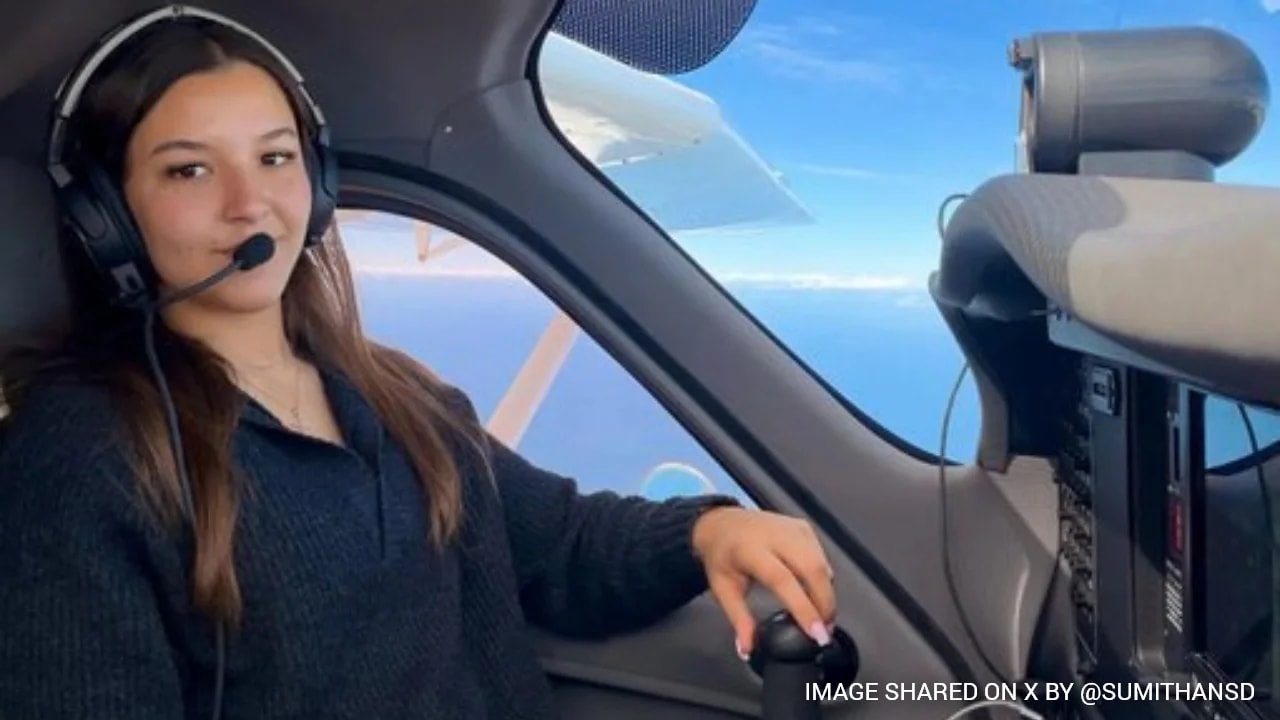
A 20-year-old co-pilot was at the controls of a twin-engine Learjet when it lost power and crashed on a Florida highway, killing two people. That single biographical detail—the age of the second-in-command—has sparked intense scrutiny across the private aviation sector. Federal regulations legally permit a 20-year-old with a commercial pilot certificate to occupy the right seat of a high-performance business jet under Part 135 charter rules, exposing a stark regulatory gap between commercial airlines and on-demand private charters.
The crash unfolded in seconds. Approaching Naples Municipal Airport, the Bombardier Challenger and Learjet series aircraft—known throughout aviation for demanding energy management and high approach speeds—suffered a catastrophic dual-engine failure. Audio from air traffic control captured the young co-pilot’s calm, clipped transmission declaring an emergency and warning controllers they would not make the runway. Moments later, the aircraft slammed into Interstate 75, colliding with vehicles and erupting into flames. Both pilots died, while three passengers managed to escape the burning fuselage. Recently making waves lately: Inside the Final Seconds of the Scottsdale Learjet Crash.
Public shock has centered almost entirely on the co-pilot's youth. To the average traveler, handing the yoke of a multi-million-dollar jet traveling at 500 miles per hour to someone who cannot legally buy a beer in the United States feels reckless. Yet within the mechanics of Federal Aviation Administration regulations, this arrangement is entirely routine.
The Two-Tier System of American Skies
To understand how a 20-year-old ends up flying a Learjet into a busy Florida airport, you have to look at the bifurcated structure of U.S. aviation law. Commercial airliners operate under Federal Aviation Regulation Part 121. Following the 2009 Colgan Air crash near Buffalo, New York, Congress overhauled Part 121 requirements. Today, anyone sitting in the cockpit of a major or regional airline must hold an Airline Transport Pilot (ATP) certificate. Getting an ATP requires a minimum age of 23—or 21 for military pilots and certain collegiate aviation graduates—along with 1,500 hours of total flight time. More details regarding the matter are covered by Reuters.
Private charters, corporate flight departments, and air ambulances play by completely different rules. Most on-demand charter operations fall under Part 135. Under Part 135, the captain—the Pilot in Command (PIC)—must hold an ATP certificate for turbojet operations. The co-pilot, officially designated as the Second in Command (SIC), faces a dramatically lower bar.
An SIC on a Part 135 charter jet needs only a Commercial Pilot Certificate and an instrument rating. The minimum age for a commercial certificate is 18. The minimum flight time is just 250 hours. In theory, a teenager who spent six months at an accelerated flight school flying single-engine Cessna 172s can legally transition straight into the right seat of a swept-wing business jet.
Insurance companies usually prevent teenagers from actually landing those jobs. Underwriters demand higher hour thresholds before they will cover a pilot on a turbine policy. However, as the industry has strained under a severe pilot shortage over the past several years, those insurance minimums have softened. Operators desperate to keep jets moving have aggressively recruited younger, lower-time aviators to fill right seats, using the promise of multi-engine turbine time as bait.
Why the Learjet Demands Respect
Not all jets forgive mistakes equally. The Learjet family, originally designed in the 1960s by Bill Lear, earned a legendary reputation for speed, climb performance, and razor-sharp handling. It is a pilot's airplane. It is also an aircraft with thin, high-speed wings that require precise airspeed control and vigilant fuel management.
Unlike modern fly-by-wire airliners equipped with envelope protection systems that prevent a pilot from stalling or overstressing the airframe, older Learjets rely on direct mechanical linkages and hydraulic boosts. If both engines flame out simultaneously, the margin for error vanishes.
Consider a hypothetical emergency scenario at 3,000 feet on final approach. At that altitude, a dual-engine flameout leaves a crew with roughly two to three minutes of gliding time before impact. In a swept-wing business jet, losing thrust causes airspeed to bleed off rapidly if the nose is not lowered immediately to maintain glide speed. The pilots must instantly run memory items—attempting an airstart, verifying fuel crossfeed valves, deploying emergency power systems—while simultaneously identifying a forced landing site and communicating with air traffic control.
Workload saturation happens fast. In a two-pilot cockpit, survival depends on seamless Crew Resource Management (CRM). The captain flies the airplane and makes command decisions; the co-pilot handles radios, runs checklists, and backs up the captain's airspeed and altitude calls. When an emergency strikes at low altitude, there is no time for coaching. Both pilots must operate at peak proficiency from the first second.
The Experience Trap in Charter Aviation
Critics of the current Part 135 framework argue that putting a 250-hour or 500-hour pilot in that environment compromises safety. Defenders of the system counter that the right seat of a corporate jet is the traditional apprenticeship model of aviation. For decades, young pilots built their careers by flying alongside seasoned captains, absorbing real-world weather decisions and mechanical troubleshooting before ever taking command themselves.
Both arguments carry weight, yet both ignore a fundamental shift in how charter companies operate today.
Decades ago, a young co-pilot might fly 300 hours a year for a single corporate owner, operating out of familiar airports with predictable schedules. Today's on-demand charter market operates like an airborne rideshare network. Pilots fly grueling schedules into unfamiliar, high-density airports like Naples, Teterboro, or Aspen. They deal with tight turnarounds, demanding clientele, and dynamic weather systems.
Furthermore, the captains sitting in the left seat are often less experienced than they used to be. Because major airlines have spent the last decade poaching experienced pilots from the charter and regional ranks, the natural mentorship pipeline has fractured. A 20-year-old co-pilot might be paired not with a retired airline veteran who has 20,000 hours in type, but with a 26-year-old captain who upgraded as soon as they hit the legal minimums.
When two relatively low-time pilots share a cockpit during a catastrophic failure, institutional memory is absent. Neither pilot has likely seen a real dual-engine failure outside of a simulator, and simulator sessions for Part 135 operators—while rigorous—cannot fully replicate the physiological shock of sudden silence at 2,000 feet over a populated coastline.
What the Cockpit Voice Recorder Will Reveal
Federal investigators from the National Transportation Safety Board (NTSB) face a complex task in reconstructing the final minutes of the Florida flight. Surviving passengers reported hearing a loud noise before the engines lost power, pointing toward a mechanical failure, bird strike, or fuel starvation issue rather than simple pilot error.
The co-pilot’s final radio transmission has already drawn praise from veteran aviators. His voice remained steady. He delivered critical information—they had lost both engines and were not going to reach the runway—without panic. That composure suggests his basic training held up under extreme stress.
Yet the investigation will look far beyond that single radio call. The NTSB will examine the cockpit voice recorder to analyze the crew's interaction in the minutes leading up to the emergency. Did they catch early warning signs on the engine instruments? Did they execute the dual-engine failure checklist in the correct order? Did the co-pilot's relative youth play any role in how the crew managed the glide profile, or did they execute a textbook forced landing onto the widest stretch of pavement available, saving the lives of their passengers in the process?
These questions cut to the core of aviation safety policy. If a 20-year-old pilot performed well under impossible conditions, blanket age restrictions miss the real problem. Conversely, if investigators find that a lack of experience slowed down emergency troubleshooting, the FAA will face renewed pressure to align Part 135 co-pilot standards with airline rules.
The Economics Behind the Right Seat
Any serious look at why young pilots are flying high-performance jets must follow the money. Private aviation exploded in popularity following the global travel disruptions of 2020. Wealthy individuals and corporations flocked to private charters, driving record demand for aircraft and crews.
At the same time, major airlines embarked on the largest hiring wave in aviation history to replace retiring baby boomers. Regional airlines doubled and tripled pilot pay to stem the bleeding, pulling talent away from flight schools and charter operators.
Charter companies found themselves squeezed. They could not match the compensation packages or predictable schedules of Delta, United, or American Airlines. To keep planes in the air, operators had to look further down the experience ladder. Flight instructors who had barely accumulated enough hours to meet minimum insurance requirements suddenly found themselves offered right-seat positions in Learjets, Citations, and Hawkers.
For a 20-year-old pilot drowning in $100,000 of flight training debt, turning down a jet job is unthinkable. Logging multi-engine turbine time is the golden ticket to an airline interview. The incentive structure rewards rapid advancement over slow, methodical skill accumulation.
Regulators Lag Behind Market Reality
The FAA moves slowly by design, often requiring years of rulemaking and industry comment before changing certification standards. Meanwhile, the business aviation market evolves in real time.
Following the 2009 Colgan Air crash, regulators fixed the airline sector by erecting the 1,500-hour wall. That rule successfully raised the experience floor for Part 121 carriers, contributing to an extraordinary stretch of commercial airline safety in the United States. However, unintended consequences rippled outward. By making it harder to enter the airline sector, the rule inadvertently created a holding pattern in Part 135 charter operations, concentrating the youngest, least experienced pilots in smaller, high-performance jets that often fly into airports with shorter runways and fewer ground support services than major hubs.
Passengers paying tens of thousands of dollars for a private charter rarely ask about the flight hours of their crew. They assume that high ticket prices automatically buy top-tier experience. In reality, a passenger boarding a major commercial airliner is guaranteed to have two pilots with at least 1,500 hours of experience and full ATP credentials, whereas a passenger boarding a private Learjet might be flying with a co-pilot who was in high school two years ago.
Until regulators, insurers, and charter operators reconcile the gap between legal minimums and operational reality, the right seat of America's business jets will remain a proving ground where twenty-year-olds learn to manage emergencies in real time.