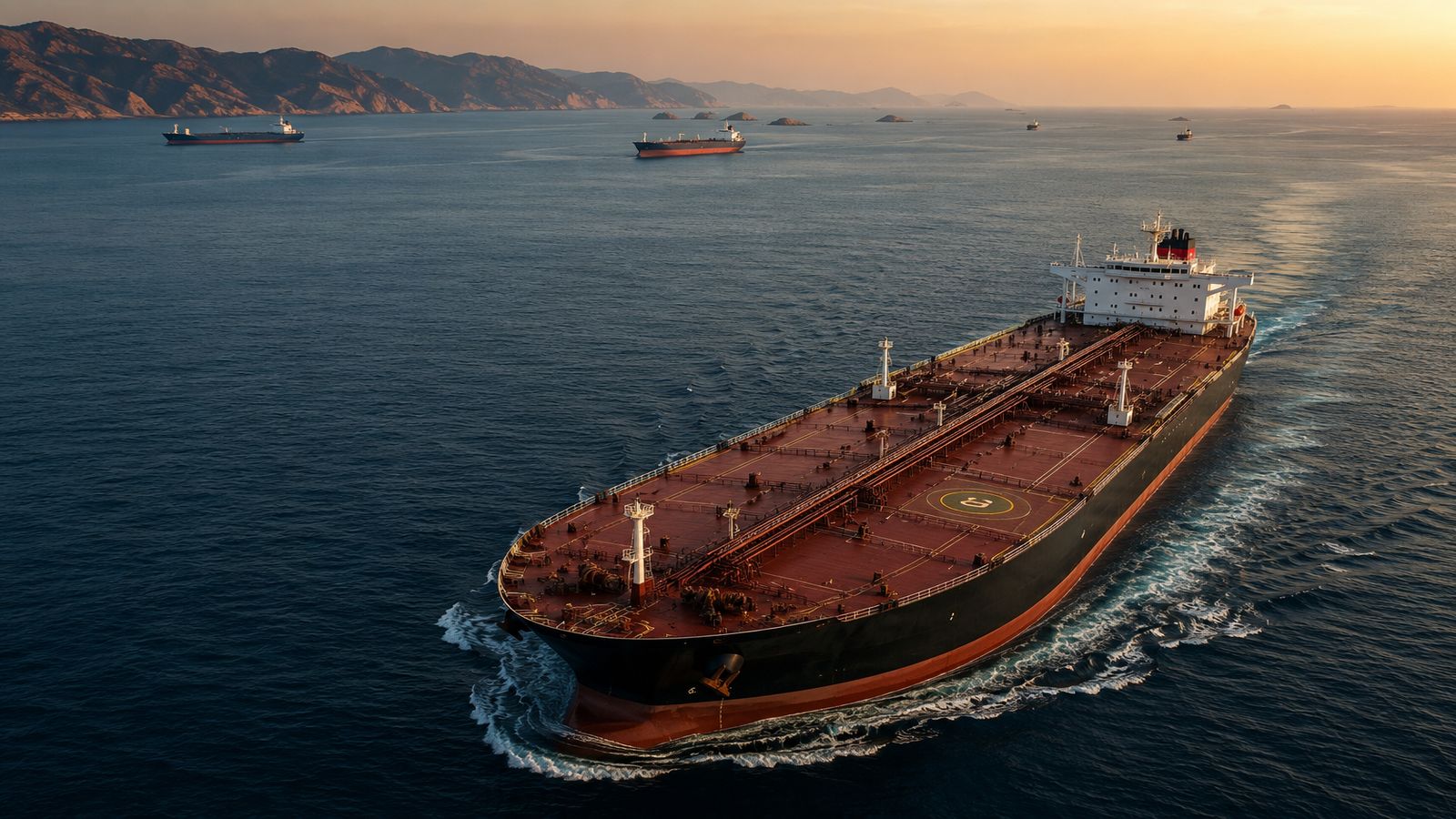
The steel underfoot vibrates with a low, rhythmic hum that feels less like mechanical power and more like a collective heartbeat. Under the blinding glare of the mid-afternoon sun, the water changes color. It shifts from the deep, reassuring blue of the open ocean to a murky, pale green.
This is the Strait of Hormuz.
For Captain Marcus Vance—a hypothetical composite of the dozens of merchant mariners who navigate these waters every week—this stretch of water is not a geopolitical talking point. It is a tightrope. At its narrowest, the shipping lanes are only two miles wide in either direction, separated by a thin, two-mile buffer zone. To his left lies the rugged, mountainous coast of Oman. To his right, the jagged cliffs of Iran.
Between them lies the throat of the global economy.
If you bought gasoline this morning, purchased a plastic toy, or ate fruit flown across an ocean, you are tied to this strip of water. More than a fifth of the world’s petroleum liquid passes through this narrow corridor. It is a fragile geographic bottleneck where global stability is constantly weighed against regional ambition. Recently, the United Nations issued a stark warning to the international community: nations must collectively reject Iranian attempts to exert control over this international waterway.
But to understand why the UN is raising the alarm, one must step off the diplomatic floor in New York and onto the bridge of a 150,000-ton supertanker.
The Mirage of Sovereignty
From the bridge windows, the sea looks infinite, but the radar screen tells a different story. It shows a crowded highway squeezed into a funnel.
For decades, international law has treated the Strait of Hormuz as an international highway. Under the United Nations Convention on the Law of the Sea, ships possess the right of "transit passage." This means that even though the shipping lanes run through the territorial waters of Oman and Iran, foreign vessels have the right to pass through quickly and without obstruction, provided they do not threaten the coastal states.
Iran sees it differently.
Tehran has long viewed the strait not as a shared global artery, but as a national moat. Over the years, the Iranian Revolutionary Guard Corps has used a strategy of asymmetric intimidation. They do not employ massive battleships. Instead, they utilize swarms of fast-attack craft, armed drones, and sea mines.
Consider what happens when theory meets reality. A commercial vessel, flying the flag of a neutral nation, is suddenly flanked by high-speed speedboats filled with armed men. The radio crackles. A voice demands that the captain alter course into Iranian waters. If the captain complies, the ship is seized, the crew is detained, and the global supply chain fractures just a little bit more. If the captain refuses, they risk an armed escalation in a corridor with zero room for error.
This is not a hypothetical risk. It has happened repeatedly. Tankers have been limpet-mined, boarded by commandos dropping from helicopters, and held for months as diplomatic bargaining chips.
The UN’s recent declaration is a direct response to this creeping normalization of lawlessness. When a single state attempts to dictate who can pass through an international strait, the entire foundation of maritime law begins to erode.
The Ripple in the Local Pond
It is easy to view these events as distant friction, a game of chess played by politicians in distant capitals. But the architecture of modern life is built on predictability.
When a tanker is delayed or seized in the Gulf, the reaction is instantaneous. Insurance companies immediately spike their premiums for vessels operating in the region. Shipping companies pass those costs down the line. Oil traders panic, bidding up the price of crude on the commodity markets.
The real problem lies elsewhere, far from the warm waters of the Middle East.
Days later, a truck driver in Ohio notices the price per gallon has jumped twenty cents. A manufacturing plant in Germany scales back production because the cost of petrochemical raw materials has become too volatile. A family in an emerging economy finds that the cost of transporting basic food staples has suddenly outpaced their weekly budget.
The Strait of Hormuz functions as a economic transformer. A spark of tension there amplifies into an economic shockwave felt across the globe.
This is why the UN is urging global unanimity. If nations look the away when a competitor tries to restrict access to the strait, they are effectively handing over the keys to their own economic security. It creates a precedent where might makes right at sea.
The Strategy of the Swarm
Naval strategists often talk about sea control, but Iran’s doctrine is about sea denial.
They recognize that they cannot match the conventional naval power of the United States or its allies in a ship-for-ship confrontation. Therefore, they have turned the geography of the strait into a weapon. The narrow channels mean that large, sophisticated warships have limited maneuverability. They are vulnerable to cheap, mass-produced technologies.
A swarm of twenty fast-boats, each carrying anti-ship missiles or packed with explosives, can overwhelm the defense systems of a modern destroyer. It is the maritime equivalent of death by a thousand cuts. By keeping this threat constantly active, Iran maintains a psychological stranglehold on global commerce.
The UN’s call to action is a recognition that no single country can counter this threat alone. Security in the strait requires a shared commitment. It demands coordinated maritime patrols, shared intelligence, and a unified diplomatic front that makes the cost of disrupting commerce unacceptably high for Tehran.
When nations fracture or seek bilateral deals with Iran to protect only their own shipping, they weaken the collective defense. They reward the behavior that threatens everyone.
The Human Cost on the Water
Behind the talk of barrels per day and strategic choke points are the people who actually move the world.
The crews on these merchant vessels are often from developing nations—Filipino deckhands, Indian engineers, Ukrainian officers. They are not combatants. They do not wear uniforms. Yet, they find themselves on the front lines of a shadow war.
Imagine standing watch at three in the morning. The night is pitch black, the humidity is oppressive, and you know that beneath the surface of the water could be unmapped mines. You know that at any moment, a fast-boat could emerge from the darkness without lights. The stress is silent, constant, and exhausting.
When a ship is seized, these sailors become hostages. They are caught in a geopolitical vice, separated from their families for months while governments argue over maritime boundaries and sanctions.
The international community's failure to secure these waters is, fundamentally, a failure to protect these workers. Freedom of navigation is not an abstract legal philosophy. It is a safety guarantee for the people who keep the lights on across the globe.
The afternoon wanes on the bridge of the supertanker. The jagged shadow of the Iranian coastline stretches further across the water, reaching toward the shipping lane. Captain Vance watches the radar, his hand resting near the radio. A gray naval vessel from an international coalition sits a few miles away, a silent sentinel on the horizon.
For today, the passage is peaceful. The ship moves through the bottleneck and out into the wide expanse of the Arabian Sea. But the tension does not dissipate; it merely waits for the next transit, the next provocation, the next test of global resolve. The twenty-one miles remain, quietly anchoring the fate of nations to the volatile currents of a single strait.