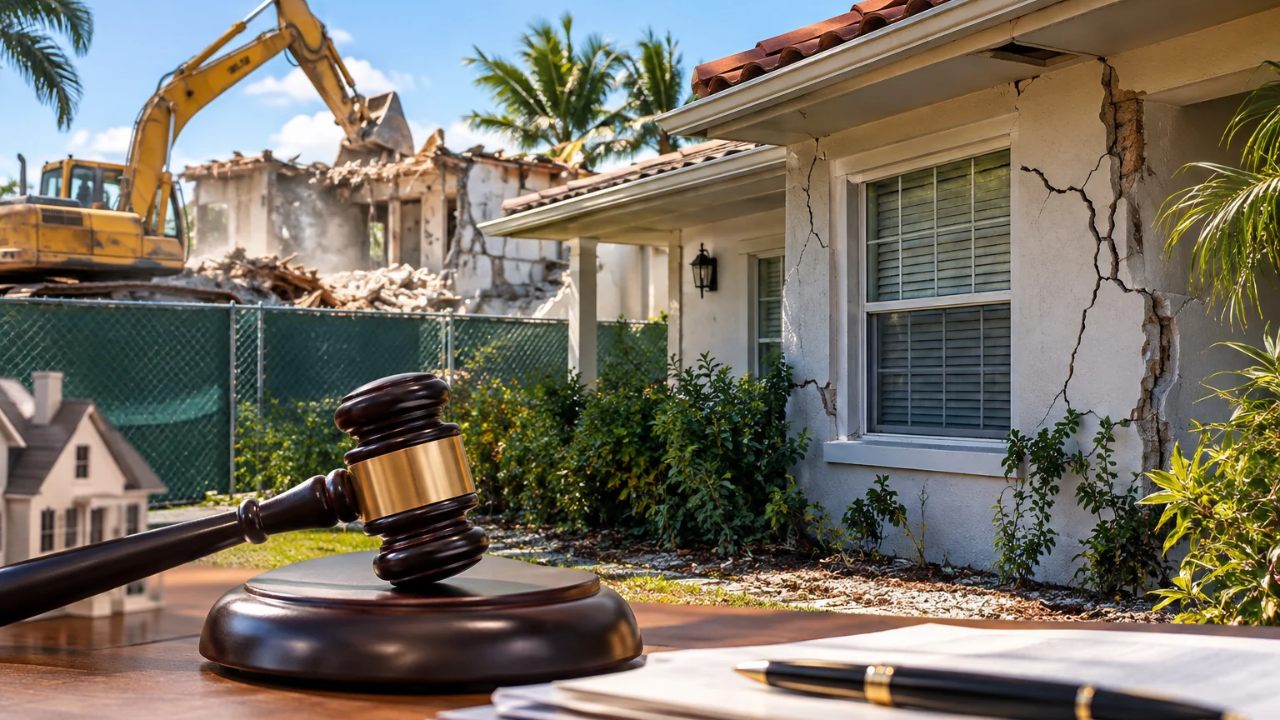
A Florida appellate court has officially upheld a $240,000 insurance victory for a Miami homeowner whose property suffered severe structural damage during a neighboring demolition in 2014, closing the door on a twelve-year legal siege. The ruling confirms that insurers cannot use vague policy exclusions to dodge payouts when adjacent construction shocks a residential foundation. For over a decade, the carrier fought every single step of the claim, turning a straightforward property loss into a grueling war of attrition. This decision sends a sharp warning across the Sunshine State's notoriously volatile property insurance market.
Twelve years is a lifetime in real estate. Think about what happens to a house in South Florida when structural cracks go unaddressed through twelve hurricane seasons, twelve summers of relentless humidity, and twelve years of shifting subtropical soil. A minor fissure becomes a gaping structural liability. Water intrudes. Mold colonizes the drywall. Yet, from 2014 until now, the policyholder sat in legal limbo while attorneys billed thousands of hours debating the semantics of earth movement and vibrations.
To understand why a carrier would spend twelve years fighting a $240,000 claim—often spending more on legal defense than the face value of the payout itself—you have to look at the mechanics of modern property insurance litigation. It is rarely about the individual house. It is almost always about precedent.
The Anatomy of the 2014 Miami Demolition Dispute
When heavy machinery rolls onto an urban lot in Miami to tear down an aging structure, the physics are violent. Excavators drop concrete slabs. Vibratory rollers compact the earth. Shockwaves travel outward through the porous limestone and sandy soil that underpin Miami-Dade County. When a neighboring house shakes, plaster cracks, foundations settle unevenly, and load-bearing walls shift out of plumb.
In 2014, that exact scenario played out for a Miami homeowner. The damage was immediate and undeniable. Naturally, she turned to her homeowners insurance policy, expecting the coverage she had paid for to make her whole. Instead, she hit a brick wall.
The insurer denied the claim, triggering a multi-year legal battle that wound its way through Miami-Dade circuit courts and eventually landed before Florida's appellate judges. The core of the dispute boiled down to how standard all-risk policies treat external, man-made forces. Under an all-risk policy, everything is covered unless it is specifically excluded. The burden falls squarely on the insurance company to prove that an exclusion applies.
Carriers routinely reach for two specific weapons in these scenarios:
- The Earth Movement Exclusion originally drafted to protect insurers from catastrophic, uninsurable earthquakes and landslides.
- The Settling and Cracking Exclusion intended to prevent homeowners from filing claims for normal, gradual wear and tear as a house ages.
Insurers have spent decades trying to stretch these clauses to cover man-made vibrations from nearby construction, blasting, or demolition. If a court buys that argument, the carrier walks away without paying a dime, leaving the homeowner to chase down a fly-by-night demolition subcontractor who might have already dissolved their LLC. By upholding the $240,000 award, the Florida appellate court rejected that expansion, keeping the financial responsibility where the policy language actually placed it.
Why Insurers Burn Millions to Fight Modest Claims
On the surface, the math makes zero sense. Litigating a complex property damage case through discovery, expert depositions, jury trial, and appellate review easily costs an insurance carrier between $150,000 and $350,000 in legal fees and engineering consultants. Why spend $300,000 to avoid paying $240,000?
The answer lies in claims suppression economics.
Insurance companies operate on massive scale. If a carrier concedes a gray-area claim quickly, word spreads among public adjusters and plaintiff attorneys. Suddenly, every homeowner living next to a new condo development in Brickell or Wynwood files a similar vibration claim. By fighting a single $240,000 claim for twelve years, the insurer sends a chilling message to thousands of other policyholders and their lawyers. The message is simple: Even if you are right, you will not see a dime until the next decade.
Most policyholders cannot survive that timeline. They have mortgages to pay, families to house, and contractors demanding cash upfront. Faced with a twelve-year wait, nine out of ten homeowners will accept a pennies-on-the-dollar nuisance settlement just to patch the roof and move on with their lives. The carrier loses the battle in court twelve years later, sure, but they win the broader financial war by exhausting everyone else into submission.
The Battle of the Forensic Engineers
In demolition and vibration cases, the courtroom becomes a theater of competing physics. Neither side relies on a standard neighborhood contractor. Instead, they deploy armies of forensic engineers who charge $500 an hour to inspect hairline fractures with magnifying glasses and seismographs.
The policyholder's engineer will measure the width of the cracks, map their diagonal trajectories across load-bearing masonry, and correlate the structural failure with the exact dates of the neighboring demolition. They demonstrate how sudden, high-frequency ground vibrations exceed the structural tolerance of residential stucco and concrete block.
The insurer's engineer will look at the exact same crack and tell a completely different story. They will blame differential settlement caused by poor drainage, thermal expansion from the Florida sun, or pre-existing construction defects from decades earlier. Because concrete naturally shrinks and cracks over time, the defense always has a plausible alternative theory to dangle in front of a jury. Overcoming that manufactured doubt requires relentless, expensive expert testimony—something only the most stubborn or well-represented plaintiffs can afford to fund.
The Shifting Sands of Florida Property Law
While this Miami homeowner finally secured her victory, the legal ground beneath Florida policyholders has shifted dramatically since her home was damaged in 2014. If the exact same demolition happened today, her path to a $240,000 payout would look entirely different—and significantly harder.
Between 2022 and 2023, the Florida Legislature passed sweeping tort reform and property insurance overhauls designed to rescue a collapsing market. Carriers were fleeing the state, insolvencies were piling up, and premiums were skyrocketing. Lawmakers sided heavily with the industry, dismantling several long-standing consumer protections that made twelve-year fights like this Miami case financially viable for plaintiff attorneys.
The single biggest change was the elimination of one-way attorney fees in property insurance lawsuits. Under the old law—the law that governed the 2014 Miami claim—if a homeowner sued their insurer and won even one dollar more than the carrier's pre-suit offer, the insurance company had to pay the homeowner's legal bills. That statute was the great equalizer. It allowed a regular Miami resident to hire top-tier trial lawyers without paying hourly retainers out of pocket, knowing the carrier would foot the bill if the denial was wrongful.
Today, that statutory safety net is gone. Under current Florida law, homeowners generally have to pay their own legal fees, often through contingency agreements that eat up 30% to 40% of their repair money.
Consider the brutal math of that change for a hypothetical homeowner facing a $100,000 demolition damage claim today. If they hire a lawyer on a standard contingency fee and win the full $100,000 after years of litigation, the lawyer takes $35,000 to $40,000. The homeowner is left with $60,000 to fix $100,000 worth of structural damage. They win the lawsuit, yet they still cannot afford to fix their house.
The Appraisal Trap and Bad Faith Hurdles
Beyond attorney fees, insurers have tightened their policy language to keep disputes out of public courtrooms entirely. Many modern policies now contain mandatory appraisal clauses or binding arbitration agreements. While appraisal is marketed as a faster, cheaper way to resolve pricing disputes, it is useless when an insurer denies coverage outright—as they did in the 2014 Miami case. Appraisers can decide how much a broken wall costs to fix, but they cannot decide whether the policy covers the break in the first place. That remains a legal question for judges.
Furthermore, holding an insurer accountable for dragging their feet has become vastly more difficult. Florida lawmakers raised the bar for bad faith lawsuits, ruling that an insurer's breach of contract alone is no longer enough to prove bad faith. Even if a carrier's initial denial was wrong, as long as they pay the eventual judgment or appraisal award within a set window, they are largely shielded from punitive damages. The financial penalty for delaying a valid claim for years has been effectively neutered.
What This Means for Urban Homeowners Near Construction
South Florida is in the middle of a relentless densification boom. Single-family neighborhoods from Little River to Coconut Grove are being bought up, scraped clean, and replaced with multi-story luxury townhomes and boutique condos. Heavy demolition is no longer restricted to commercial corridors; it is happening ten feet away from residential bedrooms.
If you own a home next to an active teardown or excavation site, relying solely on your homeowners policy after the damage occurs is a massive gamble. Even with the Miami appellate ruling establishing favorable precedent on policy exclusions, winning a twelve-year fight is a pyrrhic victory for most families. You have to build an ironclad evidentiary record before the first excavator bucket hits the ground.
- Commission a pre-construction condition survey. Hire a licensed structural engineer or a certified home inspector to photograph and document every wall, ceiling, foundation slab, and driveway prior to the start of neighboring work. Without timestamped proof that your walls were intact on Monday, you will spend ten years arguing about whether the cracks appeared on Tuesday.
- Demand the contractor's Certificate of Insurance. Before demolition begins, request proof of general liability coverage directly from the developer or demolition company. While going through your own insurer is usually faster under first-party coverage, having the third-party contractor's policy details gives your legal team an immediate secondary target.
- Install vibration monitors if the project is massive. For major adjacent excavations, property owners can legally request—or independently pay for—seismograph monitoring along the property line to record exact peak particle velocity levels. Hard data kills an insurer's "normal settling" defense on day one.
- Read the earth movement endorsements carefully. When renewing a policy, look specifically at how the carrier defines earth movement. Some surplus lines carriers have rewritten their forms to explicitly exclude "man-made vibrations, blasting, or adjacent excavation," closing the exact loophole that allowed the Miami homeowner to prevail.
The appellate court's decision in Miami is a rare triumph for an individual homeowner against a massive corporate apparatus. She stood her ground, weathered twelve years of legal warfare, and forced an insurer to honor the contract they wrote. Yet her victory exposes a broken mechanism at the heart of property insurance: a system where the promise of protection is only as good as your ability to survive a decade in court without your house falling down around you.