Silence.
That is the first thing survivors remember when dense fog swallows a highway, not the screech of locked brakes or the metallic shriek of crumpling steel, just a sudden, suffocating quiet where the horizon used to be. Meanwhile, you can find related stories here: Operating a Newsroom Under Fire The Structural Economics of The Kyiv Independent.
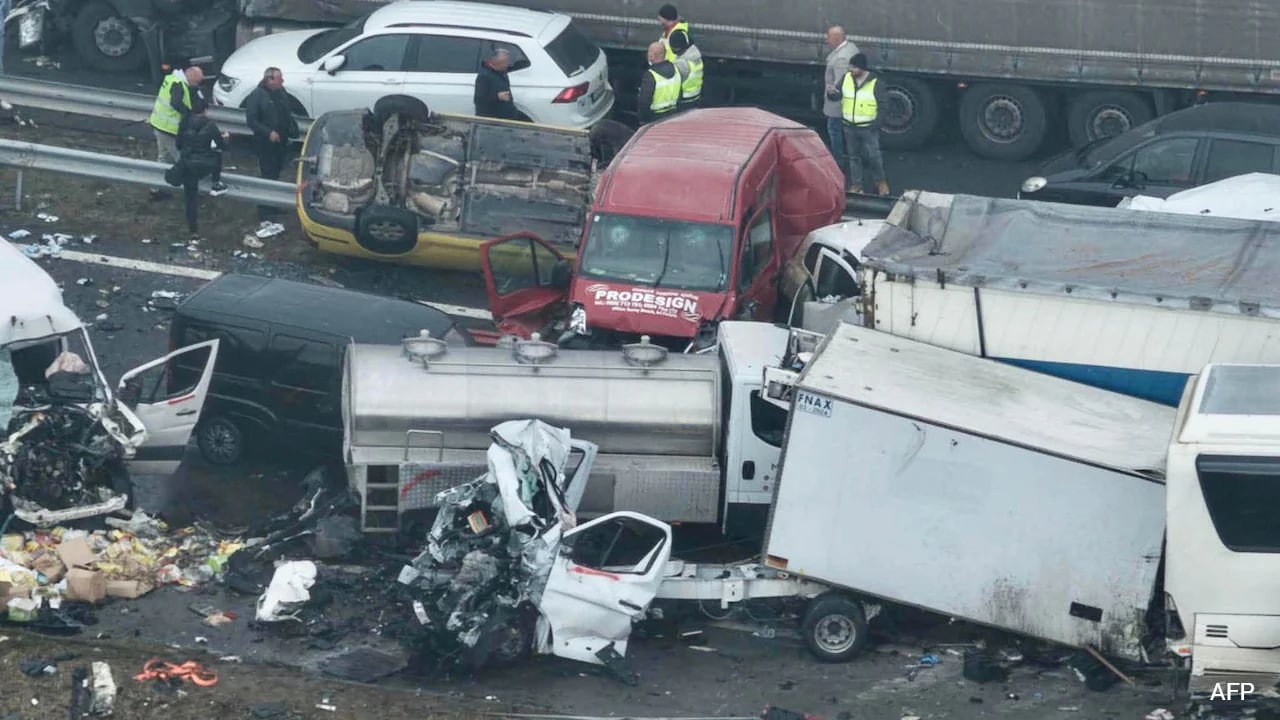
On a stretch of Bulgarian motorway where the asphalt usually hums with the steady pulse of commuters, freight haulers, and families heading home, visibility dropped from half a kilometer to the length of a car hood in the span of three heartbeats. By the time the grey curtain lifted, twelve people were dead, dozens more were trapped inside mangled cabins, and a routine morning commute had turned into one of the deadliest road tragedies in the country's recent memory.
The news tickers reduced it to a single, sterile headline. 12 Killed In Bulgaria Motorway Pile-Up Due To Fog. Twelve words. Twelve lives flattened into a weather report and a traffic statistic. To understand the full picture, we recommend the detailed report by NPR.
If you have ever driven through the valleys of the Balkans in late autumn or early winter, you know the feeling in the pit of your stomach when the road ahead simply disappears. Your knuckles whiten on the leather steering wheel. You lean forward an inch, as if pressing your nose closer to the windshield might somehow pierce the mist. You are no longer driving a vehicle; you are steering two tons of momentum into a blank white wall, trusting entirely that the person three seconds ahead of you hasn't already stopped.
The Anatomy of a Blind Trap
To understand how twelve people lose their lives in a single chain reaction, we have to look past the weather forecast and examine the physics of human hesitation.
Imagine, for a moment, a hypothetical driver named Petar—a composite of the hundreds of everyday motorists who use Bulgaria's main arterial highways every morning. Petar is driving at 110 kilometers per hour, well within the legal limit on a dry stretch of the Trakia or Hemus motorway. The radio is playing low. A lukewarm coffee sits in the console. Ahead of him, the road dips into a shallow river basin where cold night air has settled beneath a warmer layer above.
Meteorologists call this a radiation fog bank. Drivers call it a ghost wall.
Within two seconds, Petar's world shrinks to twenty meters of wet tarmac. His brain registers danger, and his foot lifts off the accelerator, hovering over the brake pedal. He does not slam the brakes immediately. Why? Because behind him, invisible in the rearview mirror, a forty-ton articulated lorry is barreling down the same lane at ninety kilometers per hour. Petar knows that stopping dead in a zero-visibility lane is a death sentence from behind. Keeping pace means flying blind into whatever lies ahead.
That is the cruelest trap on any modern highway.
At 100 kilometers per hour, a car covers nearly twenty-eight meters every single second. Human reaction time—the gap between the eye seeing a red taillight bloom in the mist and the foot actually depressing the brake hydraulic—averages 1.5 seconds under stress. Before Petar’s brake pads even touch the rotors, he has already traveled forty-two meters into the unknown. Add another fifty meters for wet asphalt stopping distance, and he needs nearly a hundred meters of clear sight just to avoid hitting a stationary object.
In thick Bulgarian valley fog, visibility frequently drops below fifteen meters. The math does not forgive.
When Steel Meets Inertia
In the real pile-up on the Bulgarian motorway, the first impact happened quietly, almost gently, before the dominoes began to fall. A lead vehicle slowed abruptly upon hitting the thickest pocket of vapor. The car behind clipped its rear bumper. Neither driver had time to deploy a warning triangle, and hazard lights—those tiny amber pulses designed for clear air—barely penetrated ten feet of dense water droplets.
Then came the heavy transport trucks.
Bulgaria sits at the crossroads of southeastern Europe, a vital transit corridor linking Central Europe, Greece, Turkey, and the Black Sea ports. Its motorways carry an immense volume of international freight alongside local passenger traffic. When a fully loaded semi-trailer enters a fog bank at highway speed, it carries kinetic energy comparable to a small locomotive. Even if the driver spots a twisted silhouette in the mist and stands on the air brakes, physics dictates that forty tons of cargo will keep sliding forward for the length of a football field.
Witnesses who managed to scramble over the steel guardrails and up the grassy embankments described a sound like distant thunder repeating every four or five seconds. Boom. Pause. Boom. Pause. Each thud meant another family sedan, another delivery van, another bus had driven blindly into the growing wall of wreckage.
First responders arriving from nearby municipalities faced an almost impossible rescue operation. Ambulances had to creep along the emergency shoulder at walking speed, guided by the glow of burning fuel and the cries of the injured echoing through the mist. Hydraulic rescue cutters—the heavy jaws used to peel back collapsed roofs—worked continuously for hours as paramedics triaged victims on the cold shoulder of the road.
Twelve people never made it out of the metal.
The Illusion of Safety Behind Modern Glass
We like to believe that modern cars make us invincible. We buy vehicles equipped with anti-lock brakes, electronic stability control, lane-keep assist, and crumple zones engineered by supercomputers. We sit inside climate-controlled cabins listening to podcasts, insulated from wind, cold, and noise.
That insulation breeds a dangerous amnesia.
I remember my own brush with a zero-visibility bank on a highway outside Sofia several years ago. The morning had started crisp and bright, the kind of clear Balkan sky that makes you feel invincible behind the wheel. Ten minutes later, crossing a low bridge over a river, the fog hit like a thrown blanket. My headlights bounced straight back off the mist in a blinding glare. Behind me, the headlights of a fast-approaching SUV grew from pinpricks to blinding suns in my mirror before swerving violently onto the gravel shoulder, missing my rear bumper by inches. My hands shook for an hour afterward. I had done nothing wrong, yet I had survived purely by chance.
Behavioral psychologists call this risk homeostasis—the tendency of human beings to adjust their behavior until the perceived level of risk feels comfortable, regardless of actual danger. When cars feel quiet, smooth, and planted, our brains underestimate our true velocity. Worse, when we see the faint red glow of a car ahead in the fog, we instinctively lock onto those taillights like a moth to a porch light.
Safety researchers call it the moth effect. Instead of slowing down and increasing following distance, drivers subconsciously speed up to keep the car ahead in sight, terrified of being alone in the white void. If that lead driver drifts off the road or slams into a stopped wreck, the follower drives straight into the exact same fate.
Why Bulgaria's Roads Bear a Heavy Toll
To understand why these disasters hit Bulgaria so hard, you have to look beyond a single morning's weather report. For years, Bulgaria has recorded one of the highest road fatality rates per capita in the European Union. While Western European nations steadily drove down highway deaths through aggressive automated enforcement, divided carriageways, and variable speed infrastructure, Bulgaria’s road network struggled under a combination of aging infrastructure, incomplete motorway stretches, and a driving culture that often treats speed limits as loose suggestions.
Consider what happens when rapid economic growth puts hundreds of thousands of faster, heavier vehicles onto roads that still lack basic smart-highway safeguards.
On modern stretches of the German Autobahn or northern Italian autostrade, entering a fog-prone valley triggers overhead digital gantries. Flashing amber strobes warn drivers miles before the mist begins, dropping legal speed limits dynamically from 130 down to 60 kilometers per hour, backed by automated speed cameras that enforce compliance without needing a patrol car parked in the fog. High-visibility road studs—embedded solar LEDs along the lane markings—outline the curvature of the tarmac even when headlights fail.
On many stretches of Bulgarian motorway, drivers still rely on painted white lines worn thin by winter snowplows and studded tires. Warning signs are static metal plates that tell you fog might occur in winter, a warning so constant that local drivers stop seeing it altogether. When the mist actually drops, there is no advance warning system telling traffic five kilometers back to slow to a crawl. By the time a driver sees the brake lights, they are already inside the kill zone.
The Rules That Actually Keep You Alive
Blaming the fog is easy. Fog cannot be prosecuted, fined, or voted out of office. Blaming bad luck is equally comforting, because it absolves the rest of us from changing how we drive tomorrow morning.
Yet survival in zero-visibility conditions is rarely a matter of luck. It comes down to breaking three deeply ingrained driving habits the exact second the horizon vanishes.
First, kill your high beams immediately. Every instinct tells you to turn on brighter lights when you cannot see. In dense fog, high beams are lethal. Millions of microscopic water droplets act like tiny mirrors, bouncing that intense white light straight back into your own eyes and creating an opaque wall of glare. Low beams angle downward toward the asphalt, cutting underneath the thickest vapor. If your car has dedicated rear fog lamps—that single, piercing red light built into the rear cluster—switch them on so trucks half a football field behind you can spot your silhouette before it is too late. Turn them off the moment the air clears, or you will blind the driver behind you.
Second, open the window and turn off the radio. When your eyes lose seventy percent of their range, your ears become your primary collision sensor. Rolling down the driver-side window even two inches lets you hear the rumble of heavy truck tires approaching from behind or the distant screech of metal ahead long before your eyes register a shape in the mist.
Third, accept the terror of slowing down—and get off the road if you can. If visibility drops below two car lengths, the highway is no longer safe at any speed. Do not stop in an active traffic lane, and do not park on the paved emergency shoulder with your lights on; panicked drivers behind you will follow your taillights straight off the road and ram you from behind. If you must pull over, get completely off the asphalt behind a concrete barrier, switch off your lights so nobody mistakes you for a moving vehicle, and get every single passenger out of the car and up the embankment away from the roadway.
Twelve Empty Chairs
Statistics have a way of numbing us. We read that twelve people died on a Bulgarian motorway, we shake our heads at the tragedy of it, and we scroll down to the next story before our morning coffee cools.
Twelve is not a rounding error. Twelve is twelve distinct universes erased in the time it takes to tie a shoelace. It is twelve front doors that will never unlock at six in the evening, twelve phones buzzing with unanswered text messages on the passenger seat, twelve families sitting around dinner tables staring at an empty chair that was occupied that very morning.
The fog over the Bulgarian valley burned off by mid-afternoon, leaving behind clear blue sky, scarred asphalt, and tow trucks hauling away twisted skeletons of steel. Tomorrow, the mist will form again over another river basin, along another highway, in front of another driver who thinks they have plenty of time to stop.
The white wall is always waiting. The only question is whether we will slow down before we hit it.