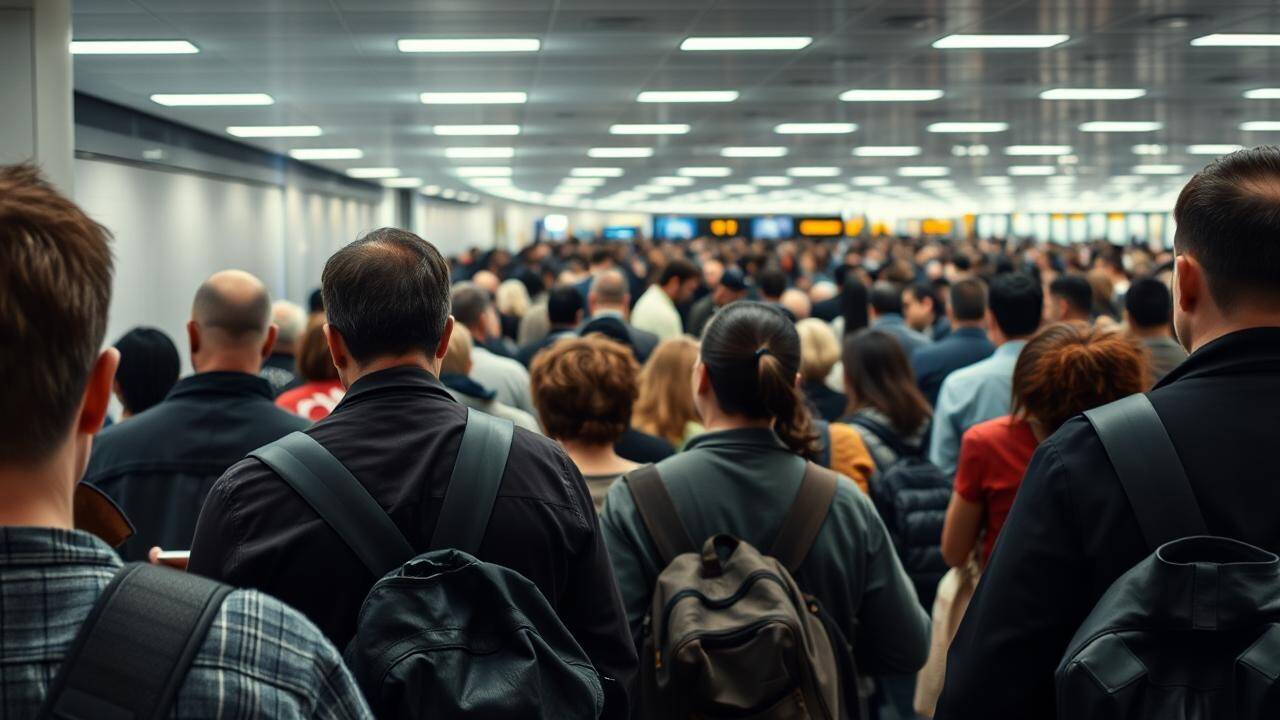
The American aviation system is currently operating on borrowed time and unpaid labor. As a partial government shutdown stretches into its third week, the visible symptoms—1,300 daily flight delays and security lines snaking through terminal parking garages—are merely the surface fractures of a much deeper structural failure. Travel chaos is no longer a looming threat; it is the current reality for millions of passengers. The Transportation Security Administration (TSA) is losing its workforce to financial exhaustion, leaving the nation’s checkpoints understaffed and the flying public vulnerable to both systemic delays and genuine security gaps.
While political figureheads exchange blame in televised briefings, the mechanics of the crisis are simple math. Federal screeners, many of whom live paycheck to paycheck, are being asked to perform high-stakes security work without compensation. They are calling out sick at record rates because they cannot afford the gas to get to work or the childcare required to stay there. This isn’t a labor strike in the traditional sense. It is a slow-motion collapse of the front line.
The Myth of the Seamless Safety Net
For years, the TSA has operated as a high-pressure environment with high turnover. The current shutdown has transformed that chronic stress into an acute emergency. When a major hub like Hartsfield-Jackson Atlanta International or Miami International reports two-hour wait times, the immediate reaction is to blame "call-outs." This framing suggests a lack of discipline among workers. The reality is far more pragmatic.
A TSA agent earning an entry-level salary is often one missed paycheck away from a housing crisis. When the federal government halts pay, these workers are forced to prioritize immediate survival. Some take temporary gig-economy jobs to cover rent. Others simply cannot justify the cost of the commute for a zero-dollar paystub. When 10% of the morning shift at a major airport fails to show up, the remaining staff must stretch to cover three times the usual volume of baggage and body scans.
Efficiency drops. Security fatigue sets in. In this environment, the "human factor"—the very thing meant to detect anomalies—becomes the weakest link. A tired, hungry, and stressed screener is statistically more likely to miss a prohibited item than one who is financially secure and alert. The crisis is not just about the length of the line; it is about the integrity of the sterile area beyond the metal detector.
Airlines and the Economic Aftershocks
The damage extends far beyond the airport terminal. Major carriers are watching their operational reliability disintegrate. A flight delayed by 45 minutes because 30 passengers were stuck in a security line doesn't just impact that single route. It creates a ripple effect that disrupts crew timing, gate availability, and connecting flights across the entire network.
The cost to the U.S. economy is measurable in the billions. Business travelers are canceling meetings. Tourism hubs are seeing a dip in last-minute bookings. Logistics companies that rely on belly cargo in passenger planes are facing unpredictable delivery windows. We are seeing a forced contraction of the aviation industry because the "public" part of the public-private partnership has ceased to function.
Airlines have tried to mitigate the damage by urging passengers to arrive three, four, even five hours before departure. This is a Band-Aid on a gunshot wound. It assumes the infrastructure can handle a massive surge of people sitting in the non-secure areas of the terminal for half a day. It leads to overcrowding in check-in halls, creating soft-target security risks that the TSA is simultaneously too understaffed to monitor effectively.
The Failure of Contingency Planning
There is a persistent belief that "essential" services are immune to the whims of a budget stalemate. This shutdown has proven that "essential" is a label, not a shield. The Department of Homeland Security (DHS) has few tools to compel work without pay indefinitely.
In past disruptions, there were whispers of bringing in private security contractors to fill the gaps. That is a fantasy. The certification process for a federal screener takes weeks of training and background checks. You cannot simply hire a private guard from a local mall and put them behind an X-ray machine. The specialized nature of the job means there is no "Plan B" when the federal workforce decides it has reached its limit.
The federal government is effectively cannibalizing its own security apparatus. By the time the shutdown ends, the TSA will likely face a mass exodus of its most experienced personnel. These people will not return to a job that treats their livelihood as a bargaining chip. The long-term cost of retraining thousands of new hires will far exceed any perceived savings from the current budget fight.
The Passenger Experience as a Warning
If you are standing in a two-hour line today, you are seeing the result of a system that values political leverage over operational stability. The frustration of the traveler is valid, but it is often directed at the wrong person. The agent at the podium is not the architect of the delay. They are the person who showed up despite being unable to pay their electric bill.
We are witnessing the degradation of the "PreCheck" promise. Travelers who paid for expedited screening are finding themselves in lines nearly as long as the general queue because the TSA is forced to consolidate lanes to manage staff shortages. When the premium product fails, consumer trust in the entire regulatory framework begins to erode.
The immediate fix is obvious: pass a standalone funding bill for transportation security. However, the political appetite for "clean" bills is non-existent in the current climate. This means the lines will get longer. More terminals will close. More flights will be grounded.
Operational Realities at the Gate
The logistics of a modern airport are tuned to the second. When the TSA throughput drops by even 15%, the gates become bottlenecks. Ground crews find themselves waiting for passengers who are still miles away, trapped in a sea of luggage and gray bins. Pilots, facing their own strict "timeout" regulations regarding how many hours they can be on duty, are often forced to walk away from a plane because the boarding process took too long.
This isn't a glitch. It is the system working exactly as it must when its primary input—labor—is removed.
Check your flight status four hours before you leave. If you are flying through a major hub like O’Hare, LAX, or LaGuardia, assume the worst-case scenario. The data shows that morning waves are currently the most affected, as call-outs are often reported last-minute, leaving supervisors scrambling to redistribute staff. If the trend of increased absences continues at its current 3% daily growth rate, we could see total terminal shutdowns in secondary markets within the next seven days.
The aviation industry is a clock. Right now, someone has stuck a crowbar in the gears. Until that bar is removed, no amount of "arriving early" will guarantee you make your flight.


