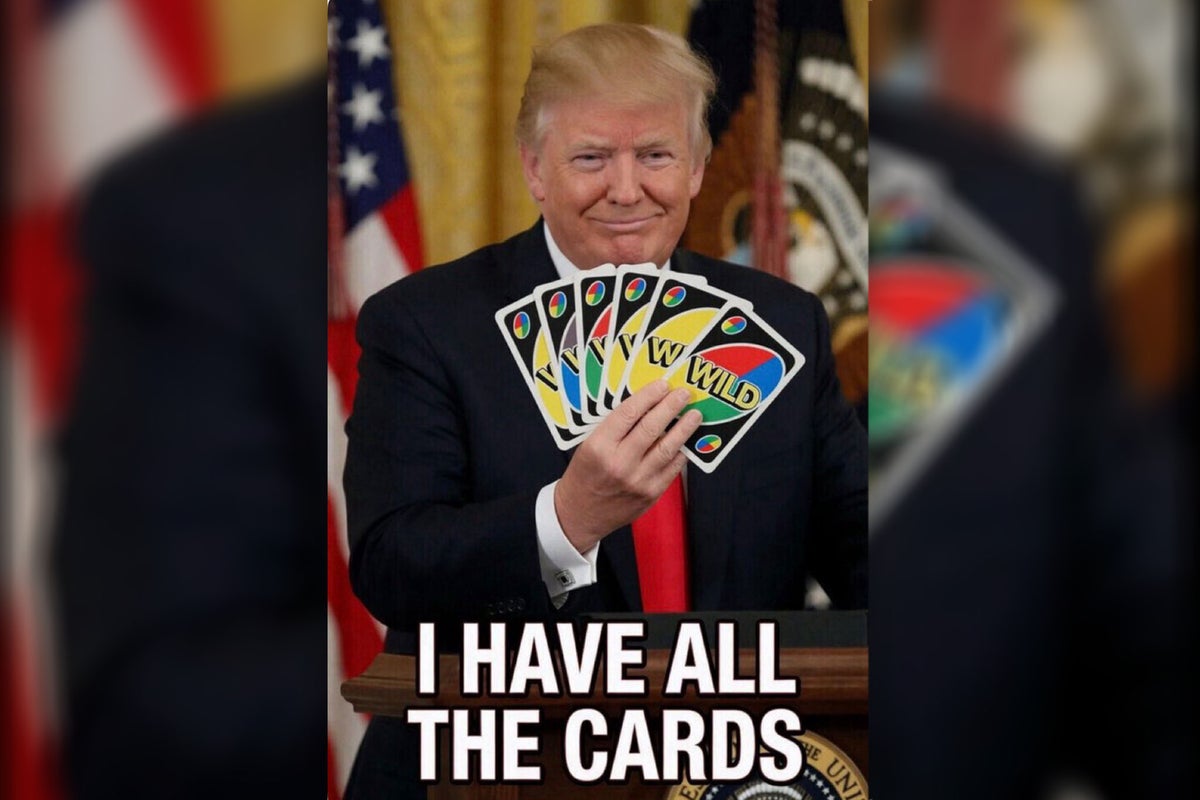
The internet is currently convulsing over a piece of "AI slop"—a hyper-saturated, surreal image of Donald Trump playing Uno, clutching a mountain of cards, and declaring victory while clearly violating every known rule of the game. The "lazy consensus" among the blue-check commentariat is predictable: "He doesn't even know how to play," "This is a metaphor for his incompetence," or "AI can’t even get a card game right."
They are all missing the point. Entirely.
What the critics see as a failure of logic is actually a triumph of memetic engineering. In the attention economy, being "right" about the rules of a Mattel card game is the consolation prize for losers. Being the center of a viral, nonsensical visual that commands millions of impressions is the only win that matters. This isn't about Uno. It’s about the total collapse of reality-based political discourse in favor of pure, uncut vibe-heavy content.
The Myth of the Hallucination
Software engineers and AI ethics "experts" love to talk about hallucinations as a bug. They see an AI-generated image of a politician with six fingers or a nonsensical hand of cards and they tut-tut about the lack of grounding.
I’ve spent a decade watching digital trends cannibalize traditional media. Here is the truth: For a meme to work, it must be slightly broken. Perfect logic is boring. It doesn't invite engagement. It doesn't provoke the "Um, actually" crowd to jump into the comments to correct the record.
When an AI generates Trump holding forty-five Uno cards and claiming he’s winning, it triggers a specific psychological response. Supporters see a defiant figure who makes his own rules. Detractors see a buffoon. Both sides share the image. The AI didn't "fail" to understand Uno; the AI successfully optimized for the only metric that matters: Velocity.
Data vs. Vibes
Critics point to the "slop" and claim it's a sign of a decaying internet. They’re right, but for the wrong reasons. The decay isn't technical. It’s a shift in how humans consume information.
We have moved past the era of the "Correct Take." We are now in the era of the "High-Energy Take." In a standard game of Uno, the goal is to get rid of your cards. In the logic of the Trump meme-sphere, the goal is to have everything. More cards, more rallies, more caps, more noise. The factual inaccuracy of the image isn't a flaw; it’s the feature that allows it to bypass the brain's logic centers and go straight to the lizard brain.
The Professionalization of Cringe
Modern political branding has realized that "cringe" is a more powerful weapon than "prestige." A polished, professionally shot campaign ad costs $500,000 and gets ignored by anyone under the age of 40. A piece of AI slop created by a teenager in a basement for zero dollars generates more conversation than a Super Bowl spot.
I’ve seen Fortune 500 companies blow millions trying to "humanize" their brand with sleek, logical content. It fails every time because it lacks the raw, chaotic energy of a nonsensical AI hallucination. The "Uno Rules" controversy is a distraction. While you’re busy explaining how a Draw Four works, the image has already reached ten million people who don't care about the rules.
The Death of the Fact-Check
Fact-checking a meme is like performing surgery on a shadow. You can’t kill it because it isn't "real" to begin with. The competitor article focuses on "shredding" the subject for not knowing the rules. This is a classic category error.
In the realm of symbolic politics, the rules are whatever the audience accepts. If the audience accepts a version of reality where holding the most cards means winning, then in that digital ecosystem, the rules of Uno have been rewritten.
The Mechanism of Engagement
- Incongruity: The image presents a known figure in an absurd situation.
- Error Trigger: The factual error (wrong rules) forces the viewer to react.
- Signal Boost: The reaction (mockery or defense) feeds the algorithm.
- Omnipresence: The subject remains the center of the universe.
Stop Trying to "Fix" AI Slop
The demand for "better" AI that understands the physics of cards or the anatomy of hands is a demand for a more boring world. The "slop" is the first truly native art form of the generative era. It is messy, illogical, and wildly effective.
If you’re a brand or a political strategist, and you’re still trying to be "correct," you’ve already lost. The winners are those who embrace the absurdity. They understand that in a world of infinite content, the only sin is being ignored.
The critics think they are winning because they know the rules of a children's game. The "slop" creators know they are winning because they own the critics' attention.
Burn the rulebook.
Buy more cards.