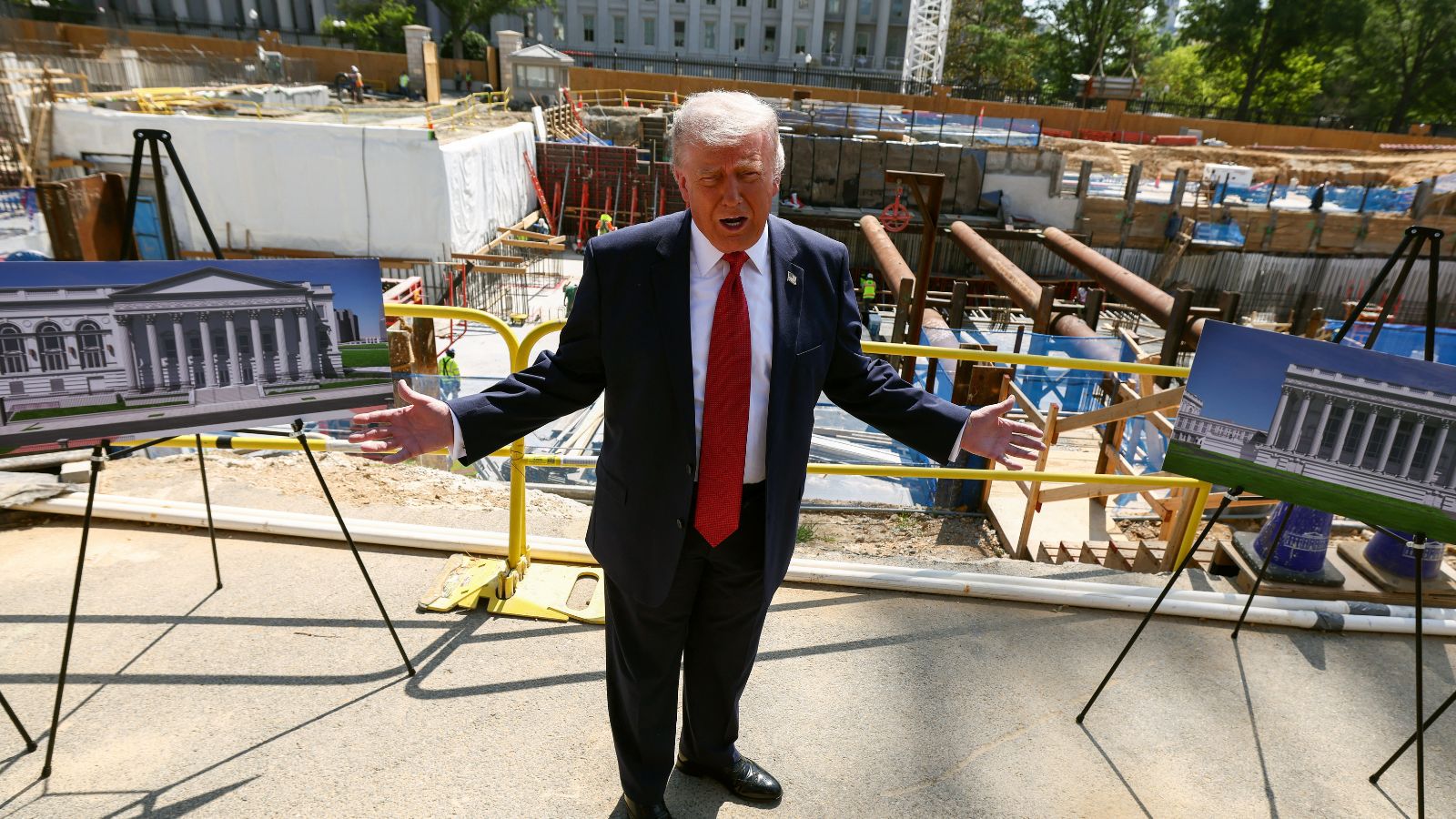
Every talking head on cable news is hyperventilating about the legal mechanics. They stare at filing deadlines, parse procedural briefs, and treat every executive branch real estate spat like a constitutional cliffhanger.
It is noise. Pure, unadulterated noise designed to keep your eyes fixed on the judicial circus while the actual architecture of power shifts right beneath your feet.
The lazy consensus in modern political commentary is that executive overreach lives or dies by judicial sanction. If a court blocks a renovation, a redesign, or a structural project on federal grounds, the narrative goes, the President hits a brick wall. The media treats the Supreme Court docket like an emergency brake on executive ambition.
That theory is dead wrong.
I have watched administrative compliance battles from the inside for over a decade. I have seen institutional budgets manipulated, federal procurement loopholes exploited, and historical preservation mandates bypassed by clever lawyers who treat court orders like speed bumps. Focusing on a Supreme Court appeal regarding a White House ballroom defeat is like arguing over who gets to rearrange the deck chairs while the hull is already holed.
The Myth of Judicial Handcuffs
Let us look at how federal property management actually operates. The statutory framework governing the White House and its immediate grounds is a tangled mess of the Presidential Records Act, the National Historic Preservation Act, and a labyrinth of General Services Administration oversight rules.
When a project hits a legal roadblock—whether it involves a ballroom, a fence line, or a West Wing addition—the standard media reaction assumes that a court ruling halts the momentum. It does not.
In practice, a temporary setback in the lower courts or an impending Supreme Court petition changes nothing about the underlying leverage dynamic. The executive branch does not need judicial permission to hoard authority; it simply waits out the administrative clock or re-routes funding through discretionary defense and maintenance line items that never hit the public radar.
Executive power is not measured by the square footage of approved construction. It is measured by the speed at which bureaucratic resistance can be starved of oxygen.
To understand why fighting over a ballroom in the highest court in the land is a structural miscalculation, you have to look past the headlines and examine how federal dollars flow when no one is watching.
Following the Money That Never Moves
The mainstream coverage treats the White House physical footprint as a static museum exhibit. That is a fundamental misunderstanding of the space. It is a command center disguised as a historical monument.
When a administration pushes for a major architectural addition, such as a large-scale reception hall or secure briefing facility, the opposition immediately weaponizes preservation laws. They file injunctions. They cry procedural foul. They run to sympathetic judges who are all too happy to issue temporary restraining orders.
Here is what the legal analysts miss: the real battle is never about the physical concrete or the marble pillars. It is about administrative endurance.
Imagine a scenario where an administration wants to bypass congressional sign-off entirely. They do not need a Supreme Court victory to do it. They simply reclassify maintenance funds, leverage emergency preparedness appropriations, or utilize private donor trusts that operate outside standard federal procurement audits.
The Supreme Court appeal is theater. It keeps the opposition lawyers busy filing briefs, drains political action funds on both sides, and gives pundits something to scream about during the evening broadcast. Meanwhile, the strategic objective—consolidating control over federal spaces and operationalizing executive infrastructure—proceeds through channels that require zero judicial validation.
The Flawed Premise of the Legal Check
Why do smart journalists keep falling for the judicial check-and-balance fairy tale? Because it provides a neat, narrative arc. Good guy files lawsuit. Bad guy loses in court. Rule of law prevails.
It is a comforting bedtime story. It is also completely divorced from political reality.
The executive branch possesses inherent structural advantages that no injunction can permanently neutralize. If a court blocks a specific blueprint, the administration alters the nomenclature. What was a "ballroom" becomes a "temporary national security briefing and hospitality annex." The structural requirements change on paper, the funding shifts to a different ledger, and the project moves forward under a different statutory justification.
By the time the Supreme Court agrees to hear arguments on the original dispute, the facts on the ground have already shifted. The legal question is moot, but the political point has been scored.
This is why treating a White House architectural defeat as a major constitutional crisis is a strategic error. It mistakes a tactical skirmish for a strategic defeat.
The Uncomfortable Truth About Executive Real Estate
Let us be completely candid about why physical spaces matter so much to modern presidencies. They are symbols of permanence. A President who can reshape the physical White House complex signals to allies and adversaries alike that they can bend the machinery of government to their personal will.
When opponents try to block these projects through the courts, they are attempting to assert legislative or judicial dominance over a space that the executive views as its private domain during its tenure.
The mistake critics make is thinking that winning a court battle stops the ambition. It only forces the ambition underground, where it becomes more creative, less transparent, and ultimately harder to monitor.
If you want to check executive overreach, focusing on courtroom victories over blueprints and ballrooms is a fool's errand. You have to cut off the discretionary funding streams and dismantle the procurement loopholes that allow administrations to self-fund their pet projects without oversight.
Until Congress and the courts change their focus from property law to purse strings, every Supreme Court appeal over a White House renovation is just background noise.
Stop watching the court docket. Start watching the ledgers.