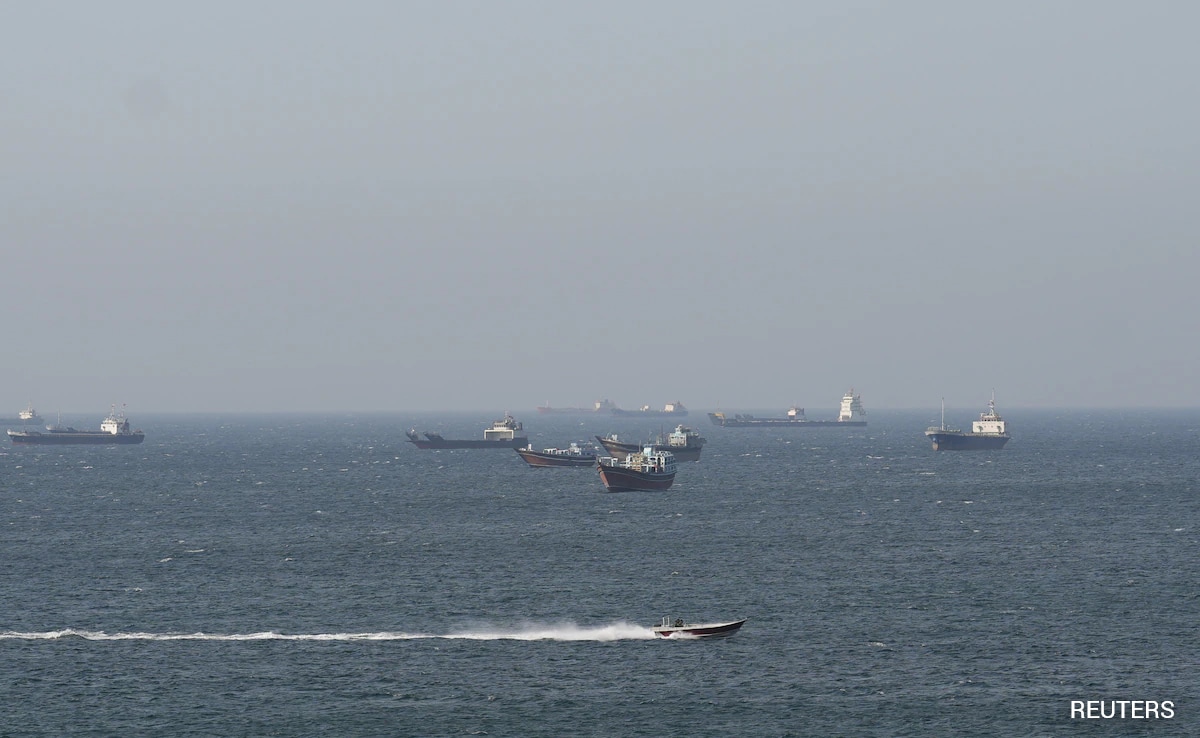
The Persian Gulf just witnessed one of the shortest military operations in modern history. President Trump ordered U.S. Navy warships to begin escorting commercial vessels through the Strait of Hormuz, only to pull the plug roughly twenty-four hours later. If you're looking for a clear, linear military strategy, you won't find it here. This was a classic high-stakes pivot that left allies confused and adversaries checking their radars.
The Strait of Hormuz is a narrow chokepoint. It's the world's most important oil artery. When the U.S. announces it's physically shielding tankers from Iranian interference, the global markets react instantly. When that protection vanishes a day later, the reaction is even more volatile. This wasn't a logistical failure or a mechanical breakdown. It was a calculated, albeit jarring, shift in executive intent.
The Reality of the One Day Operation
Operation Sentinel—or whatever the naming convention of the week happens to be—was supposed to be a show of force. The goal seemed simple on paper. The U.S. would provide a kinetic "tripwire" to prevent the Islamic Revolutionary Guard Corps (IRGC) from harassing or seizing tankers. We saw the destroyers move into position. We saw the flight decks buzz with activity.
Then, the orders changed.
The suspension of these escorts doesn't mean the ships left the region. They’re still there. But the specific mission of "escorting"—which involves a literal side-by-side accompaniment of private vessels—has been sidelined. Why? Because the cost-benefit analysis flipped overnight. Escorting every tanker is a resource hog. It ties up billion-dollar assets to watch cargo ships that often fly foreign flags of convenience. Trump's "America First" instinct likely hit a wall when he saw the bill and the lack of immediate financial contribution from the nations actually owning the oil.
Bureaucracy Meets Brute Force
There’s a massive gap between what the Pentagon wants and what the Oval Office decides. The military loves "presence." They want a persistent footprint to deter Iranian fast boats. But Trump has always been skeptical of "policing the world" for free.
The sudden halt likely stems from a few cold realities:
- The Burden Sharing Argument. Why are American taxpayers footing the bill to protect Chinese, Japanese, or European energy supplies? If the Strait is a global commons, the world should pay up.
- The Escalation Trap. A single nervous sailor on a destroyer could spark a regional war if an Iranian boat gets too close. By pulling back the escorts, the U.S. removes the immediate friction point.
- The Leverage Play. Trump often uses withdrawal as a bargaining chip. By showing he’s willing to leave the tankers vulnerable, he forces shipping companies and foreign governments to come to the table with concessions.
The IRGC hasn't gone anywhere. They’re still lurking in the jagged coves along the northern coast of the Strait. They use "swarm tactics"—dozens of small, fast, armed boats that are hard for a massive destroyer to track and engage without causing significant collateral damage.
What This Means for Global Energy Prices
Don't expect the markets to stay calm. Oil traders hate uncertainty more than they hate conflict. A steady escort mission provides a predictable environment. A "start-stop" mission creates a vacuum.
When the escorts stopped, insurance premiums for tankers spiked. If you're a ship captain, you're now back to crossing the Strait with nothing but a radio and a prayer. We’ve seen this movie before. In the 1980s "Tanker War," it took a massive, sustained U.S. commitment (Operation Earnest Will) to actually stabilize the region. Trump clearly has no interest in a multi-year, multi-billion dollar repeat of that era.
The Iranian Response to the Vacuum
Tehran reads these signals carefully. They don't see a "strategic pivot." They see a lack of resolve. Every time the U.S. pulls back, the IRGC gains confidence to test the boundaries. They might not seize a ship tomorrow, but they’ll certainly fly drones closer or conduct "training exercises" in the path of oncoming traffic.
It’s a game of chicken. Iran wants the sanctions lifted. Trump wants a "better deal." The Strait of Hormuz is just the board they’re playing on. By suspending the escorts after one day, Trump effectively told Iran that he isn't going to play the traditional military game. He’s going to keep them guessing. It’s erratic, sure. But in his view, being unpredictable is a strength, not a weakness.
How Shipping Companies are Reacting
Honestly, the private sector is scrambling. Most major shipping lines, like Maersk or Euronav, have their own security protocols, but nothing replaces a guided-missile destroyer. Some companies are already looking at rerouting, though you can't really reroute out of the Gulf. Others are hiring private maritime security contractors—essentially mercenaries at sea—to fill the gap the U.S. Navy just left.
This creates a fragmented security environment. Instead of a unified command, you have a dozen different entities with different rules of engagement. It’s a recipe for a misunderstanding that could lead to a localized skirmish.
The Logistics of a Failed Start
You can't just turn a carrier strike group on and off like a light switch. The logistical strain of prepping for a full-scale escort mission, only to be told to "stand down" 24 hours later, is immense. It affects crew morale and mechanical readiness. It also burns through fuel and supplies at an accelerated rate.
The Pentagon usually stays quiet about these frustrations, but the "whiplash" effect is real. Military planners need 30, 60, and 90-day outlooks. Trump operates on a 24-hour news cycle. This friction is where the "one day and done" escort mission was born.
Making Sense of the Chaos
If you’re trying to find a deep, hidden meaning, you’re probably overthinking it. The suspension is a reflection of a President who trusts his gut more than his generals. He saw a mission he didn't like, or he didn't like the optics of being the world's "free security guard," and he stopped it.
The immediate takeaway is that the U.S. isn't going to be the permanent shield in the Middle East anymore. Not without a direct benefit or a clear payment.
If you're involved in global trade or just following the news, watch the "War Risk" surcharges on your shipping invoices. They're about to go up. Keep an eye on the Strait of Hormuz transit data over the next week. If the volume of ships drops, it means the industry doesn't buy the "everything is fine" narrative coming out of Washington. You should also monitor the price of Brent Crude; it's the ultimate "fear gauge" for this specific region. If you're invested in energy, now is the time to tighten your stops. The volatility isn't a bug; it's the new feature of U.S. foreign policy.