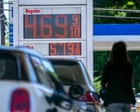
The financial press is having a collective meltdown over 4.2% inflation, pointing fingers at the geopolitical powder keg in the Middle East as the ultimate culprit. Meanwhile, Donald Trump is playing the populist provocateur, declaring his love for the rising rates because it serves his immediate political narrative.
Both sides are fundamentally blind to economic reality.
Mainstream commentators are lazy. They see a conflict involving Iran, observe a spike in energy costs, look at a 4.2% Consumer Price Index (CPI) print, and draw a straight line between them. It is a neat, digestible story for evening broadcasts, but it ignores how monetary mechanics actually operate. Inflation is not a freak weather event caused by foreign policy shocks. It is a deliberate, structural consequence of domestic policy choices that have been compounding for over a decade.
If you are running a business or managing capital based on the assumption that this inflationary wave will dissipate the moment regional tensions cool down, you are positioning yourself for financial ruin.
The Illusion of Supply-Driven Inflation
Let us dismantle the core premise of the current media hysteria. The prevailing narrative argues that tension in the Middle East is choking supply chains, driving up oil, and forcing a cost-push inflationary spiral.
This argument collapses under scrutiny.
Microeconomic supply shocks cause relative price changes, not aggregate, sustained inflation. When oil supplies tighten, the price of gasoline goes up. Because consumers must spend more at the pump, they have less disposable income to spend on restaurants, electronics, or real estate. The prices of those other goods should theoretically stagnate or drop.
True inflation—a comprehensive, sustained decline in the purchasing power of money—requires an expanded money supply.
Aggregate Inflation = (Velocity of Money × Money Supply) / Real Economic Output
Geopolitical friction does not mint new currency. The Federal Reserve and the Treasury department do. The 4.2% inflation rate we are witnessing right now is the delayed monetization of historic debt levels, not an arbitrary penalty imposed by overseas adversaries. By blaming foreign actors, policymakers get a free pass for fiscal recklessness, and the media gets a sensational headline.
Why Trump's Rhetoric is Financial Nihilism
Donald Trump’s public embrace of rising inflation exposes a deep misunderstanding of how macroeconomic instability destroys wealth. The claim that higher inflation somehow benefits domestic production or signals a robust, high-demand economy is dangerous nonsense.
I spent fifteen years institutionalizing capital allocations through volatile market cycles. I have watched leadership teams watch their margins evaporate overnight because they bought into the myth that they could easily pass rising costs onto the consumer.
Inflation acts as a highly regressive tax that distorts price signals, making long-term capital investment nearly impossible.
- Capital Depreciation: Businesses cannot accurately calculate depreciation when the future replacement cost of equipment is a moving target.
- Inventory Mispricing: Paper profits look spectacular during inflation spikes, but when you go to restock your inventory at the new, inflated wholesale price, you realize you actually lost purchasing power.
- Tax Distortion: Corporations pay taxes on nominal profits, not real profits. Inflation forces companies to hand over real capital to the state based on phantom gains.
When an influential political figure applauds a 4.2% debasement of the currency, they are celebrating the systematic erosion of private capital. It is not a sign of economic strength; it is a sign of structural decay.
Deconstructing the Official Metrics
The consensus tells you that 4.2% is an uncomfortable but manageable deviation from the Federal Reserve’s arbitrary 2% target.
The consensus is lying to you. The metric itself is rigged.
The Consumer Price Index is a heavily manipulated psychological tool designed to prevent widespread panic and keep cost-of-living adjustments for government obligations artificially low. If we measured inflation using the methodology established in the 1980s—prior to the introduction of hedonic adjustments, geometric weighting, and owner's equivalent rent—the real figure would be tracking closer to double digits.
The Owner's Equivalent Rent Fraud
Consider how the government calculates housing costs. Instead of tracking actual home prices or mortgage payments, the Bureau of Labor Statistics surveys homeowners and asks an absurd, subjective question: "What do you think your house would rent for unfurnished?" This creates a massive lag and completely divorces the index from the reality of the housing market. If you are trying to hedge your portfolio using official CPI data, you are steering a ship using a map from five years ago.
The Hidden Mechanics of Modern Inflation
To survive this cycle, you must understand the concept of the Cantillon Effect.
The Cantillon Effect: When a central bank increases the money supply, the new money does not distribute evenly across the economy simultaneously. Instead, it flows to the earliest receivers—banks, institutional investors, and massive corporations—who spend it before prices have risen.
By the time that newly minted capital filters down to the average consumer or small business owner, prices have already adjusted upward. The institutional elite gain purchasing power; the working and middle classes lose it.
Central Bank Printing → Institutional Expansion → Asset Inflation → Retail Price Spike (Consumer Loss)
This is why asset prices like equities and prime real estate can skyrocket while the average citizen struggles to buy groceries. The media frames inflation as a universal penalty, but it is actually a massive, stealthy transfer of wealth from the periphery of the economy to the center.
The Strategic Failure of Corporate Hedging
Most corporate executives are handling this 4.2% environment completely wrong. They are running to the traditional playbook: cutting headcount, delaying capital expenditures, and raising retail prices by a flat percentage.
This is a reactive, uninspired strategy that guarantees stagnation.
During the inflationary bouts of the late 1970s, the companies that survived were not the ones that hunkered down and hoarded cash. Cash is a melting ice cube in this environment. The winners were the organizations that aggressively shifted their capital into high-yield, productive assets and restructured their supply contracts to lock in long-term fixed costs.
If you are holding significant cash reserves on your balance sheet because you are waiting for the Iran conflict to resolve and inflation to subside, you are actively burning shareholder value.
Dismantling the Common Inquiries
The public discussion around this topic is flooded with fundamentally flawed premises. Let us address the questions people are actually asking, without the protective corporate veneer.
Will the Federal Reserve save us by raising rates further?
No. The Federal Reserve is trapped in a fiscal dominance loop. With national debt levels crossing catastrophic thresholds, every 100-basis-point increase in the interest rate dramatically expands the government's deficit spending just to service existing debt. The central bank cannot hike rates high enough to choke off inflation without inadvertently triggering a systemic sovereign debt crisis. They will choose to tolerate higher inflation over an outright government default every single time.
Should investors flock to traditional defensive sectors like utilities and consumer staples?
This is outdated advice. In a high-inflation, high-interest-rate environment, traditional defensive stocks with high dividend yields perform poorly because they have to compete with rising treasury yields. Furthermore, these sectors face massive regulatory pressure that prevents them from raising prices fast enough to keep pace with their own input costs.
Is cryptocurrency a viable escape hatch right now?
The asset class is highly polarized, but the data reveals an uncomfortable truth for purists: digital assets currently trade as high-beta liquidity plays rather than pure inflation hedges. When the market panics over geopolitical instability, capital flies to short-term treasuries and the US dollar, not decentralized protocols. Do not confuse long-term structural disruption with short-term capital preservation.
The Cost of Moving Against the Grain
Adopting a realistic view of inflation requires admitting the downside of going against the crowd. If you stop holding cash and aggressively allocate capital into hard assets, commodities, or automated operational infrastructure, you will face short-term volatility. Your quarterly earnings reports might look erratic. Shareholders hooked on smooth, predictable, inflation-adjusted lies will complain.
But the alternative is certain, slow-motion liquidation.
Stop looking at the Middle East. Stop listening to populist politicians who celebrate the destruction of your purchasing power for a soundbite. The 4.2% inflation print is not a temporary glitch caused by foreign supply lines. It is the structural reality of an over-leveraged monetary system.
Stop waiting for a return to normal. Normal is dead. Position your capital for a prolonged period of currency debasement, or watch your wealth get transferred to those who did.