Washington just dropped a grenade into the middle of the foreign policy establishment, and the pundits are completely misreading the blast radius.
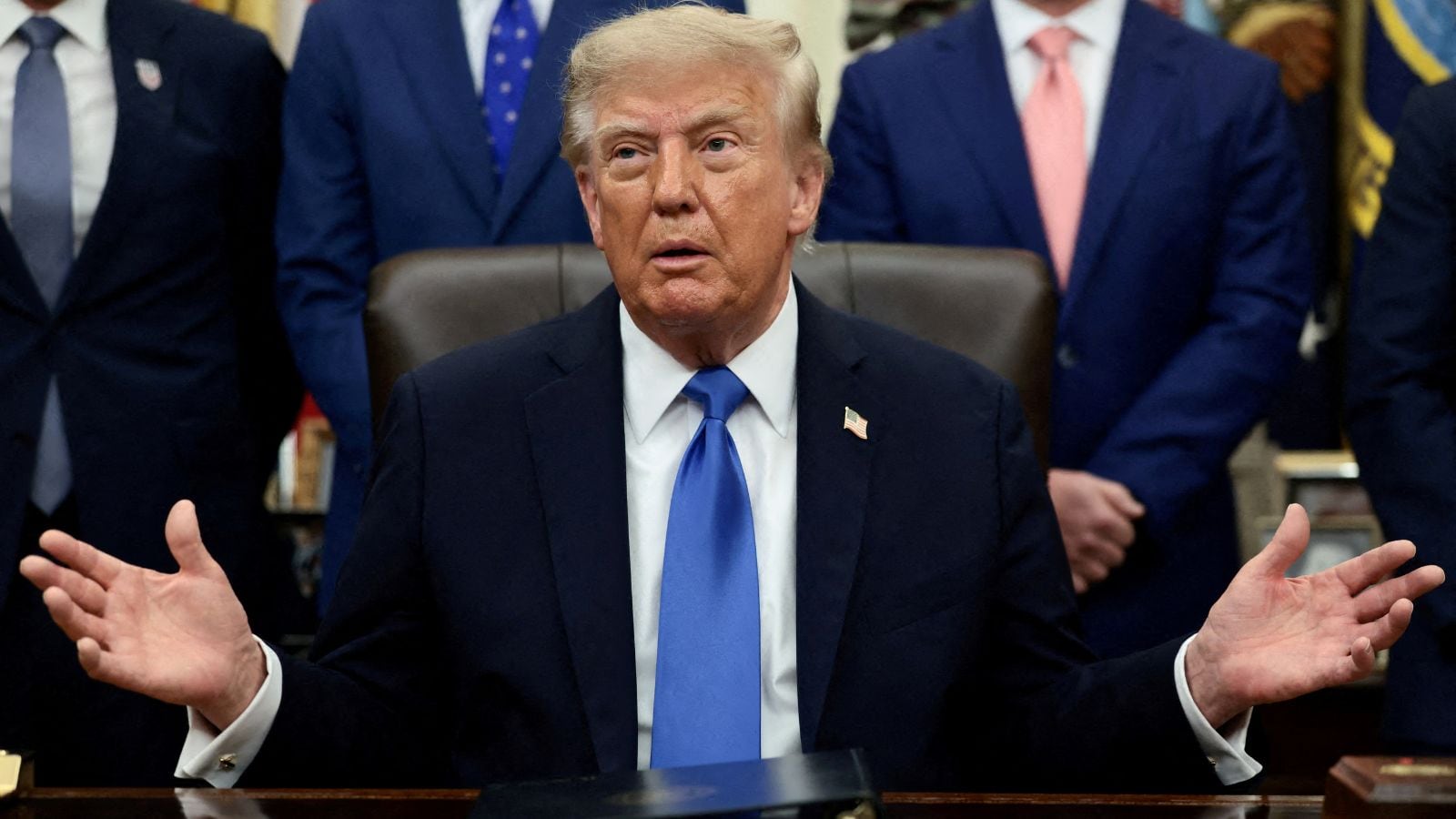
When Donald Trump announced that the United States would halt its roughly $4 billion annual funding to Israel at the end of 2026, the legacy media reacted on cue. Cable news panels immediately split into two predictable, lazy camps. On one side, hawks screamed abandonment, warning of an imminent regional collapse. On the other, critics celebrated what they assumed was a sudden ideological pivot away from a longtime ally.
Both sides missed the actual story. They are reading a balance sheet with blindfolds on.
The $3.8 billion annual Memorandum of Understanding (MOU) signed under the Obama administration in 2016—often rounded up to $4 billion in political shorthand when factoring in supplemental missile defense funds—was never a blank check for Jerusalem. It was a sophisticated corporate subsidy for American defense contractors, paired with a golden leash designed to keep Israel's indigenous arms industry from competing directly with Lockheed Martin, Raytheon, and Boeing on the global export market.
If you want to understand why this cutoff is actually a massive strategic liberation for Israel—and a shrewd business maneuver by Trump—you have to stop listening to political commentators and start looking at defense procurement contracts.
The $3.8 Billion Illusion
Most taxpayers believe the United States loads pallets of cash onto cargo planes and flies them to Tel Aviv. That is fiction.
Under the terms of the current 10-year MOU, which runs through fiscal year 2028, the money is allocated as Foreign Military Financing (FMF). By strict contractual mandate, 100 percent of those funds must be spent inside the United States. Every single dollar goes directly into the bank accounts of American aerospace and defense giants.
More importantly, the 2016 agreement systematically phased out a critical loophole known as Offshore Procurement (OSP). Previously, Israel was allowed to convert roughly 26 percent of its U.S. aid into shekels to fund its own domestic research, development, and manufacturing. That clause kept Israeli factories humming and allowed local engineers to build proprietary systems. Under the current deal, OSP was slashed down to zero by 2028.
Think about what that meant in practice. Israel was receiving "free" money that came with a strict requirement: shut down your own assembly lines, stop competing with us in third-party markets like India and Eastern Europe, and buy our hardware instead.
I have sat in rooms with defense executives in both Washington and Tel Aviv who quietly admitted the open secret of FMF. When you take free money to buy someone else's fighter jets and precision munitions, your domestic industrial base atrophies. You trade long-term sovereign manufacturing capacity for short-term budgetary relief.
By signaling an end to the handout at the close of 2026, Trump isn't starving Israel. He is accidentally—or intentionally—cutting the strings that have tethered Israel's defense sector to the Pentagon's procurement whims for decades.
The Hidden Price Tag of "Free" Money
In defense economics, there is no such thing as a free missile. Every dollar of U.S. military aid carries an invisible geopolitical surcharge.
When Washington funds a foreign military, Washington buys veto power over how, when, and where that military operates. Throughout 2024 and 2025, the world watched the Biden administration repeatedly threaten to withhold specific shipments of 2,000-pound bombs and precision guidance kits to dictate tactical decisions in Gaza and Lebanon. The aid package became a political lever pulled every time domestic polling shifted in swing states like Michigan.
Dependency creates vulnerability. When your supply chains rely on congressional appropriations, your national security is held hostage by the American election cycle.
Consider what happens the moment Israel stops taking FMF money:
- Export Restrictions Vanish: Under U.S. International Traffic in Arms Regulations (ITAR), any weapon system containing even a single American-funded component or developed with FMF dollars is subject to a U.S. export veto. Israel has lost billions of dollars in potential arms deals over the last two decades because Washington blocked sales to third-party nations to protect American market share. Without U.S. funding, Israeli firms like Elbit Systems, Rafael, and Israel Aerospace Industries (IAI) can sell their battle-tested tech to whomever they want, whenever they want.
- True Operational Sovereignty: A nation that buys its munitions with its own sovereign capital does not have to ask permission from the State Department before executing a strike.
- Supply Chain Diversification: Without the "Buy American" mandate, Jerusalem is free to source raw materials, microchips, and artillery shells from global partners—or build the factories domestically—without violating bilateral aid agreements.
Critics who claim Israel cannot survive without the $4 billion check haven't looked at Israel's macroeconomic reality. In 1985, U.S. aid accounted for roughly 10 percent of Israel's GDP. Today, Israel boasts a tech-driven economy with a GDP exceeding $500 billion. That $3.8 billion represents less than 0.8 percent of its total economic output, and roughly 12 to 15 percent of its defense budget.
It is a rounding error in a modern developed economy, yet it bought Washington disproportionate control over Jerusalem's foreign policy. Trading 0.8 percent of your GDP for complete strategic autonomy isn't a crisis. It is the bargain of the century.
Why Wall Street Should Be More Worried Than Tel Aviv
If anyone should be losing sleep over Trump's announcement, it isn't the Israeli Ministry of Defense. It is the C-suite executives in Bethesda, Arlington, and Waltham.
For decades, the FMF structure functioned as a guaranteed revenue stream for the U.S. defense industrial base. Congress appropriated the funds, the Treasury moved the numbers on a ledger, and American defense contractors booked guaranteed, multi-year orders with zero marketing overhead.
If the $4 billion stops flowing at the end of 2026, that guaranteed order book evaporates.
Imagine a scenario where Israel takes the roughly $4 billion it would have received in restricted U.S. vouchers and instead invests $4 billion of its own sovereign debt or tax revenue directly into domestic R&D. Suddenly, an ally that was legally forced to buy American drones, radars, and air-defense interceptors becomes a hungry, well-funded competitor in the global arms bazaar.
Israeli defense exports already hit record highs exceeding $13 billion annually in recent years, driven by European nations scrambling to rearm against Russia and Asian nations looking to counter China. Israeli tech—specifically in electronic warfare, drone defense, and active protection systems for armored vehicles—is widely considered faster to deploy and more adaptable than bloated, over-budget Pentagon programs.
By cutting off the subsidy, Washington is pushing its most agile defense partner out of the nest and into direct competition for global market share. American contractors are about to find out how well their overpriced, slow-moving procurement pipelines compete against Israeli firms that iterate software updates on the battlefield in forty-eight hours.
Dismantling the Worst Takes on the Internet
Whenever a major geopolitical shift happens, search engines flood with terrible questions built on broken premises. Let's tear down the most common misconceptions circulating right now.
"Will Israel's military collapse without U.S. weapons?"
No. This assumes Israel stops buying American hardware altogether. Ending aid is not an arms embargo. Israel will still purchase F-35 stealth fighters and heavy airframes from the United States because nobody else makes them. The difference is that Israel will pay cash, acting as a standard commercial customer rather than a charity case. Commercial customers get what they pay for without lectures from Senate committees.
"Is Trump turning anti-Israel?"
This is the ultimate political literacy test. Trump views every international relationship through the lens of transactional balance sheets. He has long complained that wealthy allies—from NATO members in Europe to South Korea and Japan—free-ride on American taxpayers. Applying that exact same standard to a high-income nation like Israel isn't an ideological betrayal; it is entirely consistent with his "America First" doctrine. In fact, many right-wing Israeli economists, including former Prime Minister Naftali Bennett and experts at the Kohelet Policy Forum, have argued for years that Israel should voluntarily wean itself off U.S. military aid to gain full diplomatic independence. Trump is simply forcing them to eat their vegetables.
"Does this mean the end of U.S.-Israel intelligence sharing?"
Not even close. The $3.8 billion MOU covers hardware procurement, not intelligence cooperation. The CIA, NSA, and Pentagon rely heavily on Unit 8200 and Mossad for signals intelligence, cyber warfare capabilities, and human intelligence across the Middle East. That relationship is a two-way street where Washington often gets more value than it gives. Stopping a hardware subsidy does not unplug the fiber-optic cables sharing threat data between Fort Meade and Tel Aviv.
The Brutal Reality of the Transition
Of course, pretending this transition will be painless would be dishonest. Every major structural shift carries severe short-term friction, and Jerusalem faces three immediate headaches if this cutoff holds through 2026.
First, the budget shock is real. Absorbing an extra $3.8 billion to $4 billion in annual defense spending means raising taxes, cutting domestic social programs, or issuing more sovereign debt at a time when Israel's credit ratings have already taken hits from multi-front conflict costs. Israeli taxpayers will feel this in their wallets immediately.
Second, manufacturing bottlenecks cannot be solved overnight. You cannot build a factory to produce 155mm artillery shells or precision-guided munitions in six months. Even with unlimited cash, global supply chains for propellants, specialized steel, and microelectronics are severely strained. During a two-to-three-year ramp-up period, Israel will still be heavily reliant on American commercial deliveries—meaning Washington will still retain some indirect leverage through export licensing, even without the financial subsidy.
Third, joint R&D programs face bureaucratic limbo. Co-developed systems like Iron Dome, David's Sling, and the Arrow missile defense family rely on deeply integrated engineering teams and shared intellectual property agreements between Rafael, IAI, Raytheon, and Boeing. Unwinding the financial plumbing of those joint ventures without slowing down interceptor production will require surgical legal and engineering coordination.
Stop Mourning the Crutch
The foreign policy establishment loves stability, even when that stability is slowly hollowing out the nations involved. For decades, the $4 billion annual aid package allowed politicians in Washington to posture as saviors while funneling taxpayer money to corporate lobbyists, and it allowed politicians in Jerusalem to avoid making hard fiscal choices about their own defense manufacturing.
It was a comfortable, codependent arrangement that infantilized a capable ally and bloated the American defense budget.
True allies do not keep each other on financial life support indefinitely. They trade, they share intelligence, they align on shared threats, and they respect each other's sovereignty. By pulling the plug on the 2026 funding, Trump has forced both nations to grow up.
Jerusalem finally gets the keys to its own house, and Washington gets its $4 billion back. Stop crying over the end of the subsidy and start watching what happens when Israel's defense sector is finally allowed to operate off the leash.