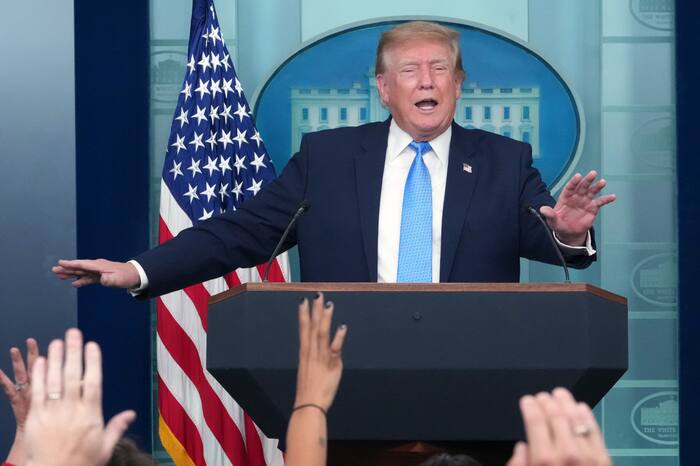
Donald Trump stepped out of high-level discussions with Qatari Prime Minister Sheikh Mohammed bin Abdulrahman Al Thani and dropped a statement designed to rattle every defense ministry from Tel Aviv to Tehran. The conflict with Iran, according to the American leader, is militarily "effectively over." It is a bold declaration. Yet anyone who has spent decades tracking asymmetric warfare in the Persian Gulf knows that declaring a conventional victory over Tehran is like claiming you have cleared a minefield because you stopped walking across it.
Standard wire reports treat a pronouncement like this as a straightforward diplomatic breakthrough or an impending ceasefire announcement. They quote the podium remarks, summarize the Qatari mediation track, and move on to the next news cycle. That approach misses the structural reality of how modern Middle Eastern conflicts actually terminate. Military degradation is not political capitulation. When a superpower measures success by destroyed air defenses, degraded missile stockpiles, and neutralized command nodes, it mistakes tactical attrition for strategic defeat.
The Architecture of Doha's Backchannel
Qatar does not host American diplomats and Iranian envoys out of simple altruism. Doha sits atop the North Dome/South Pars gas field, the largest natural gas reservoir on the planet, which it shares directly with Iran. That geological reality dictates every diplomatic maneuver Sheikh Mohammed executes. When Washington and Tehran edge toward total regional conflagration, Qatar's economic survival hangs in the balance.
The Qatari Prime Minister operates as the premier diplomatic clearinghouse in the region precisely because Doha maintains open, functional channels with actors that refuse to sit in the same room. During the talks with Trump, the Qatari delegation brought more than goodwill to the table; they brought an assessment of Iranian regime survival calculations. Tehran's leadership understands conventional military math. They know they cannot win a direct exchange of precision-guided munitions against American aerospace superiority.
By framing the war as "effectively over" in a military sense, Trump is utilizing a classic coercive off-ramp. He is signaling to domestic audiences and global energy markets that the kinetic phase of direct confrontation has achieved its objectives, while simultaneously handing Doha a diplomatic tool to carry back to Tehran. The message embedded in those words is unmistakable. Washington believes it has broken the spear tip of Iran's conventional deterrence, and it is offering the Islamic Republic a chance to freeze the battlefield before the economic and infrastructural costs trigger internal collapse.
Why Conventional Metrics Fail Against Asymmetric Doctrine
To understand why declaring the war over is premature, you have to look at how the Islamic Revolutionary Guard Corps (IRGC) fights. Western military planners measure victory through kinetic metrics—radars blinded, runways cratered, launchers destroyed, naval vessels sunk. By those standards, an overwhelming air and naval campaign can rapidly render an adversary's conventional order of battle non-functional.
Iran never built its defense strategy around winning a conventional duel. For forty years, Tehran invested in mosaic defense and forward deterrence, dispersing authority across autonomous regional proxies, underground missile cities, and low-cost drone swarms. Even if sixty or seventy percent of a nation's fixed launch infrastructure is reduced to rubble, the remaining capacity is specifically engineered to survive a first and second strike and inflict disproportionate economic pain.
Consider a hypothetical scenario involving maritime chokepoints. A navy does not need a fleet of modern destroyers to halt commercial shipping through the Strait of Hormuz; it needs a few dozen mobile coastal anti-ship batteries, a handful of midget submarines, and cheap naval mines deployed under cover of darkness. Insurance underwriters in London and New York react to the mere probability of a strike, not the statistical superiority of an American carrier strike group. Military defeat on paper does not automatically reopen sea lanes or lower crude oil risk premiums.
The Shadow War Outlives the Ceasefire
History offers a sobering corrective to premature declarations of victory in the region. In 2003, standing beneath a banner aboard the USS Abraham Lincoln, George W. Bush announced the end of major combat operations in Iraq. Conventional state forces had evaporated in weeks. What followed was nearly a decade of brutal insurgency, improvised explosive devices, and sectarian fragmentation that reshaped the geopolitical order far more profoundly than the initial invasion.
A similar dynamic governs the shadow conflict with Iran. When conventional military options are exhausted or neutralized, Tehran historically shifts resources toward gray-zone warfare. This includes cyber operations targeting critical financial and utility infrastructure, covert maritime sabotage, diplomatic hostage-taking, and the reactivation of dormant cells across multiple continents.
Trump's assertion that the war is militarily over assumes that Tehran accepts the current battlefield boundary as the final ledger. Authoritarian regimes built on ideological resistance rarely absorb humiliating military setbacks without seeking a way to restore deterrence on their own terms. If the IRGC cannot match American stealth bombers in the sky, they will look for softer targets where Western technological supremacy offers no shield.
Energy Markets and the Illusion of Stability
Wall Street and global commodities desks hung on every syllable of the post-meeting remarks. Crude benchmarks react violently to any hint of de-escalation in the Gulf, where roughly a fifth of the world's petroleum passes through a narrow waterway. Algorithms instantly price in the "Trump peace dividend," driving down oil futures and lifting equities on the assumption that supply disruptions are off the table.
Traders have short memories. The physical infrastructure of global energy—desalination plants, export terminals, undersea pipelines, and refinery complexes across the Arabian Peninsula—remains acutely vulnerable to low-tech aerial threats. A single swarm of long-range one-way attack drones, costing a fraction of a single interceptor missile, can knock out millions of barrels of daily processing capacity.
Furthermore, economic warfare does not stop when the bombers return to base. Sanctions enforcement, banking restrictions, and shadow-fleet interdictions continue to squeeze the Iranian rial and fuel domestic inflation. As long as Tehran remains locked out of the global financial system, its leadership has every incentive to maintain a baseline level of regional instability to extract concessions. Peace without economic normalization is merely an armed truce.
Domestic Calculus and the Politics of De-escalation
Every foreign policy statement made by an American leader carries a heavy domestic payload. Trump ran on a platform of ending endless wars, avoiding foreign entanglements, and projecting overwhelming strength without getting bogged down in nation-building. Declaring the military phase of the Iran conflict finished satisfies both halves of that political coalition.
To hawks, the phrase "militarily effectively over" implies total dominance—the enemy has been crushed, their capabilities dismantled, and American power vindicated. To isolationists and war-weary voters, it signals that the troops are coming home, defense spending will not spiral into another multi-trillion-dollar quagmire, and the crisis is resolved.
This rhetorical ambiguity is deliberate, and it is politically effective in the short term. Yet political rhetoric does not dictate reality on the ground in Lebanon, Yemen, Iraq, or Syria. Regional militias funded and armed by Tehran operate with varying degrees of local autonomy. Even if the Supreme Leader's office in Tehran agrees to a tactical pause via Qatari intermediaries, local commanders in Sana'a or southern Lebanon frequently pursue their own hyper-local vendettas. Controlling an empire of proxies is vastly harder than building one.
What Doha Actually Brokered
Strip away the press conference framing, and the meeting between Trump and Sheikh Mohammed looks less like a victory lap and more like urgent crisis management. Qatar has spent billions positioning itself as an indispensable mediator, walking a tightrope between hosting the massive Al Udeid Air Base for the U.S. military and maintaining cordial ties with Tehran.
When Doha steps forward to facilitate messaging between Washington and Iran, it usually means both sides have reached a point of mutual exhaustion or intolerable risk. Washington wants to avoid an open-ended ground war or a protracted naval blockade that would spike inflation at home. Tehran wants to prevent further decapitation strikes against its leadership and preserve enough military hardware to maintain internal security against domestic unrest.
The Qatari Prime Minister likely carried a specific set of parameters back to Iranian negotiators: halt direct strikes on American bases and regional allies, freeze uranium enrichment at verifiable thresholds, and in exchange, the United States will halt offensive kinetic operations and allow limited economic breathing room. Calling the war "effectively over" is Trump's way of locking in the narrative before Tehran can haggle over the fine print.
The Unresolved Nuclear Question
Beneath all the talk of conventional military exhaustion lies the core strategic dilemma that sparked the confrontation in the first place. Kinetic strikes can destroy centrifuge halls, collapse tunnel entrances, and assassinate key scientists. They cannot erase institutional knowledge.
Iran's nuclear program has transitioned from a collection of vulnerable physical facilities into a dispersed, deeply entrenched technical capability. Military force can set a program back by months or a few years, turning concrete into dust. Paradoxically, overt military defeat often hardens the resolve of hardline factions within Tehran, convincing them that a verifiable nuclear deterrent is the only guaranteed insurance policy against future foreign intervention.
If the military campaign ends without an intrusive, airtight inspection regime—the kind that only comes through grueling, multi-year diplomatic treaties—then declaring the war over simply resets the clock. The centrifuges will eventually spin again, deeper underground, shielded by lessons learned from the latest round of airstrikes.
The Long Tail of Modern Warfare
Journalists love clean endings. Politicians love them even more. A crisp quote outside a diplomatic meeting provides a convenient headline and allows everyone to close the ledger on a terrifying chapter of global instability.
Real geopolitical conflicts refuse to respect news cycles. When conventional armies stop firing, the war simply changes shape, migrating into encrypted messaging apps, covert shipping lanes, clandestine financial networks, and proxy skirmishes across forgotten borderlands. The bombs may stop falling, and the headlines may move on, but the ledger in the Persian Gulf is never truly closed.