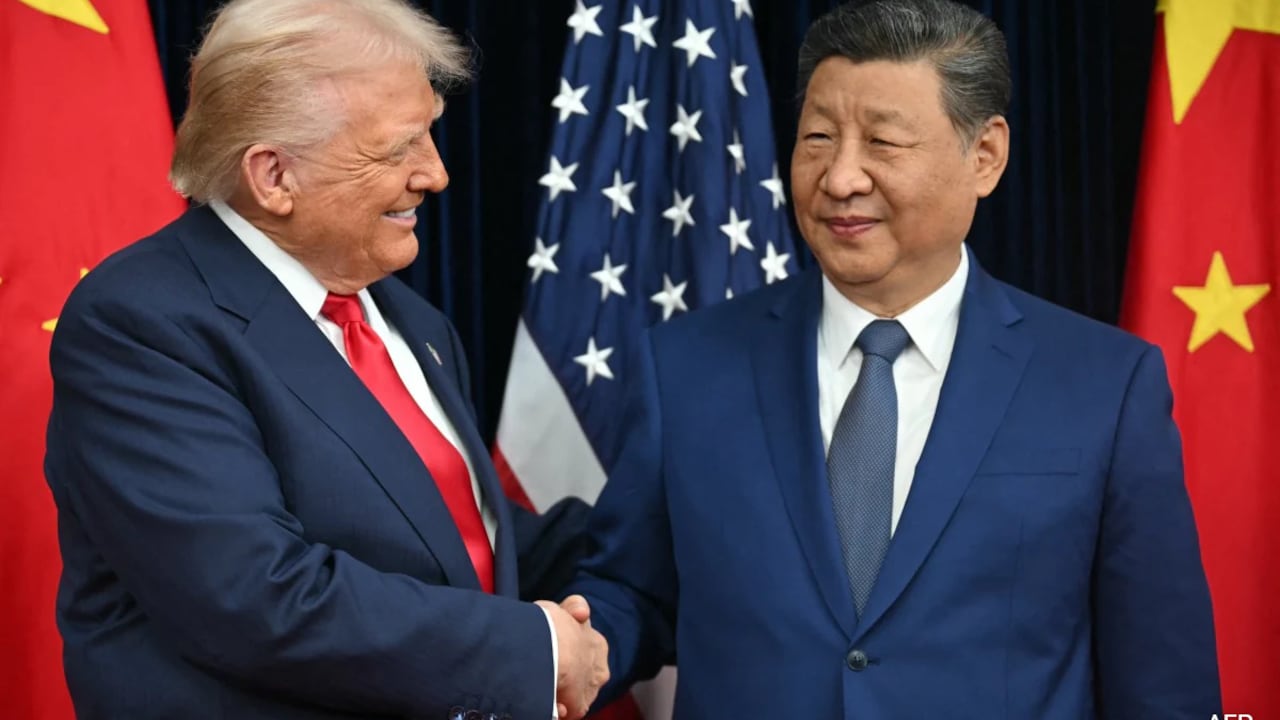
Everyone lost their minds over the headline. Donald Trump casually dropping that Xi Jinping supposedly agreed to rename artificial intelligence to super intelligence sounds like a late-night rally ad-lib or a throwaway negotiation tactic. The mainstream tech press treated it like a bizarre linguistic quirk, a minor diplomatic footnote between two leaders posturing over silicon chips and trade tariffs.
They missed the entire point.
Rebranding the technology is not a semantic game. It is a strategic masterclass in narrative control. For three years, Silicon Valley marketing departments have hidden behind comforting, domestic metaphors. They call it a copilot. They call it an assistant. They package systems capable of reasoning past human benchmarks inside friendly chat bubbles and pastel user interfaces designed to make you feel like you are delegating spreadsheet work to an intern.
Trump and Xi do not see interns. They see sovereign power.
By shifting the lexicon from artificial intelligence to super intelligence, the political establishment just stripped away the corporate sugar-coating. They stopped treating this like software and started treating it like ordnance. When you call it an assistant, you regulate it like an app. When you call it super intelligence, you regulate it like enriched uranium.
I have spent the last two decades watching executives blow hundreds of millions of dollars on enterprise digital transformation initiatives that fundamentally misunderestimated the leverage points of automation. The lazy consensus in every boardroom right now is that artificial intelligence is just the next evolution of cloud computing, another line item in the IT budget to be optimized for marginal productivity gains.
That mindset is going to bankrupt half the Fortune 500 by the end of the decade.
The Linguistic Trap of Incrementalism
Let us dismantle the core misconception driving the mainstream discourse. The press assumes that changing a name is just political theater. It is not. Words anchor expectations, and expectations dictate capital allocation.
When a CEO hears artificial intelligence, their brain translates it through the legacy framework of enterprise software. They think about Jira tickets, customer service chatbots, and automated email replies. They think about tools that require human supervision. They view the technology as an employee substitute that still needs an orientation deck and a manager.
Super intelligence breaks that mental model entirely.
When you attach the prefix super to intelligence, you cross the threshold from tool to entity. You stop thinking about software integration and start thinking about systemic displacement. A tool helps you write code faster. A super intelligence replaces the engineering department, redesigns the product architecture, and executes the deployment while you are asleep.
The political actors understand this reality better than the venture capitalists funding it. Xi Jinping has spent years tightening state control over algorithmic development, treating domestic tech giants not as indie startups, but as state infrastructure. Trump, for all his bluster, recognizes that technological dominance is the only remaining wedge in a bipolar global economy. By locking arms on a shared vocabulary—even informally—they are laying the groundwork for a bilateral regulatory cartel.
Do not look at this as a linguistic quirk. Look at it as the first draft of a non-proliferation treaty for cognitive capital.
The Real Bottleneck Is Not Compute
Every single tech analyst on television will tell you that the race comes down to chips, power grids, and data centers. More GPUs. More megawatts. More scraped Reddit threads.
They are fighting the last war.
Compute is becoming a commodity. Within five years, silicon scarcity will not be the primary constraint on capability. The bottleneck is institutional inertia and organizational architecture.
I have watched legacy enterprises acquire state-of-the-art machine learning models only to route them through three layers of middle management approval before a single prediction makes it into production. They take a system capable of real-time market optimization and use it to draft generic birthday cards for clients. They take a super intelligence and shackle it to legacy bureaucratic workflows designed for the nineteenth-century industrial age.
The companies winning this transition are not the ones with the biggest GPU clusters. They are the ones radical enough to restructure their entire operating models around autonomous execution.
Imagine a scenario where a mid-sized logistics firm fires its entire procurement department, hands the financial ledgers over to an autonomous model with explicit risk boundaries, and lets the system renegotiate supplier contracts in real time. The efficiency gains are not ten percent. They are tenfold. Most executives are terrified of that scenario because it renders their entire management hierarchy obsolete. So they comfort themselves with the word assistant, pretending that human oversight remains mandatory.
It is not mandatory. It is a security blanket for insecure executives.
The Dangerous Downside of the Super Label
Let us be completely transparent about the flaws in my own argument. Shifting the vocabulary to super intelligence carries a massive, immediate hazard: regulatory capture.
When you classify a technology as a supreme threat or a sovereign asset, you hand the incumbent monopolies the greatest gift they could ever ask for. High barriers to entry.
If every model is regulated as a potential super intelligence, compliance costs skyrocket. Open-source research gets choked out under the guise of national security. Small startups with brilliant algorithmic breakthroughs get crushed by compliance regimes designed by lawyers who think an API is a type of sandwich.
Xi Jinping loves this outcome because state control thrives in an environment of high barriers. American defense contractors love this outcome because it guarantees fat, cost-plus government contracts. The losers are the garage developers, the open-source contributors, and the agile upstarts who actually drive innovation.
By accepting the framing of super intelligence, we risk building a gilded cage around the entire industry, ensuring that only trillion-dollar balance sheets can afford the permission slip to play.
Stop Asking the Wrong Questions
If you are still asking how your marketing team can use language models to write blog posts faster, you are looking at the ocean and worrying about a ripple.
The real questions are structural, brutal, and deeply uncomfortable:
- What happens to your business model when your competitors can execute complex, multi-step strategic pivots in minutes instead of quarters?
- How do you manage human talent when the cost of cognitive labor drops close to zero?
- Where does sovereign power actually reside when the code making the decisions is compiled on servers you do not own and cannot inspect?
Trump and Xi are not debating semantics. They are redrawing the perimeter of global power.
Stop waiting for permission to change your operational model, and stop looking for a copilot to save your career. The era of comfortable software is over. Act accordingly.