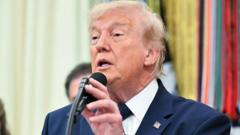
The international soccer establishment is currently having a collective, pearl-clutching meltdown over Donald Trump’s phone calls to FIFA President Gianni Infantino.
The mainstream press is running a unified script. They claim that a head of state intervening to overturn USMNT striker Folarin Balogun’s red-card suspension before a World Cup knockout match against Belgium is a dark day for the sport. They scream about "political interference." They quote UEFA calling it an "incomprehensible and unjustifiable" violation of a red line. They treat the automatic one-match ban as if it were a sacred commandment handed down from a mountaintop, rather than an arbitrary administrative rule.
It is a completely naive way to view global sports.
The outrage is entirely misplaced. Trump calling Infantino to argue that Balogun’s challenge on Bosnia-Herzegovina's Tarik Muharemovic was just "two great athletes getting tangled up" isn't a corruption of the beautiful game. It is the purest expression of how the game has actually operated for a century. Soccer is not an insular meritocracy governed by sterile rulebooks; it is a multi-billion-dollar theatre of geopolitics where leverage, host-nation status, and executive sway are deeply woven into the fabric of the sport.
The global sports media is selling you a fantasy of pure, unadulterated sporting justice. Here is the reality.
The Myth of FIFA's Pure Rulebook
The central premise of the outrage is that FIFA’s disciplinary code is an immutable system of absolute justice. The Royal Belgian Football Association and European commentators are acting as if a red card has never been challenged, bent, or reassessed through backroom influence.
Let's look at the mechanics of what actually happened. Balogun was sent off after a video review during the 2-0 win over Bosnia and Herzegovina. The referee on the pitch, Raphael Claus, originally saw nothing. The VAR booth flagged a step on the ankle. It was a classic "orange card" situation—harsh, technical, and highly debatable.
Under Article 27 of the FIFA disciplinary code, the judicial body has the explicit authority to fully or partially suspend the implementation of a disciplinary measure. FIFA did not invent a rule for the United States; they utilized an existing legal mechanism to delay the suspension for a probationary year.
I have spent decades watching sports federations operate behind closed doors. The idea that European football bodies are clean arbiters of objective truth is laughable. European giants have used political clout to dictate referee appointments, influence tournament seeding, and escape financial fair play sanctions for decades. When a European federation does it, it is called "sophisticated sports diplomacy." When an American president does it out in the open, it is called an existential crisis.
Imagine a scenario where the World Cup is hosted in Germany or France, and their star forward is dismissed on an ambiguous VAR review before the Round of 16. The local federation chiefs, who double as powerful political actors within UEFA, would be working the phones instantly. The only difference here is the lack of a filter. Trump bypassed the subtle diplomatic channels, picked up the phone three times, and applied the direct pressure of a host nation that holds the keys to the commercial success of the entire tournament.
Geopolitics and Football Are Inseparable
The modern World Cup is not merely a sports tournament. It is a massive infrastructure project, a diplomatic summit, and a commercial juggernaut. To pretend that the leader of the host country shouldn't care about the integrity or marketability of the product is dense.
The United States has spent billions preparing to host this tournament. The economic success of the knockout rounds in cities like Seattle relies heavily on the momentum of the home team. Losing Balogun—the USMNT's leading scorer with three goals—on an aggressive, accidental tangling of feet would significantly dampen domestic engagement.
Trump's logic in the Oval Office was brutally pragmatic: "We've got to have our best players and they have to have their best. If we win or we lose, it's fair."
Football purists hate this because it strips away the illusion of the sport's autonomy. But soccer has always been a proxy for state power:
- Mussolini used the 1934 World Cup as a fascist propaganda machine.
- The 1978 tournament in Argentina was heavily managed by a military junta.
- Modern state-backed clubs in Europe use sovereign wealth funds to completely rewrite domestic league hierarchies.
FIFA is a corporate-state hybrid. Gianni Infantino does not operate like a chief justice; he operates like a global diplomat. He fields calls from kings, prime ministers, and CEOs daily because football is a primary currency of international relations. Trump understanding this and exploiting it isn’t breaking the sport; it is playing it at the highest level.
The Hypocrisy of the European Backlash
The furious reaction from UEFA and European managers like Thomas Tuchel exposes a deeper anxiety: the shifting axis of footballing power. For a century, Europe has held a monopoly on the governance, culture, and structural control of global soccer. They dictate the calendar, own the biggest clubs, and dominate the decision-making apparatus.
The moment the United States applies raw political leverage to protect its sporting interests, the European establishment cries foul. They are terrified of a precedent where host nations can openly push back against decisions that harm their tournament investments.
Tuchel asked, "Where does it end now? Do we appeal if a yellow card is not a yellow card?"
The answer is simple: it ends where the stakes aren't high enough to warrant a presidential phone call. A regular group-stage yellow card does not threaten the commercial viability of a host nation's run in a knockout round. A straight red card to a superstar striker on a highly controversial VAR review does.
We must discard the fiction that all matches are played in a vacuum. The context matters. The venue matters. The economic reality of the host nation matters. FIFA’s decision to grant a probationary suspension keeps the tournament alive, keeps the stadiums packed, and ensures that the eventual winner of the USA vs. Belgium match earns it against a full-strength squad.
The Real Cost of Absolute Consistency
The current obsession with "consistency" in footballing refereeing has consistently degraded the entertainment value of the sport. The introduction of VAR was supposed to eliminate clear mistakes. Instead, it has turned soccer into a bureaucratic exercise where frame-by-frame scrutiny punishes natural athletic movements.
Balogun was running at full speed, competing for a pass, and stepped awkwardly. In a pre-VAR era, that is a common collision. Now, it is processed through a digital lens, stripped of context, and turned into a mandatory expulsion.
If FIFA blindly adhered to the "certainty of rules" that Belgium is clamoring for, the tournament would be poorer. Fans do not pay thousands of dollars to see star athletes sit in the stands because of administrative rigidity. They pay to see elite competition.
By utilizing Article 27, FIFA’s disciplinary committee chose entertainment, scale, and common sense over dogmatic adherence to a flawed refereeing decision. It is an approach that acknowledges the reality of the sport: the rules serve the tournament, not the other way around.
The USMNT coach Mauricio Pochettino was entirely correct to defend the outcome. The team played down a man for 30 minutes against Bosnia and Herzegovina. They paid their penalty on the night. Extending that punishment into the next round for a non-malicious foul would be a compounding error.
Stop looking at this through the lens of political morality. This is high-stakes entertainment and global sports commerce. The host nation used its weight to protect its asset, FIFA found a legal loophole to maximize the tournament's value, and the fans get a better game in Seattle. That is how the industry operates when the stakes are real.


