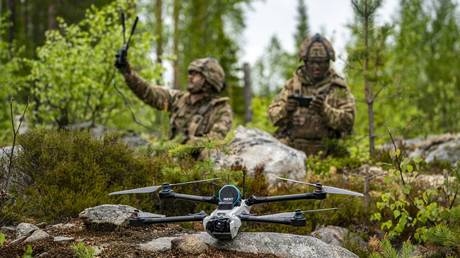
Silicon Valley is currently intoxicated by a dangerous fantasy. The narrative is comforting, almost cinematic: agile tech startups, armed with nothing but off-the-shelf components, open-source software, and raw ingenuity, are permanently rewriting the rules of modern warfare. We are told that fleets of cheap sea drones and fleets of autonomous robot trucks are making legacy defense contractors obsolete.
This is a lie. It misunderstands the brutal reality of attritional, industrial-scale conflict.
The comforting consensus suggests that a $2,000 commercial drone dropping a 3D-printed grenade onto a multi-million-dollar tank represents a permanent shift in military economics. Tech evangelists look at the Black Sea, see asymmetric sea drone successes, and declare the era of the traditional navy dead. They look at autonomous supply trucks navigating contested terrain and declare the logistics problem solved.
They are looking at the opening act of a tragedy and calling it a triumph.
What the hype cycle willfully ignores is that asymmetric advantages are inherently perishable. The window of opportunity for cheap, unhardened commercial tech in a combat zone is measured in weeks, not years. The moment a peer competitor scales electronic warfare (EW) capabilities, your nimble startup’s drone fleet becomes expensive litter.
The Electronic Warfare Wall: Where Consumer Tech Goes to Die
The narrative surrounding low-cost robotic warfare relies on an assumption of permissive electromagnetic environments. In the early stages of recent conflicts, hobbyist drones and hastily modified commercial uncrewed surface vessels (USVs) wrought havoc. They did this because they were operating in a temporary regulatory and tactical vacuum.
That vacuum has closed.
Consider the mechanics of radio-frequency jamming. A standard commercial drone relies on civilian GPS frequencies and unencrypted Wi-Fi or cellular bands for control signals. To an industrial-grade electronic warfare system—like the Russian Krasukha-4 or Borisoglebsk-2—these signals are not hurdles; they are invitations. When a battlespace becomes saturated with EW, unhardened systems fail instantly. They lose telemetry, drift off course, or simply fall out of the sky.
I have watched venture capitalists pour tens of millions into drone startups boasting about "advanced AI computer vision" for targeting. What they fail to realize is that if the drone cannot survive the first five miles of electronic jamming to get its cameras within range, the AI is completely useless.
True military-grade resilience requires:
- Frequency-hopping spread spectrum (FHSS) tech that cycles through thousands of frequencies per second.
- M-code GPS receivers that are highly resistant to spoofing.
- Inertial Navigation Systems (INS) that don’t rely on satellites at all.
These components are not cheap. They are heavily regulated under International Traffic in Arms Regulations (ITAR). You cannot order them on Alibaba. You cannot iterate them in a weekend hackathon. The moment a startup adds proper military hardening to a $2,000 drone, that drone becomes a $150,000 drone. The cost advantage vanishes, and with it, the entire thesis of the startup warfare revolution.
The Industrial Scale Illusion: Handcrafted Cannot Scale
The media loves stories of boutique workshops producing dozens of sea drones a month. It sounds heroic. In reality, it is a cottage industry trying to fight an industrial war.
Modern peer-to-peer conflict consumes material at a rate that hasn't been seen since World War II. During peak periods of artillery duels in Ukraine, Russia was firing up to 60,000 shells per day, while Ukraine consumed roughly 7,000. In a high-intensity conflict, attrition rates for drones hover around 10,000 units per month.
Startups are fundamentally unequipped to handle this scale of manufacturing.
+---------------------------+----------------------------+----------------------------+
| Metric                    | Tech Startup Model         | Defense Prime Model        |
+---------------------------+----------------------------+----------------------------+
| Production Capacity       | Dozens/month (Handcrafted) | Thousands/month (Factory)  |
| Supply Chain Resilience   | Just-in-Time (Fragile)     | Strategic Stockpiling      |
| Regulatory Compliance     | High Risk (ITAR Blindness) | Deeply Integrated          |
| Margin Tolerance          | Dependent on Venture Capital| Sustainable Free Cash Flow |
+---------------------------+----------------------------+----------------------------+
The startup playbook is built on "Just-in-Time" supply chains and capital efficiency. They buy components from global distributors, trusting that the global logistics network will always deliver their semiconductors and lithium-ion batteries.
But a real war doesn't care about your agile sprint cycles. If a adversary chokes off the supply of rare earth elements or specific microcontroller architectures, the startup’s assembly line grinds to a halt. Traditional defense primes like Lockheed Martin, General Dynamics, or BAE Systems are frequently criticized for being slow and expensive—and they are. But they also maintain deep, national-security-vetted supply chains, strategic stockpiles of raw materials, and factories capable of running three shifts a day under bombardment. They build for attrition; startups build for a demo day.
Robot Trucks and the Fallacy of the Autonomous Supply Line
The second pillar of the startup defense myth is the autonomous robot truck. The argument claims that removing the human driver from supply convoys solves tactical logistics.
It solves nothing. It merely shifts the target.
An autonomous cargo vehicle navigating a dirt road via LiDAR and computer vision is a marvelous engineering feat for a structured environment like an Arizona highway or a controlled mining site. In a combat zone, logistics lines are not just roads; they are primary targets for enemy interdiction.
An autonomous truck cannot change a tire shredded by shrapnel. It cannot clear a fallen tree from the road. It cannot negotiate with a local checkpoint or spot an improvised explosive device (IED) buried under a pile of garbage that looks exactly like the rest of the debris on its camera feed.
When an autonomous truck gets stuck, it becomes a fixed block on the supply route, stalling every vehicle behind it. To make that truck viable, you must escort it with human soldiers. If you are deploying infantry squads to protect an uncrewed truck, you haven't saved manpower. You have actually increased your operational footprint and created a highly predictable bottleneck.
People Also Ask: Dismantling the Defense Tech Myths
Can't AI algorithms overcome the lack of expensive hardware?
No. This is a software-centric delusion born out of SaaS bias. Software cannot override physics. An AI targeting algorithm requires data from sensors (cameras, radar, LiDAR). If those sensors are blinded by smoke, degraded by mud, or fried by high-power microwave weapons, the algorithm has no data to process. You cannot code your way out of a physical hardware failure.
Why shouldn't the military adopt the "move fast and break things" ethos?
Because when the military breaks things, people die and nations lose territory. In the commercial software world, a bug means your app crashes, and you push a patch in the afternoon. In electronic warfare, a bug means an autonomous strike drone misidentifies a civilian bus as a military transport, or turns around and targets its own launch site due to a GPS spoofing attack. The rigorous, agonizingly slow validation processes of traditional defense acquisition exist for a reason: safety and mission assurance under the worst possible conditions.
Aren't defense primes too slow to innovate against agile threats?
Yes, the legacy defense acquisition system is broken, bureaucratic, and maddeningly slow. But the solution is not to replace it with fragile tech companies that don't understand military standards. The solution is to force defense primes to adopt modular architectures while retaining their industrial manufacturing muscle. A slow pipeline that delivers 10,000 reliable, hardened missiles is infinitely better than a fast pipeline that delivers 500 unhardened, glitchy drones that stop working when the enemy turns on an antenna.
The Hidden Danger of the Venture Capital War Model
Venture capital operates on a specific timeline: fund a company, scale it rapidly, and exit via acquisition or IPO within seven to ten years. This model is fundamentally incompatible with the realities of national defense.
A nation's defense architecture requires multi-decadal stability. A weapons system deployed today must be supportable, repairable, and upgradable twenty years from now. Startups do not build for twenty-year horizons. They build for the next funding round.
If a defense tech startup fails to secure its Series C funding because the macroeconomic environment shifts, that company goes bankrupt. If the military has integrated that startup's proprietary software or hardware into its operational doctrine, a critical capability suddenly vanishes overnight. National security cannot be dependent on the whims of Sand Hill Road investors looking for 10x returns on a software margin profile.
Furthermore, the focus on cheap, disposable tech creates a dangerous strategic distraction. It allows politicians to avoid making the hard, expensive decisions required to rebuild our crumbling industrial base. It is cheap and politically popular to announce a new partnership with a hip drone startup. It is expensive and politically difficult to build new shipyards, reopen munitions factories, and secure domestic supplies of critical minerals.
The reliance on startup innovations is an escape hatch for leadership that has lost the will to build real industrial power.
The Hard Reality of the Next Conflict
If you want to win a modern war, stop looking at the software dashboard and start looking at the foundry.
The future of conflict is not a clean, automated chessboard managed by algorithms and fought with disposable plastic quadcopters. It remains a gritty, industrial meat grinder defined by mass, manufacturing capacity, and engineering resilience.
The startups trying to disrupt this space are bringing a knife to a laser fight. They are designing weapons for an idealized version of war where the internet always works, the GPS signal is always clean, and the components are always available at the local hardware store.
The defense primes understand the ugly truth: when the world burns, the winner is the side that can produce the most iron, harden its systems against the electromagnetic spectrum, and keep its factories running while the global supply chain collapses around it. Everything else is just marketing.