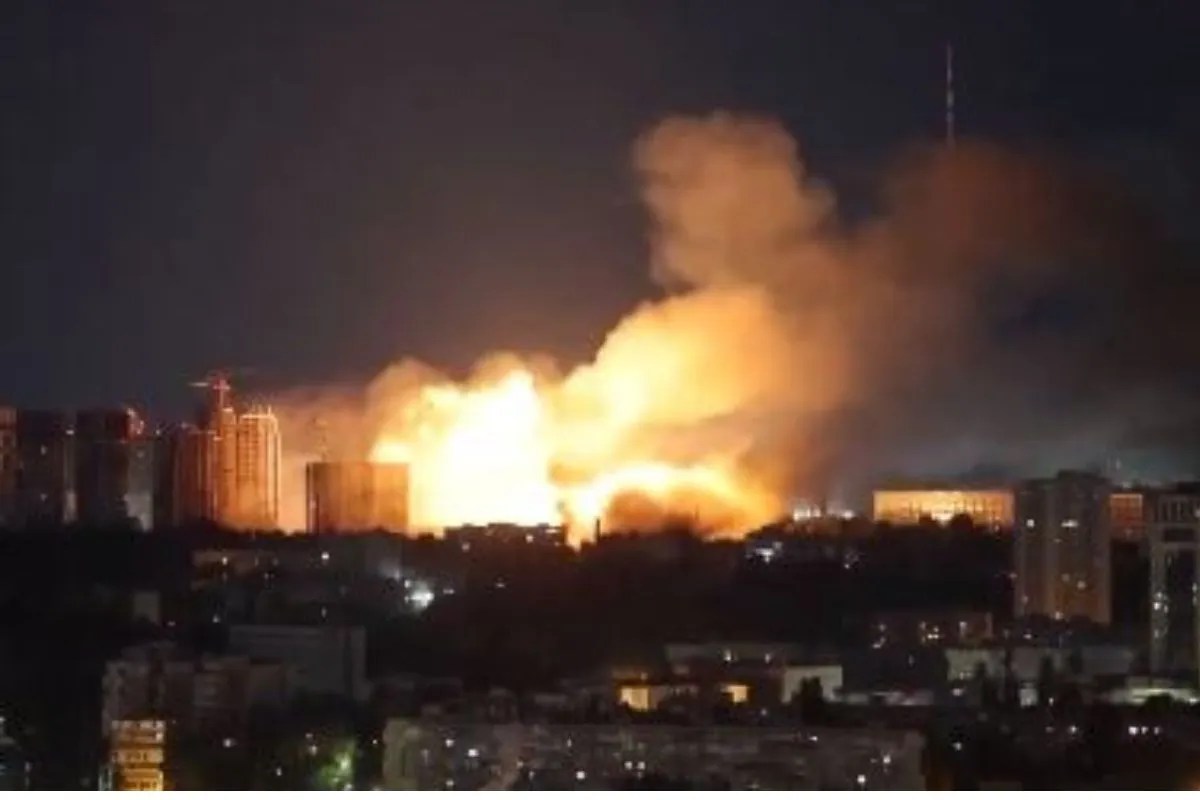
Every time air raid sirens wail across the Dnieper and another residential block in Kyiv absorbs a Kalibr or an Iskander, the media playbook snaps open with predictable panic. The headlines scream about escalation, war crimes, and impending doom. Commentators on cable news act as though a single night of explosions rewrites the entire geopolitical map.
It is time to stop buying the theater.
The lazy consensus in modern war reporting reduces a brutal, grinding war of attrition down to a daily emotional ledger. Missiles hit a neighborhood, a child dies, grief turns into rage, and analysts on Twitter declare that the psychological threshold of the conflict has shifted. This approach treats localized tragedy as strategic pivot points. It mistakes tactical terror for operational transformation.
I have watched strategists and intelligence analysts misread this rhythm for years. They chase every flash of light in the night sky, reacting to the noise while ignoring the dull, grinding mechanics of logistics and industrial capacity that actually decide outcomes.
The Mechanics of Attrition versus the Theater of Retaliation
Let us be precise about what these strikes actually achieve from a military standpoint, stripped of the horror and the headlines.
Russia launches cruise and ballistic missiles at Ukrainian urban centers for two distinct reasons. Neither of them involves capturing territory or breaking the will of a population that has already endured years of bombardment.
First, these barrages drain high-end air defense inventories. Every Patriot interceptor or NASAMS missile fired at a incoming drone or cheap decoy is a unit that cannot be replaced overnight. Moscow understands the mathematical asymmetry of modern defense. Missiles are cheaper and faster to stockpile than sophisticated interception batteries.
Second, these strikes serve an internal political consumption loop in Russia and signal defiance to Western capitals. They project momentum when the front lines are frozen in muddy stalemate.
Yet, mainstream commentators persist in treating these attacks as masterstrokes of terror designed to collapse civilian morale. That premise fails basic historical scrutiny. History shows that sustained aerial bombardment of civilian zones almost universally hardens national resolve rather than fracturing it. The Blitz in London did not knock Britain out of World War II. The American bombing of North Vietnam did not halt Hanoi's logistical push.
Kyiv is not going to fold because an apartment building takes a direct hit. Pretending otherwise is either profound ignorance of human behavior or deliberate sensationalism designed to drive engagement metrics.
The Cost of Reactive Policy
When newsrooms and policymakers treat every localized strike as an emergency that demands an immediate, emotional policy shift, bad decisions follow.
Imagine a scenario where military aid packages are drafted and approved within forty-eight hours solely because a particularly brutal video of a blast in downtown Kyiv goes viral on social media. That is not strategy. That is reactive impulse buying driven by shock value.
War does not care about your algorithmically optimized outrage.
When you allow tactical violence to dictate macro-strategy, you lose the plot. The real conflict is not being decided by how many windows shatter in the capital today. It is being decided in the assembly lines of artillery shells, the security of electrical grid sub-stations heading into winter, the quiet negotiations over rare earth supply chains, and the demographic exhaustion of two societies bleeding out in trenches across the Donbas.
By focusing exclusively on the dramatic explosions in the capital, analysts ignore the quiet bleeding happening hundreds of miles away in places like Pokrovsk or Toretsk, where the actual structural integrity of the front line is tested meter by grinding meter.
Dismantling the Escalation Trap
Another favorite trope of the pundit class is the constant invocation of the escalation ladder. Every time Kyiv is targeted, we hear warnings that the conflict is spiraling out of control toward direct nuclear confrontation or a wider regional conflagration.
This view assumes a linear trajectory that does not exist. Both sides operate within heavily calculated thresholds of pain and deterrence. Russia knows the limits of NATO's proxy support, and Western capitals know the limits of how far they can push sanctions and weapon supplies without crossing red lines that trigger unpredictable asymmetric responses.
The strikes on Kyiv are loud, visible, and deeply tragic, but they are bounded by these unspoken rules of engagement. They are designed to stay just beneath the ceiling of total war. Treating them as unpredictable catalysts for global Armageddon is fundamentally dishonest. It flatters the egos of commentators who want their daily updates to feel like momentous chapters in history books, but it obscures reality.
The Uncomfortable Truth About War Weariness
There is a downside to this contrarian view, and it requires brutal honesty to admit. By stripping away the emotional theater and looking at the cold calculus of attrition, we are forced to confront a grim reality.
If these strikes do not break Kyiv's morale, and if they do not fundamentally alter the military balance overnight, what do they do? They signal a long, agonizingly slow descent into permanent stalemate.
They mean that the war will not end with a sudden collapse, a dramatic breakthrough, or a cinematic victory parade. It ends when both sides reach an economic and demographic wall, battered into exhaustion.
The obsession with daily missile attacks is a distraction from that grinding reality. It offers an easy narrative arc—crime, grief, outrage, retaliation—that fits neatly into a two-minute news segment. But real wars are won and lost in the unglamorous margins of supply chains, industrial output, and political endurance.
Stop looking at the flashes in the sky. Look at the balance sheets, the factory floors, and the logistics lines. That is where the war is actually being decided, whether the headlines choose to notice it or not.