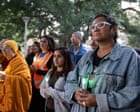
Bikram Lama didn't come to the city to die under a bridge or on a cold sidewalk. Like thousands of others, he came with a pocketful of dreams and the kind of hope that keeps you moving when your stomach is empty. He wanted a better life. Instead, he became a ghost in plain sight. When a crowd gathered recently to say goodbye to him, the tears weren't just for the man. They were for the collective failure of a society that watches people vanish while they're still standing right in front of us.
We talk about "the homeless" as a monolithic block, a problem to be solved or a nuisance to be managed. We forget that every person on the street has a name, a history, and a family that might be looking for them. Bikram Lama was a human being. He was a son, a peer, and a man who deserved more than a quiet, unnoticed exit. His death highlights the brutal reality of urban isolation. It’s a wake-up call that most of us will probably ignore by the next news cycle. In similar news, take a look at: Why AIPAC is winning the battle but losing the Democratic party.
The Quiet Death of Bikram Lama
Bikram Lama’s story is heartbreakingly common. He was part of the invisible workforce, the people who keep cities running in the shadows but never get to enjoy the fruits of that labor. He lived on the fringes. When he died, he was "unseen," a word that carries a heavy weight. It means people walked past him. It means the systems meant to catch him didn't even notice he was falling.
The gathering for his funeral wasn't just a memorial. It was a protest of sorts. People showed up because they felt the weight of that invisibility. They felt the shame of living in a world where a man can expire in a public space and only be acknowledged once his body becomes a logistical issue for the city. It’s a gut-wrenching irony. We only see the homeless when they’re gone or when they’re "in the way." Reuters has also covered this critical subject in great detail.
Why Hope Is Not Enough in the Modern City
Hope is a dangerous thing when you don't have a safety net. For Bikram Lama, hope brought him to an environment that takes much more than it gives. Our cities are designed for productivity, not for people. If you aren't producing, you’re often discarded.
We see this across the globe. From London to Kathmandu, the story remains the same. Migration for work leads to precarious living situations. One injury, one lost job, or one mental health crisis is all it takes. Once you're off the ladder, the rungs are too high to reach again. Bikram’s "hope" was met with a wall of bureaucracy and indifference.
The Failure of Urban Social Safety Nets
The systems we have in place are broken. That’s not a radical statement; it’s a fact. Most city services for the homeless are reactive. They wait for someone to freeze or starve before offering a bed for a night. There’s almost no proactive reach for men like Bikram Lama.
We need to stop looking at homelessness as a personal failing and start seeing it as a systemic collapse. When someone dies "unseen," it’s because we’ve built our lives to avoid looking. We’ve turned "minding our own business" into a shield against empathy.
The Psychology of Being Unseen
Living on the street does something to the human psyche. It’s not just the cold or the hunger. It’s the realization that you have become a non-entity. Passersby look through you. They look at their phones. They cross the street.
Bikram Lama lived in that space for a long time. Imagine the mental toll of being treated like a ghost while you're still breathing. That kind of isolation is a slow-motion death sentence. By the time his physical body gave out, the city had already buried his humanity years ago.
Lessons We Refuse to Learn from Bikram Lama
Every time a story like Bikram’s hits the news, there’s a brief moment of public mourning. We see the tearful crowds and the flowers. Then, the news cycle moves on. We go back to our coffee and our commutes, and we walk past the next Bikram Lama without a second glance.
If we actually cared, we’d be demanding changes to how we handle housing and migrant worker rights. We’d be funding street-level outreach that doesn't require a person to fill out twenty forms just to get a meal.
What You Can Actually Do Today
Don't just feel bad. Feeling bad is easy. It makes you feel like you've done something when you haven't. If you want to honor the memory of people like Bikram Lama, you have to be intentional.
- Look people in the eye. If you see someone on the street, acknowledge them. You don't have to give money every time, but you should give them the dignity of being seen. It sounds small. It isn't.
- Support local street medicine teams. These are the people who go out and find the "unseen." They provide care where people are, rather than waiting for them to show up at a clinic.
- Demand "Housing First" policies. Research from organizations like the National Alliance to End Homelessness shows that giving people a stable place to live first—before trying to "fix" their other problems—is the only thing that actually works.
- Learn the names. If there’s a regular person in your neighborhood who is unhoused, learn their name. Ask how they are. Break the cycle of invisibility.
Bikram Lama’s death is a stain on the city he hoped would save him. We can’t bring him back, but we can stop the next person from dying in the same silence. Stop looking away. The cost of our indifference is measured in human lives, and that price is far too high to keep paying.