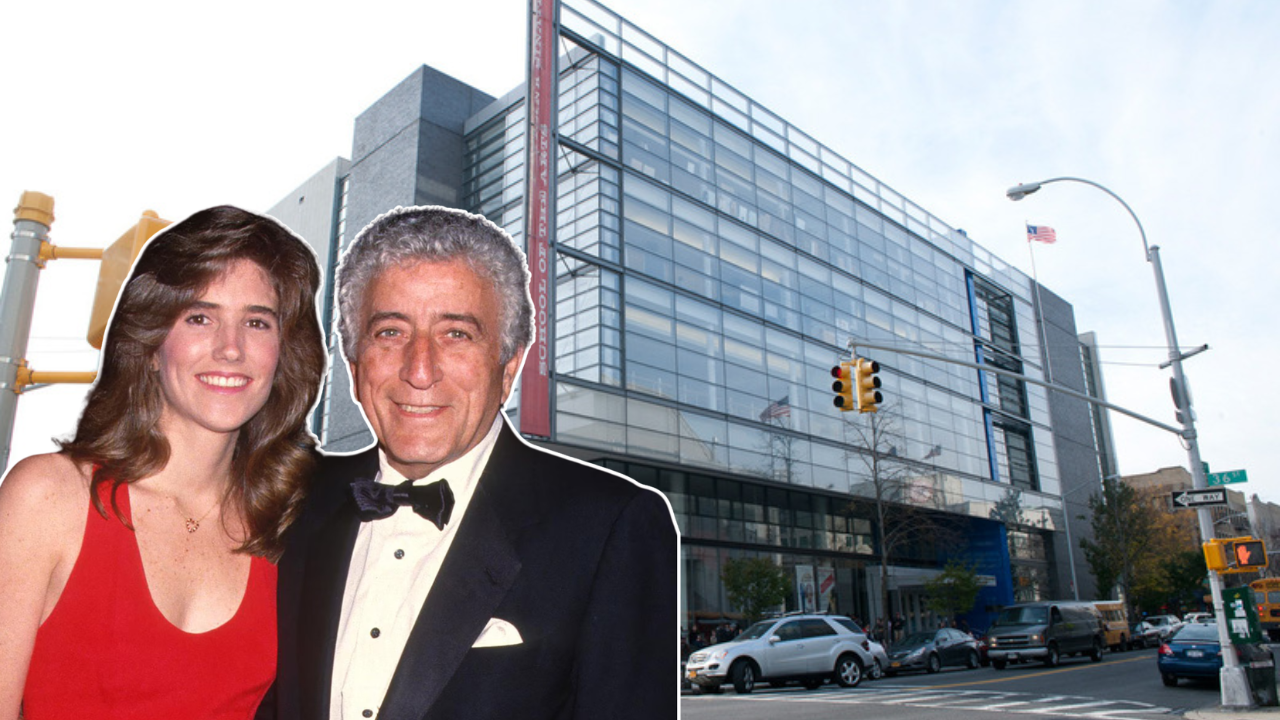
Two hundred and fifty teenagers in temporary rooms. That was how the Frank Sinatra School of the Arts began in 2001, back when public school budgets in New York City were already treating music, painting, and theater like luxuries you could cut whenever spreadsheets got tight.
Tony Bennett and his wife, former public school teacher Susan Benedetto, refused to treat art as an extracurricular treat. They wanted it woven straight into the daily public school day, right alongside math, science, and history.
Twenty-five years later, that 250-student experiment has grown into an Astoria powerhouse serving roughly 850 to 890 students inside a dedicated facility at the Kaufman Astoria Studios complex, backed by a concert hall named for Bennett, black box theaters, a film lab, and a fresh push through the new Tony Bennett Institute for Arts Education at Third Street. Honestly, when you look at how often school art programs get gutted first, watching this model hold its ground—and expand—is kind of remarkable.
How a 250-Student Idea Became a Queens Landmark
People often picture celebrity-backed schools as vanity projects with big ribbons and thin follow-through. That wasn't how this went. Working alongside the New York City Department of Education and local leaders, Bennett and Benedetto helped launch the school in 2001 in temporary quarters, then pushed through a capital campaign that brought the permanent building to life in 2009 in Bennett's own childhood neighborhood of Astoria, Queens.
Architect Susan T. Rodriguez of Ennead Architects designed the permanent home. Walking into a building etched with names like Vincent van Gogh, Marlene Dietrich, and Frank Lloyd Wright changes how teenagers carry themselves. Benedetto pointed out years ago that kids walk in, their shoulders go back, and they feel proud to be there—a detail any educator who has taught in under-resourced rooms immediately recognizes. When a teenager gets a real stage, a real studio, and adults who take their craft seriously, posture and standards shift fast.
Naming the school after Frank Sinatra rather than Bennett himself surprised some people at first. For Bennett, though, it came down to loyalty and friendship—honoring a close friend and colleague while building something meant to outlast both of them.
What Students Actually Study Inside Today
A lot of folks assume an arts high school lets kids coast through core academics if they can sing a scale or shoot a clean short film. At Frank Sinatra School of the Arts, that's a fast way to get humbled. Students follow a four-year curriculum pairing conservatory-style arts training with college-preparatory academics, including four years of math and science alongside English, social studies, and Advanced Placement options.
Students audition into six distinct arts majors:
- Dance: Ballet, modern dance, jazz, tap, choreography, dance history, and anatomy/kinesiology.
- Drama: Acting technique, scene study, speech for actors, dramatic writing, Shakespeare, and main-stage productions.
- Film and Media Arts: Video production, film history and theory, industry practices, and digital production tools.
- Fine Arts: Foundation skills, 2-D and 3-D design, painting, sculpture, printmaking, digital photography, and AP Art History.
- Instrumental Music: Small-group instruction, jazz and concert bands, orchestras, chamber ensembles, theory, and ear training.
- Vocal Music: Choirs, musical theater, Great American Songbook ensembles, opera workshop, voice training, and sight singing.
Performances and screenings take place in the venue bearing Bennett's name—listed as an 800-seat hall on the school's site—giving young performers and filmmakers real rooms and real audiences rather than makeshift auditoriums. According to NYC Public Schools and MySchools, admission relies on auditions, and recent school data shows high four-year graduation rates alongside strong college and career outcomes.
One nuance worth keeping straight: numbers vary slightly across public listings and press reports depending on the exact cohort or seat count measured (for instance, around 849 to 890 enrolled students in recent NYC reporting, and concert hall seating cited as 750 in some coverage vs. 800 on the school's website). Treat those minor variations as snapshot differences rather than contradictions.
Why One School Was Never Enough for Tony and Susan
Here's where most people miss the bigger picture. Opening a single selective high school—even a great one—doesn't fix public arts education on its own. Audition schools are vital, yet plenty of curious, talented kids don't get an audition seat or don't live near one.
That's why Bennett and Benedetto founded Exploring the Arts (ETA) in 1999 and expanded support to arts programs in other New York City public high schools starting in 2008, later extending partnership work beyond New York as well. And in November 2026—marking Bennett's centennial year and the 25th anniversary milestone around the school's founding era—Exploring the Arts and Third Street Music School announced plans for the Tony Bennett Institute for Arts Education at Third Street.
From my perspective as someone who has watched arts initiatives boom and fade over two decades, tying a flagship school to a broader ecosystem is the smartest move you can make. One building proves what's possible; partner networks and teacher/school support keep the doors open for kids who never set foot in Astoria.
Common Myths About Public Arts High Schools
- Myth: Arts schools are only for kids going straight to Broadway or art school. Plenty of graduates pursue creative careers, sure, yet rigorous academics plus creative problem-solving serve students across law, tech, healthcare, education, and business too.
- Myth: You can wing an audition with raw talent alone. Preparation matters. Actors need contrasting published monologues and scene work; musicians need scales, solo pieces, and sight-reading or rhythm checks; visual artists need portfolios and observational drawing.
- Myth: Public arts education is a "nice-to-have" extra. When students get consistent access to creative expression and disciplined practice inside school hours, engagement and belonging rise—especially for kids who thrive when making things with their hands, voices, or bodies.
Practical Next Steps If You're Planning Around Arts Education
If you're a parent, student, or local advocate looking at how to tap into this model—or build something like it locally—start small and concrete:
- Map local audition and community options early. If you're in New York City, check current MySchools requirements, audition rubrics, and open-house dates well ahead of eighth-grade deadlines, and look into community hubs like Third Street Music School alongside school programs. Anywhere else, check your district's magnet/audition calendar and municipal arts council.
- Prep your audition piece months ahead. Record yourself performing monologues or pieces on video, ask a teacher or mentor for blunt feedback on pacing and clarity, and practice cold reads or sight-reading under mild pressure so audition day doesn't feel unfamiliar.
- Support broader school arts, not just flagship campuses. If you want to help locally, back nonprofits, PTA arts funds, and district partnerships that bring instruments, studio supplies, and visiting artists into neighborhood schools—because one great school inspires the movement, while everyday classrooms sustain it.