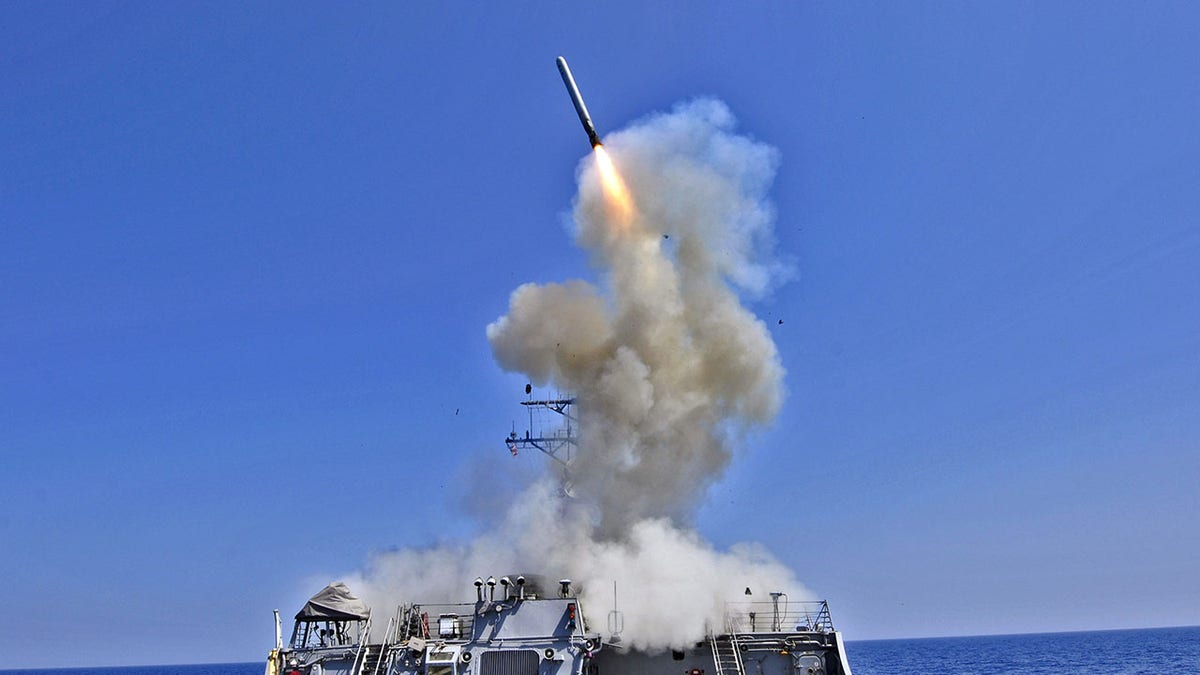
Counting missiles is the security equivalent of checking Instagram likes. It feels significant, it generates a big number, and it tells you absolutely nothing about the actual health of a military campaign. The recent reports fixating on the "850 Tomahawk" figure in the escalating friction between Washington and Tehran are a masterclass in superficial journalism. They treat a kinetic conflict like a game of Battleship, where the winner is whoever dumps the most expensive hardware into the ocean first.
If you’re measuring success by the volume of RGM-109s leaving a vertical launch system, you’ve already lost the plot. The "850" figure isn't a sign of American dominance. It’s a red flag indicating a lack of strategic creativity and a terrifyingly high burn rate for a weapon system that is becoming increasingly obsolete against peer competitors.
The Myth of the "Magic Bullet"
The media loves the Tomahawk because it’s a brand name. Since the 1991 Gulf War, it has been the go-to visual for "American Resolve." But here is the reality from someone who has spent years analyzing strike packages: a Tomahawk is a slow, subsonic flying bus. It is a 1970s solution to a 2026 problem.
When a report brags about 850 launches, it conveniently ignores the "Probability of Kill" ($P_k$). In a high-end electronic warfare environment like the one Iran has spent decades perfecting, a significant percentage of those $2 million-per-unit assets are being spoofed, jammed, or shot down by localized point defense.
We are trading million-dollar slugs for thousand-dollar decoys and concrete bunkers. That isn't a victory; it's a wealth transfer from the U.S. taxpayer to the defense industrial base, with no guaranteed shift in the geopolitical needle.
The Logistics of Exhaustion
Let's talk about the numbers the Hindustan Times and others won't touch: replenishment rates.
The U.S. Navy’s inventory of Tomahawks isn't infinite. In a sustained conflict with a regional power that has "home field advantage," the burn rate is the only metric that matters. If the U.S. fires 850 missiles in a single phase of a campaign, it is depleting a stockpile that takes years, not months, to replace.
Raytheon’s production lines are not optimized for "Total War." They are optimized for "Just-in-Time" delivery. While pundits cheer the fireworks, the actual planners in the Pentagon are likely sweating over the fact that we are emptying our magazines against a secondary threat while a primary competitor in the Pacific watches and takes notes on our dwindling inventory.
- The Cost-Exchange Ratio: If it takes three Tomahawks to reliably destroy a single mobile drone launcher that costs $50,000 to build, the U.S. is losing the economic war 120-to-1.
- The VLS Problem: Once a destroyer or cruiser fires its complement of missiles, it cannot reload at sea. It has to pull back to a specialized port. Every missile fired brings that ship one step closer to being a multi-billion dollar paperweight until it can navigate back to a friendly pier.
Why "Deep Strike" is a Shallow Strategy
The obsession with missile counts stems from a flawed premise: that you can "bomb a country into submission" from 1,000 miles away without putting boots on the ground or risk to pilots. This "Push-Button War" fantasy is what leads to reports focusing on the 850 number.
In reality, Iran’s military infrastructure is designed for this exact scenario. They have spent forty years hardening, burying, and dispersing their assets. They use "mosaic defense"—a decentralized command structure that doesn't collapse just because you hit a few headquarters in Tehran.
When you fire 850 missiles, you aren't dismantling a regime. You are pruning a hedge. It grows back. And it grows back meaner, having learned exactly how your guidance systems operate and where your blind spots are.
The Signal and the Noise
People often ask, "If we aren't using Tomahawks, what should we be doing?"
The answer is uncomfortable: Stop looking for the easy button. True strategic dominance in 2026 isn't about how much ordinance you can drop; it’s about how much of the enemy’s kill chain you can break without firing a single shot. Cyber-kinetic integration, sub-threshold maritime pressure, and the aggressive use of low-cost loitering munitions are the actual frontiers of modern warfare.
The Tomahawk is the "Big Iron" of the past. It’s useful for hitting static, poorly defended targets in the desert. Against a sophisticated adversary with integrated air defense (IADS), relying on a subsonic cruise missile is like bringing a musket to a sniper fight. It might work if you have enough muskets, but eventually, you run out of lead.
The Industrial Base Reality Check
I’ve sat in rooms where "surge capacity" was discussed. The consensus among those who actually build these things is grim. We have hollowed out our manufacturing to the point where a high-intensity conflict would exhaust our "smart" munitions in weeks.
The media focuses on the 850 missiles fired because it looks impressive on a map with red dots. They don't show you the map of the factories in the Midwest that can only churn out a fraction of that number per year. They don't mention that the specialized chips and rare-earth components inside those missiles often have lead times of 18 to 24 months.
Stop Asking "How Many" and Start Asking "So What?"
The next time you see a headline screaming about missile counts, ignore it. It is a distraction. Instead, ask these three questions:
- What was the verified BDA (Battle Damage Assessment) of those 850 strikes?
- How many of those missiles were fired at "shadow" targets or empty buildings?
- How long until the U.S. Navy has to rotate its fleet because of VLS depletion?
We have entered a world where the "overwhelming force" doctrine is dying. Modern warfare is about endurance, economic sustainability, and the ability to replace losses. When you fire 850 Tomahawks, you’re not showing your strength. You’re showing your hand. And for a smart adversary, it's a hand they know how to play against.
The real news isn't the number of missiles fired. It’s the number of missiles we don't have left.
Would you like me to analyze the specific supply chain bottlenecks for the Tomahawk RGM-109 Block V to illustrate the industrial base problem in more detail?