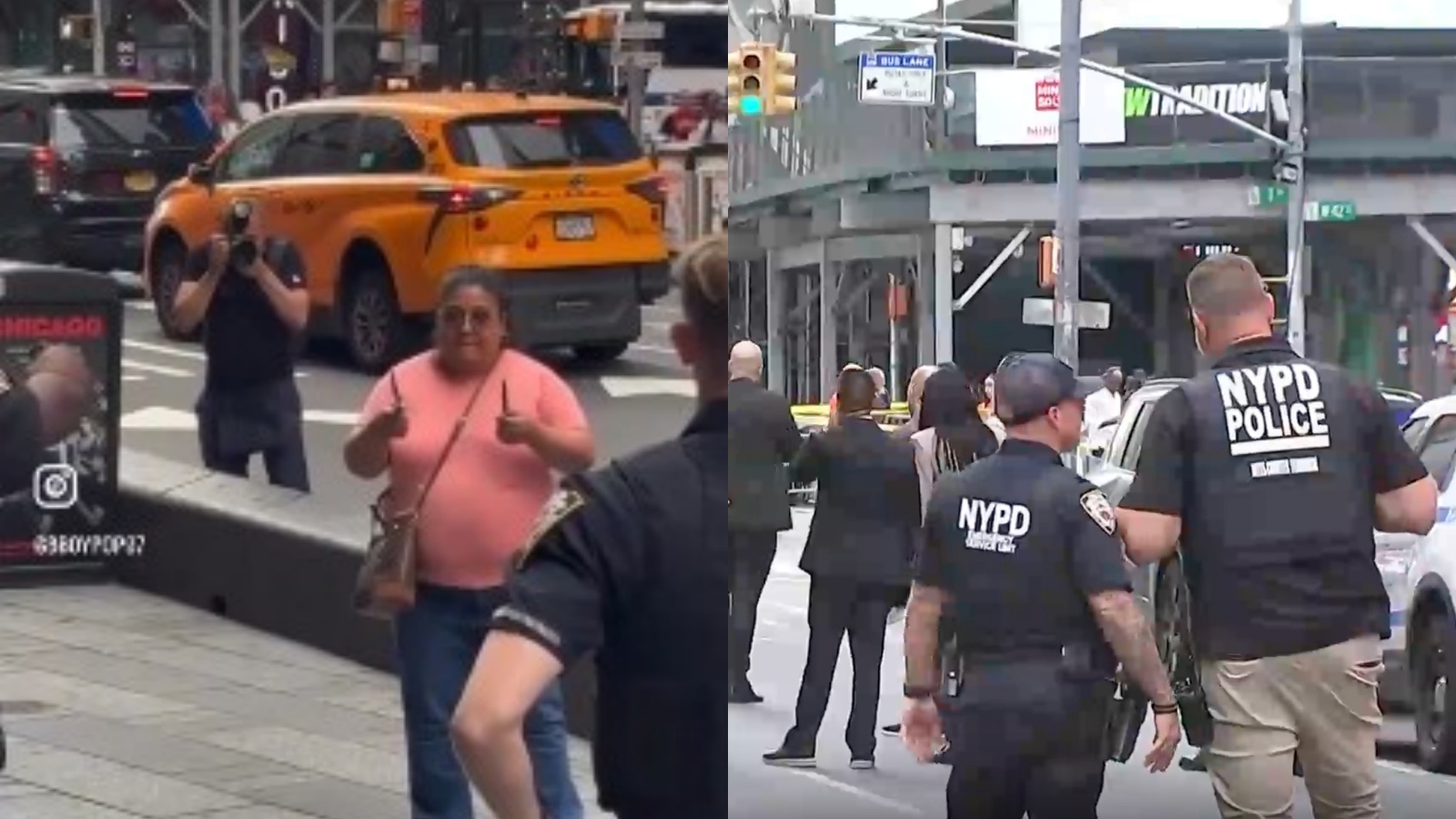
Urban public safety incidents involving active threats in high-density pedestrian corridors require immediate tactical intervention to prevent catastrophic casualties. When a violent actor initiates a lethal assault in a restricted geographic bottleneck like Times Square, the response window measured by law enforcement is compressed into seconds. Evaluating these events demands a systematic breakdown of tactical response, environmental constraints, and the physiological realities of high-stress kinetic engagements.
The Operational Environment and Threat Vector
Times Square functions as one of the highest-density pedestrian zones globally, processing hundreds of thousands of daily visitors within a confined footprint. This physical geometry introduces unique variables for security architectures. High foot traffic, structural blind spots, and ambient sensory overload degrade response times and complicate target identification for responding units.
An individual deploying an edged weapon in this environment exploits the inherent advantages of proximity. Unlike ballistic threats that require clear lines of sight across extended distances, contact-range knife attacks close the reaction gap instantaneously. The assailant initiates the sequence with total predictability of action while defenders operate under conditions of extreme information asymmetry.
Law enforcement personnel deployed to transit hubs and high-profile commercial districts operate on continuous threat monitoring protocols. When an active stabbing event begins, the primary objective shifts from perimeter containment to immediate disruption of the kill chain. The tactical timeline splits into distinct operational phases: identification, command transmission, spatial engagement, and lethal force application.
The Kinetics of Lethal Force Decision Making
Police intervention during an ongoing violent crime relies on statutory authority and tactical necessity. Under established use-of-force frameworks, officers are authorized to deploy lethal countermeasures when faced with an imminent threat of death or serious physical injury to themselves or the public.
In a dynamic street-level confrontation, the physical distance between the aggressor and victims dictates the response modality. The Tueller Drill, a foundational law enforcement concept, demonstrates that an attacker armed with an edged weapon can cover a distance of twenty-one feet in approximately 1.5 seconds, often outpacing an officer's ability to draw and fire a sidearm from a holstered position. When an officer encounters an active stabbing in progress at close quarters, the available margin for verbal de-escalation collapses.
The decision to discharge a firearm in a crowded urban corridor introduces secondary risk vectors, specifically regarding stray rounds and ricochets. Officers undergo specialized training to mitigate these environmental hazards through close-quarters positioning and muzzle discipline. However, the physiological stress response—often called auditory exclusion, tunnel vision, and sympathetic nervous system activation—fundamentally alters cognitive processing during the event. Precision aiming degrades into center-mass target acquisition to ensure the immediate cessation of the threat.
Post Incident Systems Analysis and Policy Implications
Following a fatal officer-involved shooting in a public space, institutional review mechanisms activate concurrently across multiple municipal and judicial bodies. The investigative architecture includes internal affairs evaluations, ballistics forensics, video evidence synthesis from municipal surveillance systems, and independent oversight reviews.
The investigative process reconstructs the timeline through digital forensics. Security camera feeds, body-worn camera footage, and civilian smartphone recordings are synchronized to establish the exact sequence of movements, the duration of the assault, and the precise intervals between officer arrival and weapon discharge. This digital audit trail provides objective validation of the tactical decisions executed under duress.
Policy frameworks governing these interventions continuously adapt based on empirical findings from urban security data. Municipal agencies evaluate the deployment distribution of specialized units, response time metrics, and the integration of less-lethal alternatives. While tools like conducted electrical weapons offer non-lethal options for certain scenarios, their efficacy against an active, highly motivated assailant armed with a contact weapon remains severely constrained by deployment distance and heavy clothing layers. Consequently, lethal force remains the baseline standard for neutralizing active threats where human life is concurrently being extinguished.
Deploy integrated high-resolution closed-circuit surveillance grids coupled with predictive acoustic gunshot and kinetic anomaly detection software to reduce initial law enforcement reaction latency in major pedestrian hubs.