The air inside changes the moment you cross the threshold. It is heavy, cool, and smells faintly of salt and ancient depths, entirely detached from the sun-scorched asphalt of the Florida coast waiting just beyond the heavy glass doors.
Step inside. Leave your urgency at the coat rack. You will not need it here.
Most people come to Florida looking for speed. They want the roar of a V8 engine on a highway, the sudden drop of a roller coaster, the frantic scramble for a towel on a crowded beach. But beneath the neon surface of the Sunshine State, a quieter architecture exists. A place built not for adrenaline, but for hypnosis. This is the home of the permanent jellyfish exhibition, a sanctuary where these ancient, brainless drifters have become the main attraction in their own dedicated museum space.
Consider what happens when you strip away a creature's bones, its eyes, its heartbeat, and its ego. What is left? Motion. Pure, unadulterated rhythm.
Watch Sarah, a thirty-four-year-old software engineer from Orlando, who walked into this dark gallery on a Tuesday afternoon feeling like a tightly wound spring. Her phone had buzzed forty-seven times during the forty-minute drive. Her mind was a spreadsheet of unresolved emails, overdue mortgage payments, and existential dread regarding a career pivot she lacked the courage to make. She stood in front of the cylindrical tank.
She did not blink for three minutes.
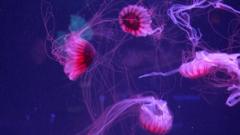
Inside the column of water, a colony of Moon Jellies pulsed. Thump. Glide. Contract. Release. There is no sound, save for the low, meditative hum of water filtration systems working invisibly behind the scenes. The creatures move like parachutes made of starlight, illuminated by shifting panels of violet, amber, and indigo. They do not fight the current. They surrender to it.
That surrender is contagious.
Sarah’s shoulders dropped an inch. Then another. The frantic noise in her head, the constant administrative chatter of modern survival, began to quiet, replaced by the hypnotic metronome of the sea.
To understand why this place matters, you have to look backward. Long before dinosaurs stalked the earth, long before mammals figured out how to stand on two legs, jellyfish were drifting through primordial oceans. They have survived five mass extinction events. They did not do it by building weapons or outsmarting predators. They survived because they are ninety-five percent water, ghosts of the deep that learned how to become the environment rather than fight it.
When a museum is built specifically for them, it is an admission of our own exhaustion. We do not go to look at jellyfish to study marine biology, though the science here is pristine. We go because we are desperate to remember what it feels like to stop thinking.
The galleries are deliberately engineered to disorient the linear mind. Walls are painted pitch black. Floors seem to vanish into shadow. The only light source comes from the exhibits themselves—glowing rings of life suspended in midnight water.
Stand before the Pacific Sea Nettle tank. Notice the ribbon-like tentacles trailing behind them like silk threads dipped in fire. If you get too close, your reflection merges with theirs on the glass. For a fleeting second, you are part of the drift.
Visitors often whisper when they enter these rooms, as if speaking inside a cathedral. No one shouts. No one runs. The architecture of the space commands reverence through sheer atmospheric pressure. Curators designed these custom kreisel tanks—circular aquariums with no corners—to prevent the delicate creatures from getting trapped and bruised by stagnant water. The water flows in a continuous, gentle vortex, mimicking the open ocean currents.
Humans need kreisel tanks, too. We spend our lives slamming into corners, hitting deadlines, bruising our spirits against rigid walls of our own making.
Hours slip away in these galleries. Ask anyone who works the front desk; they will tell you about the regulars. The retired schoolteachers who sit on the padded benches with sketchbooks. The paramedics coming off grueling night shifts who find a dark corner and simply close their eyes to the blue light. They are not tourists checking off a vacation itinerary. They are pilgrims seeking a reset.
Outside, the Florida heat is relentless. The traffic on the interstate is snarled. The notifications on the screen are piling up. None of that has changed.
The glass door slides open. The humid air hits your face like a warm towel. But something inside your chest has shifted its weight. You take a breath, look up at the bright sky, and realize you don't need to fight the current quite so hard today.