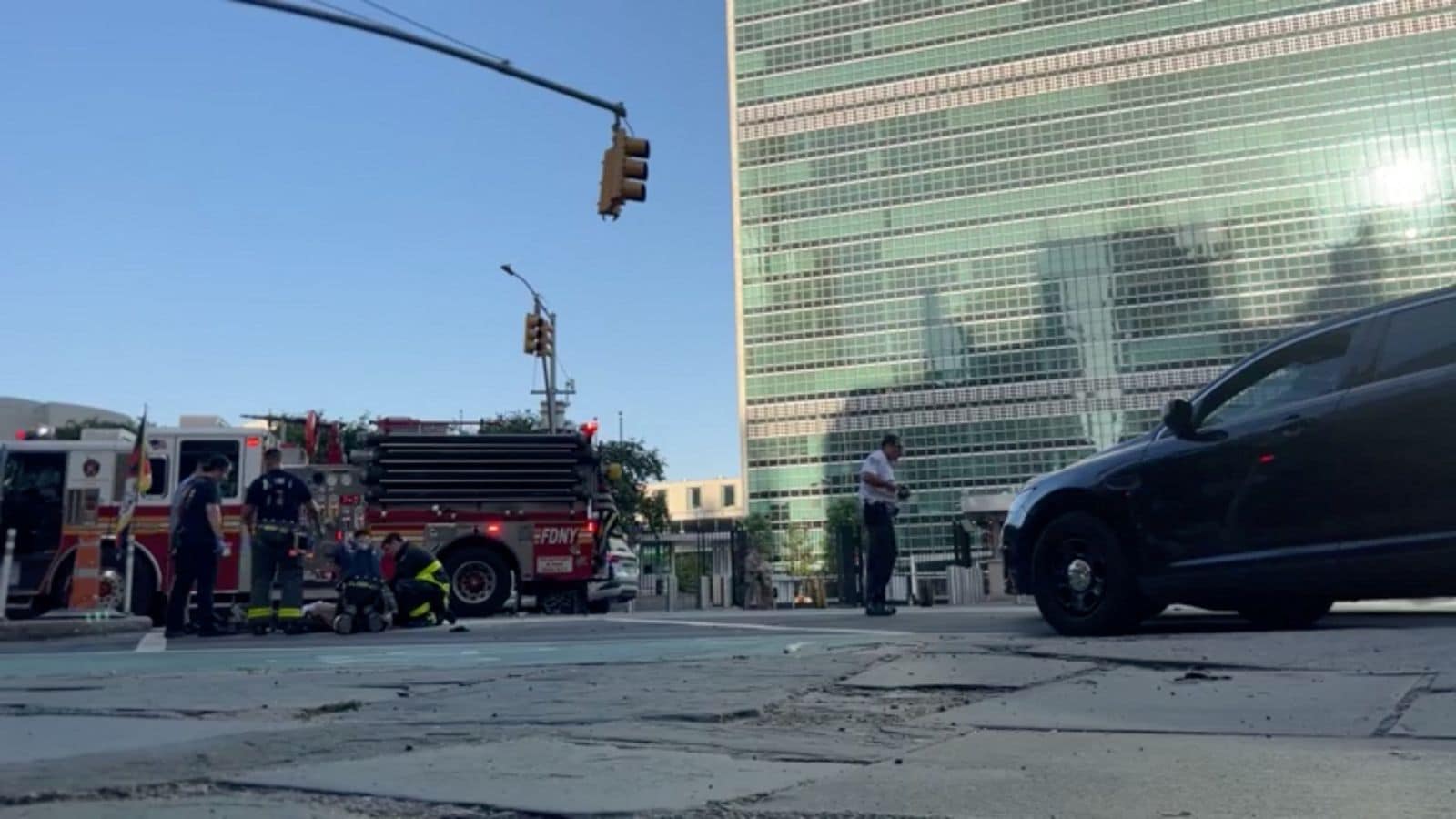
On July 2, 2026, the evening rush hour in Manhattan was moving just like any other Thursday. Cars honked. Pedestrians rushed toward Grand Central. Then, right outside the United Nations headquarters near East 43rd Street and First Avenue, a man changed everything.
Lobga Rangzen, a 42-year-old Tibetan immigrant who spent the last two decades driving an Uber in America, walked onto the pavement. He was wearing traditional monastic robes. He calmly placed a Tibetan flag on the sidewalk. He started a live stream on Facebook to broadcast his final words to the world. Then, he poured fuel over his body and set himself on fire.
Witnesses watched in horror as he became engulfed in flames. Passing drivers continued to honk, some out of confusion, others out of sudden panic. Within fifteen seconds, first responders rushed over with fire extinguishers to douse the flames, but the damage was done. Rangzen was rushed to Bellevue Hospital, where doctors pronounced him dead. Left behind on the soot-stained concrete was a pristine Tibetan flag and a scattered pile of leaflets bearing a simple, devastating demand: "CHINA OUT OF TIBET."
This isn't a random tragedy. The agonizing reality of why a Tibetan man self-immolates outside UN HQ a day after China enforces ethnic unity law points directly to a massive shift in Beijing's strategy to erase an entire culture. It's an act of ultimate protest against a piece of legislation that went into effect just days ago. This new law marks the beginning of a terrifying new phase of forced cultural erasure.
The Brutal Reality of China's New Ethnic Unity Law
Beijing calls it the Ethnic Unity and Progress Law. Don't let the polite name fool you. This legislation, which officially took effect at the start of July 2026, is a coordinated legal weapon designed to strip the country's 55 recognized ethnic minority groups of whatever cultural autonomy they have left. This targets Tibetans and Uyghurs directly.
The law mandates the creation of a unified national identity. In plain terms, that means erasing distinct languages, local religious traditions, and historical narratives to replace them with a state-approved version of Chinese nationalism. Under this law, practicing traditional Tibetan customs or teaching children their native language can easily be reclassified as an act of separatism or an attack on national solidarity.
What drove Lobga Rangzen to make the ultimate sacrifice in New York wasn't just what this law does inside Tibet. It's what the law claims it can do outside China's borders.
The most alarming aspect of this 2026 legislation is its explicit assertion of extraterritorial jurisdiction. Beijing has given itself a legal framework to target, track, and punish activists living anywhere on earth. If an exile in New York, Zurich, or London speaks out against Chinese policy, the state now considers them a criminal under Chinese law. It opens the floodgates for escalated transnational repression, allowing Chinese security agencies to legally justify harassing the families of exiles still living back home.
Rangzen knew this. His friends in the local immigrant community stated he was completely enraged by the suffocating new rules. By setting himself on fire outside the United Nations, he chose the ultimate way to scream back at a totalitarian state that is actively trying to silence the entire global Tibetan diaspora.
A History Written in Flames
To understand why someone would choose such an agonizing death, you have to look at the numbers. Rangzen is not an isolated case. He's part of a horrific, ongoing historical pattern.
Since March 2009, more than 150 Tibetans have set themselves on fire to protest Chinese occupation. Most of these acts occurred within the tightly locked-down borders of Tibet itself, where traditional protests are met with immediate live gunfire or lifetime imprisonment. When a protest happens inside Tibet, the government cuts off internet access, blocks cell towers, and arrests anyone who dares to share a photo of the incident with the outside world.
The International Campaign for Tibet has tracked these events meticulously. At least ten of these self-immolations have occurred outside Tibet, carried out by exiles who felt completely helpless as they watched their homeland undergo systematic demographic and cultural replacement.
Look at what these protesters yell out before they collapse. They aren't asking for economic aid or better jobs. They shout for the long life and return of the Dalai Lama, the release of the Panchen Lama, and basic human rights.
China took control of Tibet back in 1950, sending the People's Liberation Army across the border in what Beijing still insists on calling a peaceful liberation from feudalism. In 1951, Tibetan leaders were forced to sign the Seventeen Point Agreement under military duress, solidifying Chinese administrative and military control. Since Xi Jinping assumed power in 2012, the level of surveillance has reached dystopian levels. Facial recognition cameras line the streets of Lhasa. DNA samples are harvested from ordinary citizens. Monasteries are managed by state officials. The new ethnic unity law is simply the final nail in the coffin, designed to finish the job that started decades ago.
Why the Location Matters
Lobga Rangzen didn't choose a busy intersection in Queens or a Chinese consulate in a quiet neighborhood. He chose the front steps of the United Nations. He wanted to force the international community to look at the cost of its own diplomatic cowardice.
The United Nations has a long, embarrassing history of staying quiet when it comes to Chinese human rights abuses. Because Beijing holds a permanent seat on the UN Security Council, it wields massive veto power and immense financial influence over various UN sub-agencies. Human rights reports regarding Tibet or Xinjiang are routinely delayed, watered down, or buried under mountains of bureaucratic red tape.
The United Nations High Commissioner for Human Rights recently called for the repeal of the ethnic unity law, but these statements lack any real teeth. Western governments like the United States and the European Union express deep concern, yet they continue to trade heavily with the very regime building the camps and drafting the assimilation laws.
Rangzen's death is a direct message to every diplomat walking into that Manhattan skyscraper. It says that while you sit in air-conditioned rooms debating resolutions and economic partnerships, real people are burning themselves alive on your doorstep just to get you to notice their existence.
The Myth of a Peaceful Rise
For years, global corporations and politicians bought into the narrative that economic integration would naturally cause China to moderate its authoritarian tendencies. That theory turned out to be completely wrong. Instead of global capitalism democratizing China, the Chinese Communist Party used its vast wealth to build the most sophisticated surveillance state in human history.
The ethnic unity law proves that Beijing has no intention of allowing diversity to exist within its borders. The state views any identity that doesn't place absolute loyalty to the party above all else as a direct threat to national security.
Think about the sheer desperation required to buy a can of gasoline, stand in front of a crowd of strangers, and strike a match. It runs entirely counter to basic human survival instincts. When people turn to self-immolation, it means every other path for political expression has been completely blocked. There are no independent courts in Tibet. There are no free newspapers. There are no peaceful protest zones. There is only the state, and the state wants you to disappear.
What Happens Now
The shockwaves from this Manhattan sidewalk are already spreading across the globe. Parliamentary groups in the United Kingdom, Germany, and Switzerland are facing renewed pressure from activists to respond to this tragedy by implementing actual policy changes rather than just issuing hollow press releases.
We can expect Beijing to stick to its usual script. The state media will likely smear Lobga Rangzen, labeling him as mentally unstable, a criminal, or a tool manipulated by foreign anti-China forces. They will double down on security inside Tibet, pre-emptively arresting anyone who might try to honor his sacrifice or replicate his protest.
If you care about human rights, you can't let this story fade out of the news cycle in 48 hours. Here is how you can take direct action today.
First, contact your local representatives and demand they support legislation targeting transnational repression. The fact that a foreign dictatorship can pass laws threatening US residents on American soil is completely unacceptable. Governments must sanction the specific officials who drafted and enforced the Ethnic Unity and Progress Law.
Second, support grassroots organizations like the International Campaign for Tibet and the Free Tibet movement. These groups work constantly to bypass Chinese censorship, verify data, and ensure that the names of those who die for freedom are never forgotten.
Lobga Rangzen spent twenty years driving a car through the streets of America, enjoying the freedoms of a democracy while carrying the immense weight of his homeland's suffering. He gave up his life to make sure the world couldn't look away from Tibet's ongoing cultural destruction. Don't let his final, desperate act disappear into the background noise of the internet.