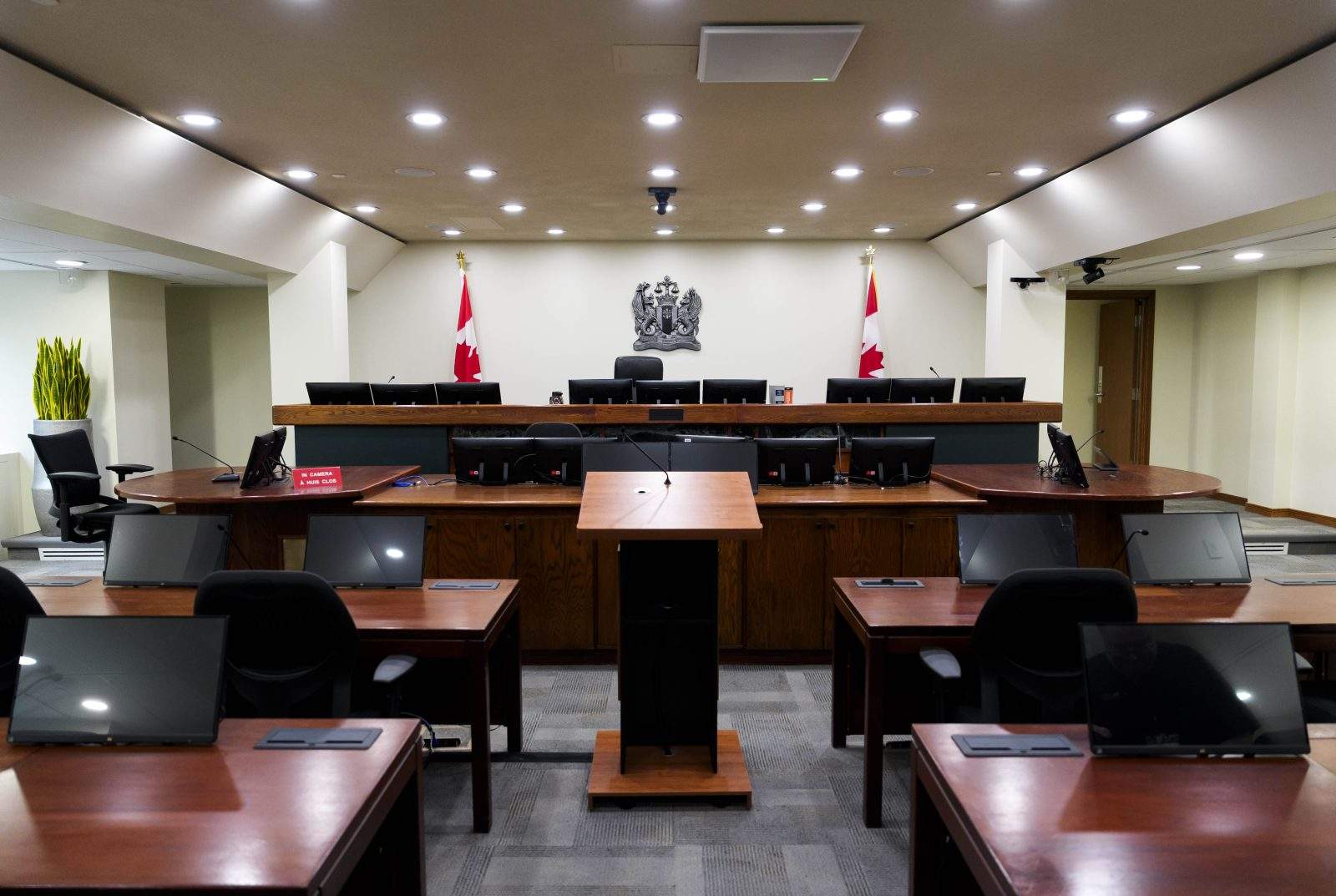
Throwing capital at a congested judicial system without altering its underlying operational architecture rarely clears a backlog. In federal courts facing massive caseloads, skepticism from practicing attorneys regarding the efficacy of extra funding is rooted in basic queuing theory and institutional economics. When a system suffers from structural bottlenecks, unallocated or poorly targeted financial injections merely subsidize existing inefficiencies rather than expanding true case-disposition capacity. Clearing a federal docket requires isolating the exact constraints governing judicial throughput, distinguishing between fixed statutory friction and variable administrative capacity, and applying capital strictly to the rate-limiting steps of litigation.
The Queuing Theory of Judicial Congestion
A federal court operates as a multi-stage processing pipeline governed by Little's Law, which states that the average number of items in a queuing system ($L$) equals the average arrival rate ($\lambda$) multiplied by the average time an item spends in the system ($W$).
$$L = \lambda W$$
In litigation terms, $L$ represents the active pending caseload, $\lambda$ represents new filings per unit of time, and $W$ represents the average time to disposition. Practitioners express doubt about budget increases because extra funding rarely alters $\lambda$, and unless it directly compresses $W$ at the narrowest point of the pipeline, $L$ remains static or continues to grow.
Induced Demand and the Supply-Side Trap
Expanding judicial infrastructure without procedural reform triggers an economic phenomenon analogous to the Lewis-Mogridge Position in civil engineering: adding capacity to a congested network induces latent demand, quickly returning the system to equilibrium congestion.
- Lowered Filing Thresholds: When litigants and institutional plaintiffs perceive faster docket movement, the expected net present value of filing a claim increases. Marginal suits that were previously deterred by multi-year delays enter the pipeline, pushing $\lambda$ upward.
- Prolonged Discovery Cycles: Increased administrative staffing or extended courtroom availability often encourages counsel to file more complex, granular motions rather than settling early. The available capacity is absorbed by deeper litigation per case rather than higher total case volume.
- Appellate Feedback Loops: Accelerating trial-level rulings without simultaneously expanding appellate capacity simply shifts the queue downstream. Cases return to the trial docket via remands, artificially inflating the arrival rate with recycled litigation.
Deconstructing the Judicial Production Function
To understand why lawyers doubt the impact of raw funding, one must examine the judicial production function. Judicial output—measured in resolved controversies—is constrained by three distinct operational inputs. Funding only improves throughput if it expands the scarcest input.
1. Non-Scalable Judicial Attention
The ultimate bottleneck in any Article III or federal tribunal is the cognitive bandwidth of the presiding judge. Unlike clerical processing, judicial decision-making on dispositive motions, evidentiary hearings, and bench trials cannot be easily parallelized or delegated without compromising constitutional and statutory mandates.
Hiring additional law clerks or administrative staff provides diminishing marginal returns once a judge's reading, deliberation, and courtroom hours hit physical limits. If a judge can preside over a fixed number of trial days per year, doubling the administrative budget will not double the number of jury verdicts. Capital spent on peripheral operations fails to move the needle when the primary constraint is the statutory authorization and confirmation of new judgeships—a political variable insulated from routine budget appropriations.
2. Procedural Friction and Mandatory Timelines
Federal litigation is governed by rigid procedural rules—such as the Federal Rules of Civil Procedure, statutory notice periods, and constitutional speedy-trial mandates—that create irreducible minimum durations for $W$.
Consider a standard complex civil dispute. Even with unlimited funding, the system cannot compress the mandatory waiting periods for service of process, responsive pleadings, statutory discovery windows, and briefing schedules on summary judgment. When criminal dockets surge, statutory speedy-trial requirements force courts to prioritize criminal proceedings, pushing civil trials indefinitely into the future. Extra funding for courtrooms or technology cannot override statutory priority hierarchies; it merely maintains the waiting room while civil litigants sit in queue.
3. External Party Incentives
Courts do not control the pace of litigation in isolation; they share operational control with external actors—government prosecutors, public defenders, corporate defense firms, and plaintiffs' counsel.
If the court receives an appropriation to double its hearing capacity, but the local public defender's office, government litigation division, or private bar lacks the personnel to staff concurrent trials, hearings must still be continued. Unilateral funding creates an asymmetric system where the bench is ready to proceed, yet motions for continuances remain at historic highs because external counsel are double-booked across parallel dockets.
Where Capital Fails vs. Where Capital Converts
Evaluating whether a funding injection will reduce a federal caseload requires categorizing expenditures into low-leverage maintenance and high-leverage constraint removal. Most legislative appropriations default to the former because it is administratively simple to execute.
Low-Leverage Capital Allocations
- General Administrative Overhead: Increasing budgets for standard clerical staffing, physical facility upkeep, or non-specialized support personnel addresses peripheral friction. While necessary for baseline operations, these expenditures do not accelerate the resolution of contested legal issues.
- Legacy IT Patching: Spending money to maintain or marginally upgrade antiquated case-management databases without redesigning workflow logic digitizes paper bottlenecks rather than eliminating them.
- Unconditional Overtime and Temporary Stipends: Paying existing staff to work longer hours yields temporary, marginal gains followed by severe burnout and attrition, ultimately degrading long-term institutional knowledge and slowing down future case processing.
High-Leverage Capital Allocations
Capital successfully compresses $W$ only when directed at mechanisms that divert cases away from the primary judicial bottleneck or standardize repetitive analytical tasks.
- Expanded Magistrate Judge and Special Master Infrastructure: Funding additional magistrate judges, mediator panels, and specialized settlement officers creates parallel processing tracks. By offloading discovery disputes, pretrial conferences, and routine non-dispositive motions from district judges, this capital directly protects the scarcest resource in the system.
- Automated Triage and Docket Analytics: Investing in algorithmic case-routing systems allows courts to identify and group related filings, flag jurisdictional defects immediately upon intake, and fast-track simple administrative appeals before they consume substantive chambers time.
- Balanced Ecosystem Funding: Appropriations must be indexed across the entire courtroom ecosystem. Matching judicial budget increases with proportional funding for federal defenders, prosecuting attorneys, and legal aid clinics prevents external counsel bottlenecks from stalling newly opened courtroom calendars.
Diagnostic Framework for Evaluating Court Funding Proposals
Practitioners and policymakers assessing whether a specific budget increase will clear a federal backlog should apply a four-step diagnostic sequence rather than relying on topline dollar figures.
First, audit the bottleneck ratio. Compare the ratio of pending weighted filings per authorized judgeship against the ratio of administrative staff per judge. If weighted filings per judge exceed standard capacity thresholds while support ratios remain stable, non-judicial funding will produce near-zero backlog reduction.
Second, measure continuance attribution. Track the percentage of delayed hearings caused by court unavailability versus external party unpreparedness. If external counsel drive the majority of delays, internal court funding must be paired with strict case-management enforcement and external agency appropriations.
Third, isolate the civil-criminal displacement rate. Calculate how many civil trial dates are vacated annually due to criminal docket priority. In jurisdictions with high criminal arrival rates, general funding will be entirely absorbed by criminal case processing, leaving civil backlogs untouched unless dedicated civil-only adjudication tracks are established.
Fourth, evaluate procedural deflection metrics. Determine what percentage of total filings terminate via early dismissal, mandatory mediation, or magistrate settlement prior to summary judgment. Funding initiatives that fail to include explicit targets for increasing early-stage deflection will simply push larger volumes of cases into the most expensive, time-consuming phase of litigation.
The Structural Reality of Docket Clearance
A financial injection is an accelerant, not a redesign. If a federal court's workflow is structurally flawed—characterized by uncoordinated scheduling, asymmetrical party resources, and an over-reliance on scarce district judge hours for routine case management—extra money merely funds a more expensive backlog.
To convert capital into measurable docket reduction, court administrators and lawmakers must abandon blanket budget increases in favor of conditional, constraint-targeted appropriations. Every dollar allocated to a congested federal tribunal should be tied strictly to expanding parallel adjudication capacity through magistrate judges, enforcing non-negotiable pretrial scheduling orders, and synchronizing funding across both the bench and public litigation offices. Without simultaneous structural reform of how cases enter and move through the pipeline, skepticism from the bar remains the only rational assessment of fiscal intervention.