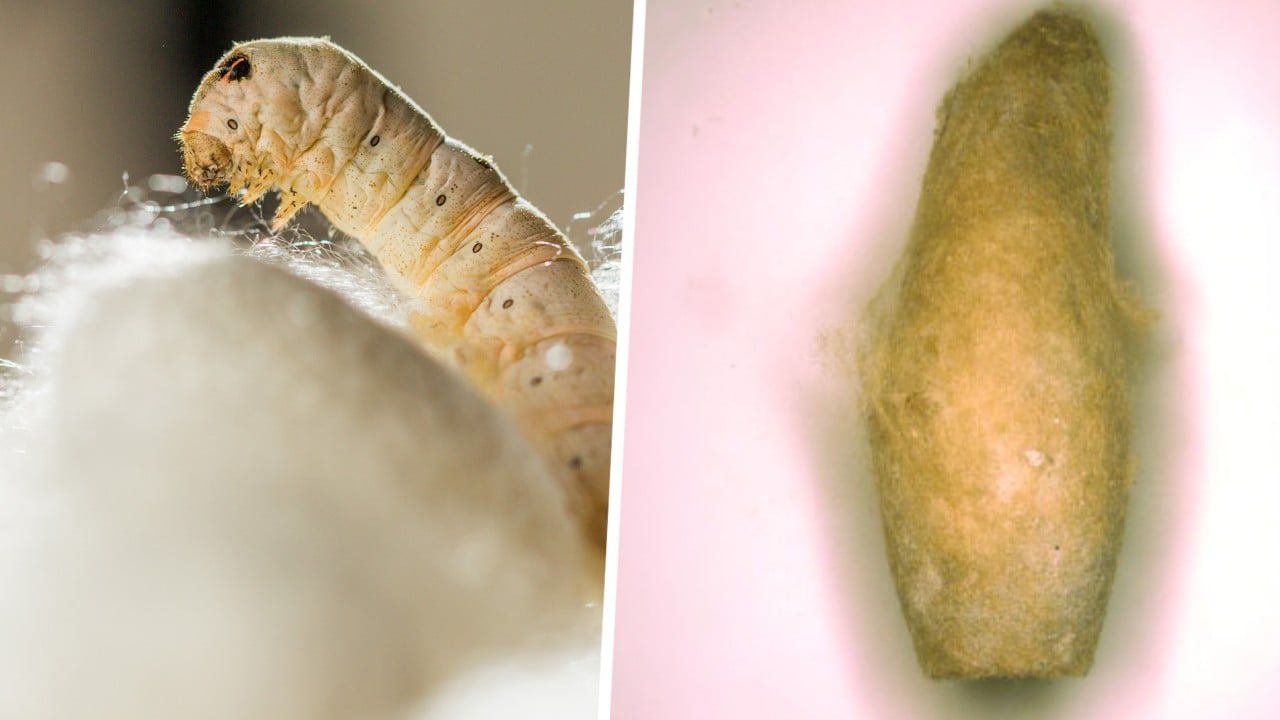
Silk does not shout. It whispers against the skin, a cool breath of luxury that feels entirely effortless. When you pull a fine scarf from your neck or trace the interior lining of a tailored jacket, you touch a substance born of meticulous violence. Thousands of microscopic cocoons, boiled alive, their fragile filaments reeled together by hands that vanished centuries ago. We thought we knew where those hands first moved. We were wrong.
History is rarely a straight line drawn by triumphant empires. More often, it is a tangle of dropped threads waiting for someone to pull.
For generations, the origin story of silk was a geographical monopoly. China held the secret, locking the mulberry groves and the precious Bombyx mori caterpillars behind an economic iron curtain. The Silk Road was born of this exclusivity—a staggering web of caravanserais, desert tracks, and mountain passes stretching from the East to the gates of Rome, built on the desperate Western hunger for a fabric lighter than air and richer than gold. Every school textbook agreed. Silk belonged to China, and China alone, until the Byzantine Empire smuggled out the eggs centuries later in hollow walking sticks.
Then came the dirt.
Archaeologists working far outside traditional boundaries do not usually expect to rewrite global commerce with a shovel. They look for shards of pottery, broken bones, burnt hearths. But sometimes, science listens closer to the silent sediment.
Picture a dusty trench in a region long dismissed as a periphery of the ancient world. The air is dry, smelling of sun-baked clay and crushed thyme. A researcher brushes away centuries of accumulated grime from a burial site, uncovering tiny, unassuming fragments clinging to ancient bronze or preserved in bone. Under a high-powered microscope, the truth refuses to stay buried. Protein structures. Microscopic residues. The undeniable molecular signature of silk fibroin.
Evidence of earliest silkworm farming outside China has officially surfaced, and with it, the entire timeline of the ancient world's most glamorous trade route has been quietly upended.
Consider what this means. Long before Roman senators bankrupt their provinces to drape themselves in Chinese imports, long before merchants braved the Taklamakan Desert where the sand dunes shift like orange oceans, people elsewhere were already tending to these strange, voracious little caterpillars. They were harvesting the harvest of the mulberry tree. They were spinning.
We tend to view antiquity through the lens of monoliths. We see Rome as the center of power, China as the sole font of technological marvels, and the spaces between as empty voids crossed only by desperate traders. Reality was far messier, far more interconnected, and infinitely more human. Innovation does not wait for official permission. It bubbles up wherever people look at a natural resource, see potential, and decide to experiment.
Imagine a weaver sitting in the dim interior of a prehistoric dwelling. Outside, the wind howls across an unfamiliar steppe or a Mediterranean valley. Inside, the light of an oil lamp catches the sheen of a thread drawn from a boiled cocoon. This weaver does not know about the Silk Road. They do not know about Roman sumptuary laws or Han Dynasty emperors. They only know the rhythm of their own fingers, twisting raw, rebellious nature into something soft enough to wear against a newborn's skin.
That is where history actually happens. Not in the grand proclamations carved into marble, but in the quiet persistence of craft.
The new findings force us to confront a humbling truth: our maps of the ancient world are always too small. We draw neat borders around civilizations because it helps us teach history in forty-minute increments. But humanity has always leaked across those borders. Ideas traveled on the wind, carried by refugees, itinerant traders, and wandering craftspeople who took their secrets with them wherever they walked.
A caterpillar does not care about geopolitical boundaries. It eats mulberry leaves, spins its golden prison, and waits. And humans, across vast distances and separated by trackless wilderness, looked at that exact same miracle of metamorphosis and decided to make it their own.
The Silk Road was never just a highway from one superpower to another. It was an awakening. It was the moment disparate pockets of human ingenuity realized they were all reaching for the exact same threads. When we rewrite the timeline of silk, we are not just adjusting dates in a textbook. We are restoring a lost chapter of human curiosity—proving that brilliance was never confined to a single empire, and that the urge to create beauty out of the raw earth is as old as civilization itself.