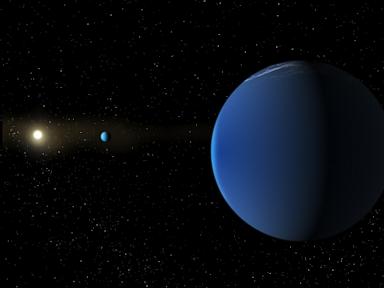
Imagine a planet the size of Jupiter that has the actual density of shaving cream or a ball of spun sugar. You couldn't step on it. You couldn't even drop an anchor into it. It's essentially a massive, cosmic illusion. Astronomers just found a pair of these bizarre worlds, and they're officially the largest super-puff planets ever recorded.
These aren't your typical gas giants. They defy basic physics models of how planets form and survive. Found orbiting a star 1,110 light-years away in the southern constellation Volans, these sibling worlds have sent shockwaves through the astrophysics community. The team behind the discovery, led by George Dransfield at the University of Oxford, openly admits that these things shouldn't really exist under our current understanding of the cosmos. Learn more on a related subject: this related article.
People look at the night sky and assume planets are solid chunks of rock or dense balls of compressed gas like Jupiter. This discovery completely flips that script. It proves our galaxy loves making weird things that mock our neat little scientific textbooks.
The Impossible Density of TOI-791 Sibling Worlds
The two newly analyzed planets, labeled TOI-791 b and TOI-791 c, are gargantuan. They match the massive physical dimensions of Jupiter. But their weight tells a completely different story. Jupiter is a heavy, dense beast. These two new things are featherweights. More reporting by NBC News delves into comparable perspectives on the subject.
To understand how absurd this is, look at the actual numbers. Jupiter has a density of roughly 1.33 grams per cubic centimeter. Earth sits at a heavy 5.51 grams per cubic centimeter because of its iron core and rocky crust. These new super-puff planets have densities hovering around 0.02 to 0.04 grams per cubic centimeter. That makes them less dense than the cotton candy you buy at a state fair. It makes them 35 times less dense than Jupiter.
George Dransfield described them as being comparable to a fresh blob of shaving foam straight from the can. If you could somehow find a bathtub big enough to hold them, they wouldn't just float. They would practically sit on top of the water like empty plastic bubbles.
We aren't talking about a rare chemical compound here. Astronomers suspect these worlds are almost entirely comprised of pure hydrogen and helium. These light gases form an incredibly bloated atmosphere that stretches out for tens of thousands of kilometers. This atmosphere wraps around a tiny, negligible core. It's a giant cloud pretending to be a solid planet.
How Citizen Scientists Beat the Billion-Dollar Algorithms
The story of how we found these worlds is just as wild as the planets themselves. They weren't flagged by an AI script or a supercomputer. Instead, everyday people doing free volunteer work spotted them first.
Volunteers working with the Planet Hunters TESS project combed through mountain ranges of public data from NASA’s Transiting Exoplanet Survey Satellite. They flagged the subtle dipping of starlight that happens when a planet passes in front of its sun. The human eye is still remarkably good at finding patterns that algorithms miss.
After those initial flags, an international coalition of scientists spent eight long years verifying the data. They used ground telescopes scattered across the planet, including extreme observatories down at Concordia Station in Antarctica.
Measuring the size of a planet is easy. You just look at how much starlight it blocks. Measuring its mass is the real nightmare. Astronomers normally use the radial velocity method, watching how much the planet’s gravity pulls and wiggles its host star. But because these planets are so incredibly light, their gravitational pull is almost nonexistent. It took nearly a decade of careful calculations to finally pin down their true weight.
The Weird Gravitational Dance Keeping Them Alive
These two puffy planets share a bizarre orbital relationship that keeps them locked together in space. They operate in a 5:3 mean-motion resonance. This means the inner planet completes exactly five orbits around the star in the exact same timeframe that the outer planet takes to complete three.
This isn't just a fun math coincidence. It is a critical survival mechanism. This tight gravitational lock creates a constant push-and-pull dynamic between the two worlds.
Planet Resonance Matrix:
TOI-791 b (Inner): 5 Orbits
TOI-791 c (Outer): 3 Orbits
System Status: Locked in Gravitational Resonance
Most super-puff planets are unstable. When a planet sits too close to its host star, the intense stellar radiation strips away the light atmosphere. The planet essentially evaporates over time. The upper layers of these atmospheres are constantly bleeding gas into space. Yet, these worlds remain inflated.
Scientists are currently debating two main theories on how this happens. The first theory suggests these planets were born much further out in the freezing depths of their solar system, where gases are easy to capture. They then migrated inward over billions of years. The second theory points to internal tidal heating. The gravitational tug-of-war from their resonant orbit might be cooking the planets from the inside out, causing the gases to puff up like a hot air balloon.
What Color Is a Shaving Cream Planet
People hear "cotton candy planet" and immediately picture a bright pink wonderland floating in space. The reality is likely far different, though no less beautiful.
Dransfield notes that these planets are probably shades of white or deep blue. The final color depends entirely on the cloud chemistry in the upper atmosphere. If the skies are completely cloudy, they will reflect light as a brilliant, sterile white. If the skies are clear, the Rayleigh scattering of light through the thick hydrogen-helium envelope will turn the planets a deep, oceanic blue.
We will know the exact chemical signature soon. The James Webb Space Telescope is already being pointed at the TOI-791 system. Its instruments can read the starlight filtering through the edges of the planet’s fluffy atmosphere, revealing the exact molecules hiding inside.
Why the Cosmic Fluff Matters for Our Own Future
Studying these extreme anomalies isn't just an academic exercise for people with physics degrees. It directly rewires our understanding of how solar systems form, including our own.
For decades, scientists thought planetary systems followed a strict template. Small rocky planets form close to the sun, while dense gas giants stay out in the cold. Super-puffs break those rules completely. Out of nearly 6,300 confirmed exoplanets discovered by humanity so far, fewer than 40 are classified as super-puffs. They are the rarest outcasts in the galaxy.
If you want to track this discovery as it unfolds, keep your eyes on the upcoming publication schedules for the Monthly Notices of the Royal Astronomical Society. Follow the public data releases from the James Webb Space Telescope’s atmospheric transit surveys. You can even join the Planet Hunters TESS project yourself online. The next impossible world hiding in the data will likely be found by an ordinary person staring at a laptop screen.