The hum of a lithium-ion battery is the sound of a countdown. If you listen closely to your phone, your laptop, or the humming EV in your driveway, you aren't just hearing electricity moving. You are hearing a chemical mid-life crisis. Every time those ions scramble from one side of the cell to the other, they leave scars. They expand. They contract. They grow tiny, jagged crystalline whiskers called dendrites that eventually pierce the heart of the machine. We have built our modern world on the backs of batteries that are, by their very nature, suicidal.
But on a stretch of industrial land in Kentucky, and soon within the high-density verticality of Hong Kong, a different kind of heartbeat is beginning to throb. It doesn't sound like a countdown. It sounds like a promise. For a deeper dive into similar topics, we suggest: this related article.
EnerVenue just closed a US$300 million Series B funding round. In the dry language of venture capital, that is a "capital infusion for scaling operations." In the language of human survival, it is the moment the world finally decided to stop betting on the sprinter and start betting on the marathon runner.
The Hubble Secret
To understand why $300 million is flowing into a company that most people have never heard of, you have to look up. Way up. For decades, while we struggled with phone batteries that bloated and died after two years, the Hubble Space Telescope was orbiting the Earth in the freezing, unforgiving vacuum of space. It relied on nickel-hydrogen batteries. To get more context on this issue, extensive reporting can also be found at The Next Web.
These celestial power cells didn't just work; they were immortal. They endured tens of thousands of charge cycles in the most extreme environments imaginable without flinching. But they had a fatal flaw for life on Earth: they cost as much as a private jet. They were hand-crafted boutique items for NASA's elite projects.
Jorg Heinemann, the man steering EnerVenue, saw the absurdity in this. We had the technology to store energy for thirty years, yet we were burning through disposable minerals to keep our lights on at night. The mission became simple but staggering. Bring the cost of space-grade immortality down to the price of a suburban utility bill.
The Problem of the Tuesday Evening
Think about a baker named Elias in a small town. Elias wants to run his ovens on 100% wind power. During the day, the gusts are howling, and his meters are spinning backwards. He’s winning. But the bread needs to bake at 4:00 AM. The wind has died down. The sun isn't up.
Currently, Elias has to rely on the "big battery" model—usually lithium-ion. But lithium is a prima donna. It hates being too hot. It hates being too cold. If Elias cycles it too often, the capacity drops. If he wants to store ten hours of energy to get through a long, still night, the costs explode. Most importantly, Elias lives in constant, quiet fear of "thermal runaway"—the polite industry term for a fire that cannot be extinguished with water.
This is the invisible wall we’ve hit. We can generate all the green energy we want, but we are trying to catch a waterfall with a leaky bucket.
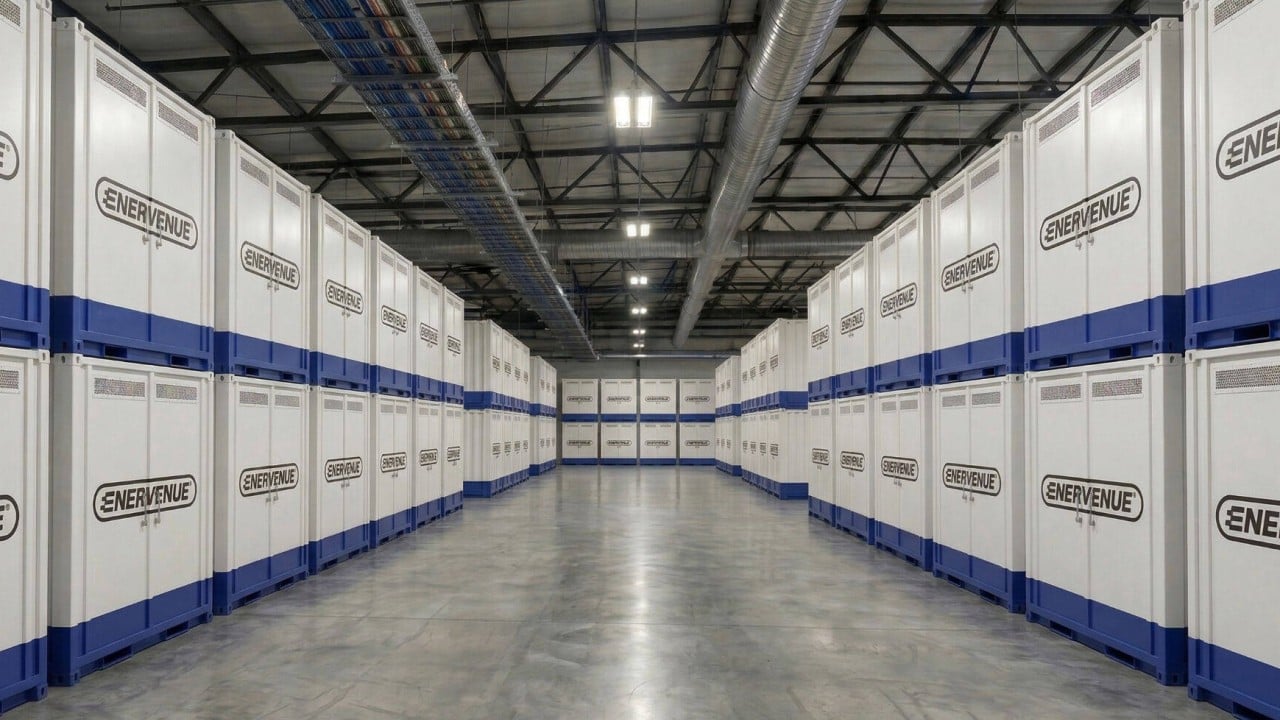
EnerVenue’s solution is a metal-hydrogen vessel that looks less like a sleek tech gadget and more like a rugged piece of diving equipment. It doesn't use lithium. It doesn't use cobalt. It doesn't use anything that requires a specialized cooling system to keep it from melting down. It uses nickel, a material we already know how to mine and recycle, and hydrogen, the most abundant element in the universe.
The Hong Kong Connection
The news of the US$300 million raise isn't just about domestic manufacturing. It is about a bridge to the East. A significant portion of this momentum is tied to the Towngas Smart Energy partnership, eyeing Hong Kong as a strategic hub.
Why Hong Kong? Because space is a luxury that doesn't exist there.
In a city of vertical glass and steel, you can't just throw up another hundred lithium-ion storage farms without risking a catastrophic blaze that could take down a city block. Fire safety in high-density areas is the unspoken nightmare of the green transition. Nickel-hydrogen cells, however, are inherently safe. They don't catch fire. They don't explode. You can overcharge them, puncture them, or ignore them for a decade, and they won't rebel.
The Metal That Never Tires
Consider the lifecycle of a standard battery. You buy it. It works beautifully. After five hundred charges, it starts to get sluggish. After a thousand, it’s a shadow of its former self. After three thousand, it’s trash.
EnerVenue’s cells are rated for 30,000 cycles. Thirty thousand.
That is roughly the number of sunrises a human sees in a full lifetime. If a utility company installs an EnerVenue system today, it will still be humming, still storing the wind and the sun, when the children of the engineers who built it are retiring. That is the true "business model" of EnerVenue. It is the end of planned obsolescence in energy. It is a shift from the "throwaway" culture of lithium to the "generational" culture of nickel.
The Invisible Stakes
When we talk about $300 million in funding, it’s easy to get lost in the zeros. But those zeros represent a choice. They represent the choice to walk away from the volatility of lithium-ion supply chains that have held us hostage. They represent the choice to stop digging deep, dangerous holes in the Earth for rare-earth metals that we only use for a few years before tossing them into a landfill.
But the real problem lies elsewhere. The real problem is inertia.
Most energy companies are comfortable with what they know. They know how to build gas plants. They know how to build lithium farms. Moving to a nickel-hydrogen world means admitting that the last twenty years of battery dominance was just a stopgap. It means realizing that the future looks more like a 1990s satellite than a 2024 smartphone.
EnerVenue’s push into Hong Kong isn't just a business deal. It's a test case for the world’s most crowded cities. If it can work in the vertical heart of Asia, it can work in London, in New York, in Tokyo. It can work anywhere that fire is a fear and space is a luxury.
The Return to Simplicity
There is a quiet dignity in a machine that doesn't need a fan. In the world of high-tech energy, we have become obsessed with complexity—liquid cooling, thermal management software, complex sensor arrays that monitor every tiny fluctuation in temperature.
EnerVenue’s cells breathe. When they charge, the pressure of the hydrogen inside the vessel increases. When they discharge, it decreases. It is a mechanical breath. There is no mystery to it. There are no hidden chemical breakdowns. It is a simple, elegant piece of physics that we’ve known for half a century, finally stripped of its "NASA-only" price tag.
But consider what happens next: The $300 million isn't the finish line. It's the moment the starting gun goes off. As EnerVenue ramps up its Kentucky gigafactory, they aren't just making batteries. They are making time. They are buying us the time to transition our grids without worrying if the storage will fail before the wind turbines do.
If you stood in a field of these nickel-hydrogen vessels, you wouldn't hear much. No roaring fans. No buzzing cooling pumps. Just the silent, steady storage of the sun's leftover work.
The sound of thirty thousand sunrises, waiting to be used.