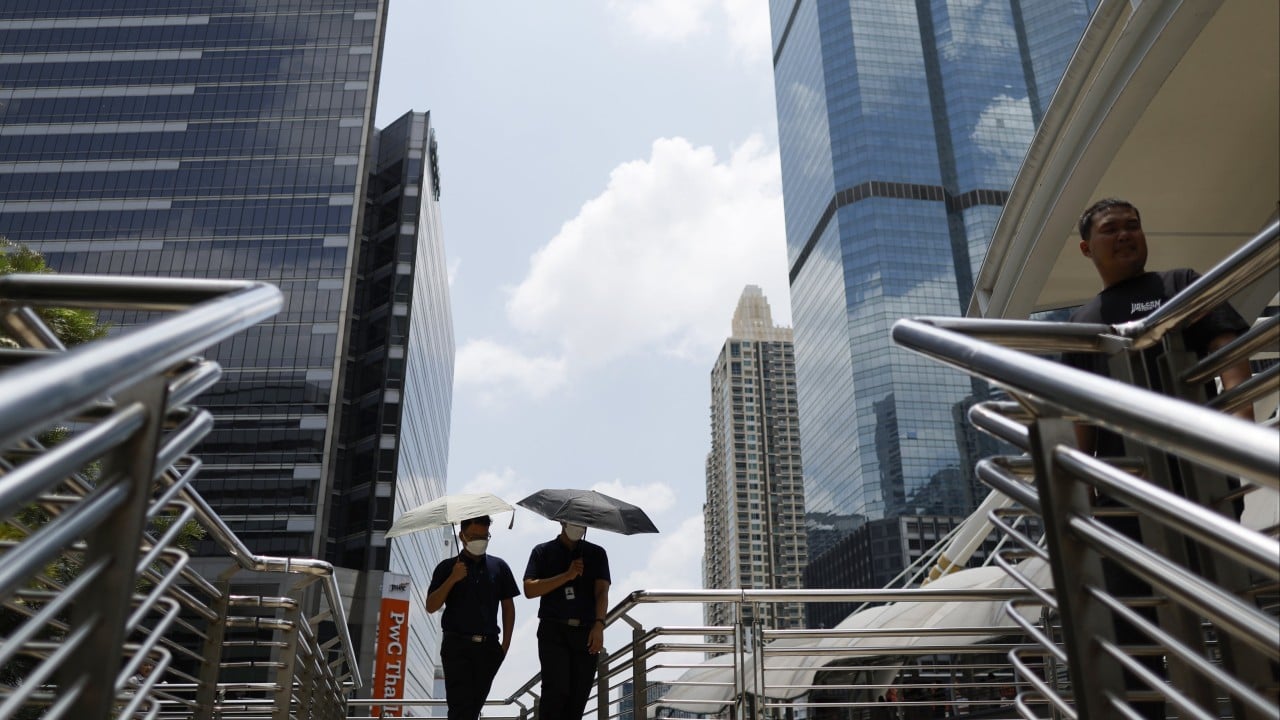
The intersection of extreme heatwaves and aggressive energy-conservation mandates in Southeast Asia is creating a silent crisis of cognitive depreciation. As temperatures in regional hubs like Bangkok, Manila, and Ho Chi Minh City consistently breach 40°C, the traditional "energy-saving drive" implemented by building managers is no longer a sustainable cost-mitigation tactic; it is a direct tax on human capital. The relationship between ambient temperature and cognitive throughput follows a non-linear decay curve, where every degree Celsius above the optimal 22°C threshold triggers a measurable drop in error-checking capacity and executive function.
The Thermodynamics of Cognitive Capital
Human labor in the modern Southeast Asian economy is increasingly concentrated in high-value services, software development, and financial operations. These sectors rely on cognitive endurance, which is biologically tethered to thermoregulation. When indoor temperatures rise because of restricted HVAC usage—often aimed at meeting ESG targets or reducing operational expenditure—the body shifts resources from the prefrontal cortex to autonomic cooling mechanisms.
This shift creates three distinct "Thermal Friction Points" that erode the bottom line:
- Metabolic Redirection: The physiological cost of perspiration and vasodilation consumes glucose and oxygen that would otherwise fuel focus. This results in "mental fog" long before heat exhaustion becomes a medical concern.
- Circadian Disruption: Prolonged exposure to high heat during work hours elevates core body temperatures, which fails to drop sufficiently by evening. This prevents deep REM cycles, leading to a compounding debt of sleep-deprived labor the following day.
- The Error-Rate Inflection: Internal data from high-density processing centers indicates that once ambient temperatures exceed 26°C, the frequency of clerical and coding errors increases by approximately 15% to 25%.
The False Economy of Energy Conservation
Commercial real estate managers in the region are currently operating under a flawed "Linear Savings Model." This model assumes that turning off chillers or raising thermostat set-points at 3:00 PM results in a net gain for the firm. However, this ignores the Total Cost of Operation (TCO) of an employee.
If an enterprise spends $5,000 per month on an employee's salary and benefits, a 10% drop in their output due to heat-induced lethargy costs the company $500 per month. In contrast, the energy savings achieved by raising the AC from 22°C to 26°C for that same employee’s square footage likely amounts to less than $20 per month. The ROI on "energy saving" in this context is deeply negative.
The failure to account for this discrepancy stems from a siloed corporate structure. Facilities management is tasked with reducing utility bills, while human resources and department heads are responsible for output. The facilities manager receives a bonus for a 5% reduction in electricity spend, unaware that this same metric caused a 12% drop in departmental billable hours.
Structural Vulnerabilities in Southeast Asian Infrastructure
The crisis is exacerbated by the "Urban Heat Island" (UHI) effect, which is particularly aggressive in Jakarta and Manila. In these cities, concrete density and lack of green space mean that night-time cooling is negligible. Buildings do not have the opportunity to "reset" their thermal mass.
The Glass Box Trap
The architectural preference for floor-to-ceiling glass in Southeast Asian CBDs is fundamentally incompatible with the current climate reality. These structures act as solar kilns. Even with high-performance glazing, the radiant heat gain requires HVAC systems to work at 110% of their rated capacity just to maintain baseline habitability. When governments mandate "energy drives," these buildings become uninhabitable within two hours of a cooling reduction.
Grid Fragility and the Generator Gap
The "reel" mentioned in regional reports is not just about discomfort; it is about the fear of grid collapse. In Vietnam and the Philippines, the margin between peak demand and available capacity is razor-thin. Companies are forced into a "Load Shedding Lottery." The loss of productivity during a black-out is absolute, but the "Brown-out Productivity Decay" (operating at reduced power/cooling) is more insidious because it is harder to quantify and thus harder to solve.
The Hierarchy of Thermal Mitigation
To navigate this, firms must move beyond the reactive "fans and water" approach and adopt a structured mitigation framework.
- Tier 1: Behavioral Load Shifting. If the grid peaks at 2:00 PM, firms should shift high-intensity cognitive tasks to the "Cool Window" (7:00 AM to 11:00 AM). The afternoon should be reserved for low-stakes administrative work or mandatory downtime.
- Tier 2: Micro-Climate Sovereignty. Instead of attempting to cool 5,000 square feet of open-plan office to a uniform temperature, firms are pivoting to localized cooling. This involves high-efficiency desk-integrated air purifiers with cooling elements or "cool-zones" where servers and high-value teams are consolidated.
- Tier 3: The Remote-Thermal Pivot. When the cost of cooling a centralized office becomes prohibitive or the grid becomes unreliable, the rational move is a decentralized "Heat-Shedding" strategy. Employees are encouraged to work from home, provided their residential infrastructure can support it, effectively shifting the thermal cost to the individual (often compensated via utility stipends).
Quantifying the "Heat Tax" on Innovation
Innovation requires more than just "showing up"; it requires "divergent thinking." Neuroscientific studies suggest that high-level problem-solving is the first casualty of thermal stress. While a worker might still be able to answer emails at 28°C, they are statistically unlikely to synthesize new ideas or identify complex patterns.
For the Southeast Asian tech hub to remain competitive against temperate-climate rivals, the "Heat Tax" must be acknowledged as a sovereign risk. Investors are already looking at "Thermal Resilience" as a metric for long-term regional stability. A city that cannot guarantee a 22°C environment for its knowledge workers is a city that will see its talent migrate to more temperate latitudes or better-engineered buildings.
Engineering the Adaptive Workspace
The solution is not more air conditioning, but smarter thermal management. This involves a transition from Active Cooling to Passive-Active Hybridization.
- Phase-Change Materials (PCMs): Integrating materials into office walls that absorb heat during the day and release it at night can dampen the temperature spikes that occur when the AC is dialed back.
- Sensory Cooling: Research into "Perceived Thermal Comfort" shows that increasing air movement (via high-volume, low-speed fans) can make a 26°C room feel like 23°C, at a fraction of the energy cost of a chiller.
- Dynamic Façades: Implementation of automated external shading systems that track the sun's position to prevent solar gain before it enters the building envelope.
The Strategic Play for Regional Leadership
The current "energy-saving drive" is a blunt instrument applied to a surgical problem. Leaders who continue to enforce rigid office hours in non-optimized environments are actively devaluing their own human capital. The competitive advantage in Southeast Asia will shift to firms that treat Thermal Stability as a critical infrastructure requirement, similar to high-speed internet or stable electricity.
The immediate mandate for C-suite executives is to audit their "Productivity-to-Temperature Ratio." This requires installing granular IoT sensors to map "hot spots" in the office and correlating that data with output metrics. If a correlation exists—and the biology suggests it does—the energy-saving drive must be abandoned in favor of a Productivity-First Thermal Strategy. Stop measuring the cost of the kilowatt-hour; start measuring the cost of the lost breakthrough.
Managers must implement a "Thermal Threshold Protocol." When internal temperatures exceed 25.5°C, the office should be officially declared "Low-Cognitive Mode," triggering an automatic transition to remote work or a suspension of high-complexity projects. This transparency protects the brand's output quality and prevents the long-term burnout of top-tier talent who are currently "reeling" under the delusion that physical presence in a 29°C glass box constitutes productive labor.