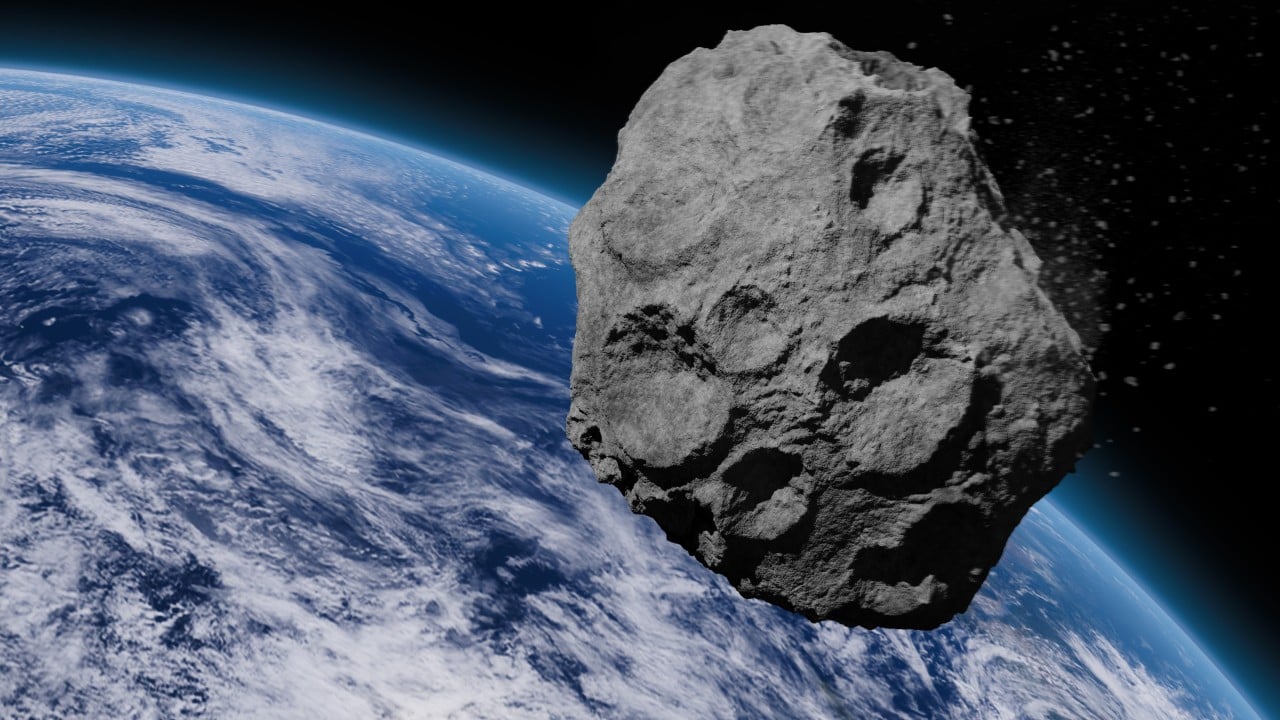
A spacecraft roughly the size of a home refrigerator is currently screaming through the void of space toward a lump of primordial rock. Japan’s space agency is executing a high-stakes flyby designed to test our ability to intercept fast-moving celestial threats before they collide with Earth. This is not a Hollywood script, nor is it a luxury science experiment. It is a calculated gamble to solve a mathematical nightmare that keeping our species alive depends upon.
While mainstream media reports celebrate the sheer audacity of steering a tiny probe past an asteroid millions of miles away, the deeper truth is far more unsettling. We are drastically unprepared for a major asteroid impact. This Japanese mission represents a frantic pivot in planetary defense, shifting from abstract theoretical modeling to active kinetic reconnaissance.
The mission is simple in concept but punishingly complex in execution. Spacecraft must use precision autonomous navigation to skim past low-reflectivity targets at relative speeds that make a rifle bullet look like a snail. But understanding why this tiny probe matters requires looking past the superficial triumph of space engineering and examining the stark physics of cosmic impacts.
The Dark Sky Blindspot
We cannot stop an object we cannot see. For decades, global astronomical surveys focused on tracking giant "planet-killer" asteroids, the celestial bodies wider than one kilometer that could end human civilization in an afternoon. Astronomers have cataloged roughly 95 percent of these behemoths, and none are on a collision course with Earth for the foreseeable future.
The real danger comes from the fragments left behind.
Objects between 30 and 140 meters in diameter are far more numerous, numbering in the hundreds of thousands, and our detection rate for them is dangerously low. An asteroid of this size will not cause a global extinction event. Instead, it will instantly vaporize a metropolitan area, flatten forests across thousands of square miles, and trigger atmospheric shockwaves capable of killing millions.
Consider the Chelyabinsk meteor that exploded over Russia in 2013. It was a mere 20 meters wide. It went undetected until it entered the atmosphere because it approached from the direction of the sun, blinding ground-based telescopes. The resulting blast shattered windows across six cities, injured over a thousand people, and served as a blunt warning to planetary defense scientists.
A 50-meter rock carries the kinetic energy of a massive nuclear warhead. Because these objects are small and incredibly dark, reflecting less light than a lump of charcoal, we frequently spot them only days or hours before they pass close to Earth. Sometimes, we see them only after they have already missed us. The current Japanese mission aims to prove that a lightweight, cost-effective probe can be deployed rapidly to intercept, photograph, and analyze these smaller, elusive threats before they threaten population centers.
The Mirage of Kinetic Deflection
The public frequently misunderstands how we plan to defend the planet. The goal is almost never to blow an asteroid to pieces.
An explosion simply turns a single bullet into a cosmic shotgun blast, leaving Earth to face thousands of radioactive fragments instead of one solid rock. Instead, planetary defense relies entirely on orbital alteration. We change the speed of the asteroid by a fraction of a millimeter per second. Over years of orbital travel, that tiny adjustment compounds, causing the asteroid to completely miss Earth's orbit when it arrives at the predicted intersection point.
This strategy depends heavily on advanced notice.
To shift an asteroid’s path using a kinetic impactor, the smash-and-nudge method tested by NASA’s DART mission, we need a lead time of five to ten years. If an incoming threat is discovered only six months before impact, a kinetic impactor is useless. The laws of orbital mechanics dictate that the closer an object is to Earth, the more energy is required to push it out of the collision corridor.
The Japanese approach explores a different tool in the arsenal. By utilizing ultra-efficient ion thrusters, a lightweight probe can maintain a prolonged chase, matching orbits with highly irregular targets. The data gathered from these close flybys tells scientists exactly what these asteroids are made of. This is vital because a solid iron asteroid responds very differently to an impact than a loose "rubble pile" asteroid, which acts like a cosmic sponge, absorbing kinetic energy without shifting its trajectory.
The Brutal Physics of Spacecraft Design
Building a spacecraft the size of a refrigerator is an exercise in extreme minimalist engineering. Every gram of mass added to the payload requires exponentially more propellant to move.
Mass Allocation of a Deep-Space Interceptor
+------------------------+-----------+
| Component              | Mass %    |
+------------------------+-----------+
| Xenon Propellant       | 40%       |
| Structural Frame       | 25%       |
| Solar Arrays & Power   | 15%       |
| Guidance & Avionics    | 12%       |
| Scientific Instruments | 8%        |
+------------------------+-----------+
To survive deep space, the probe must carry its own power generation, thermal management, long-range communication systems, and autonomous navigation computers. This leaves an incredibly small margin for actual scientific instruments. Designers must choose between a high-resolution camera, a laser altimeter, or a mass spectrometer. They cannot have them all.
The reliance on autonomous navigation is non-negotiable. At distances of tens of millions of miles, radio signals take several minutes to travel from Earth to the spacecraft and back. If the probe relies on a human operator with a joystick, it will crash into the asteroid or sail past it into the void before the command to steer can arrive.
The onboard computer must look at a field of distant stars, identify a faint, moving speck of grey light, and constantly calculate its own trajectory relative to the target. It does this while traveling at speeds exceeding fifteen miles per second. A single software glitch, a stray cosmic ray flipping a bit in the memory chip, or a slight miscalculation of the asteroid’s gravitational field results in total mission failure.
The Geopolitical Collision Corridor
While the engineering challenges are immense, the geopolitical ramifications of planetary defense are arguably even more complex.
If a large asteroid is confirmed to be on a direct collision course with Earth, entering a path that will strike central Europe, a deflection mission must be launched. However, as the kinetic impactor hits the asteroid, it does not instantly clear the threat. It shifts the impact point along a line across the surface of the globe, known as the risk corridor.
As the deflection process occurs, the projected strike zone moves across countries. To save Europe, the impact point might temporarily shift across Russia, Asia, or the Pacific Ocean before moving off the planet entirely.
This introduces a terrifying diplomatic question. Who authorizes a mission that temporarily puts another nation at risk to save themselves? If the deflection mechanism fails halfway through execution, the asteroid could end up hitting a country that was never originally in danger. Currently, no international treaty or legally binding framework governs this scenario. The United Nations has advisory groups, but no sovereign nation has agreed to cede control of its domestic safety or aerospace assets to an international committee.
The Deflection Dilemma
| Defense Method | Required Lead Time | Technical Complexity | Primary Risk |
|---|---|---|---|
| Kinetic Impactor | 5–10 Years | Medium | Asteroid shattering into fragments |
| Gravity Tractor | 10–20 Years | High | Extremely low thrust, slow response |
| Nuclear Detonation | 1–2 Years | Extreme | Geopolitical fallout, unpredictable yields |
Relying on lightweight probes is a calculated compromise. It trades raw defensive power for speed, agility, and lower manufacturing costs. While a fleet of these small spacecraft gives us eyes in the deep sky, they lack the mass to deflect a large threat on short notice. We are effectively building a sophisticated radar network without building the corresponding interceptor missiles.
The true value of Japan’s fridge-sized explorer is not that it can save Earth tomorrow. It is that it proves we can navigate the treacherous, low-gravity environments of the solar system’s smallest bodies with precision. But validation of a tracking mechanism is cold comfort when the sky remains filled with uncataloged rocks.
The math remains entirely indifferent to human readiness. Every century, smaller asteroids hit our atmosphere with absolute certainty, and the clock is ticking down to the next major event. Our current planetary defense infrastructure is a patchwork of underfunded academic surveys and occasional experimental probes. Until global space agencies commit to a permanent, coordinated defensive fleet, we are simply crossing our fingers and hoping that the next sky-splitting flash happens over an empty ocean.