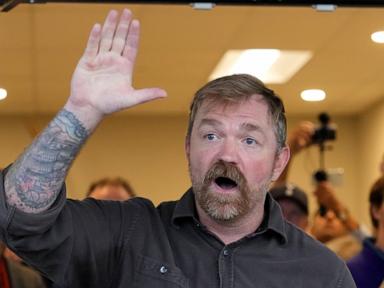
The folding chairs always scrape against the gym floor with the exact same high-pitched screech. It is a sound everyone in Maine knows. It is the sound of a town budget meeting, a high school basketball game, or a wake. On Tuesday night, it will be the sound of a political survival strategy.
Graham Platner is stepping into the fluorescent light. His Senate campaign is bleeding, though his staff would prefer to use terms like "correcting" or "stabilizing." The numbers do not care about staff vocabulary. They show a steady, chilling downward slide. When a campaign reaches this particular temperature, a candidate has two choices. They can hunker down in a television studio, broadcasting expensive, polished anxiety to empty living rooms. Or they can walk into a room full of people who are tired, skeptical, and holding utility bills. For a more detailed analysis into similar topics, we suggest: this related article.
Platner chose the room.
He is opening the floor to unfiltered questions from Maine voters. No pre-screened index cards. No friendly moderators softening the edges. It is a tactical move, certainly, born of necessity and declining poll numbers. But the mechanics of a political pivot matter far less than the sudden, stark vulnerability of the act itself. To get more context on this development, comprehensive reporting can be read at TIME.
Consider the anatomy of a modern town hall meeting.
To the casual observer, it looks like democracy in its purest, most nostalgic form. We like to picture Norman Rockwell paintings—the honest worker standing up to speak his mind while his neighbors listen in rapt, respectful silence. The reality is far more fragile. A town hall is an arena of unpredictable friction. The air is usually thick with the smell of damp coats and stale coffee. The microphones always hum with a low, nervous feedback.
For a candidate whose numbers are dropping, every person standing by that microphone is a potential landmine. There is the voter who has spent three weeks drafting a hyper-specific question about maritime trade logic. There is the voter who is just angry about the state of the roads and wants to see a powerful person sweat. There is the quiet observer in the third row, watching not the candidate’s mouth, but his hands, looking for the telltale tremor of a politician who does not believe his own talking points.
The true stakes of Tuesday night have very little to do with policy white papers.
They are about the terrifyingly subjective metric of human instinct. Voters do not read three-hundred-page legislative proposals. They look at a candidate’s face under harsh lighting and make a gut-level calculation: Do I trust you to care when I am not looking?
Right now, that calculation is running in the negative for Platner. The campaign’s previous strategy relied heavily on macro-level messaging—broad statements about economic resilience and national stability. But macroeconomics do not buy oil for the tank in November. They do not fix the fishing gear. By retreating into the abstract, the campaign allowed a vacuum to form. In politics, a vacuum is always filled by your opponent’s definition of who you are.
The opponent’s definition has been simple: Platner is out of touch, distant, a creature of committee rooms rather than coastal towns.
To break that narrative, a candidate cannot just speak louder. They have to change the environment entirely. That is why this meeting is happening. It is an attempt to shock the system, to trade the controlled safety of the campaign trail for the raw, chaotic energy of a public forum. If you are accused of being a ghost, you have to let people touch the hem of your garment.
But the real problem lies elsewhere.
Town halls are an exercise in high-wire theater where the audience knows the script better than the actor. The average voter in this state is not easily impressed by a rolled-up sleeve or a carefully timed pause for emotional effect. There is a deeply ingrained cultural radar for performative humility. If Platner walks into that gym looking like a politician pretending to be a regular person, the room will turn cold faster than a November Atlantic tide.
The art of survival in these settings requires a strange, contradictory skill set. A candidate must be authoritative yet utterly defenseless. They must take a verbal blow without flinching, acknowledge the validity of a voter’s anger, and somehow redirect that anger into a shared purpose. It is a grueling, exhausting psychological dance.
Imagine a hypothetical voter named Sarah. She lives thirty minutes outside of Bangor. She works two jobs, her knees hurt when it rains, and her oldest son is trying to figure out how to stay in the state without working for a poverty wage. Sarah does not care about Senate committee assignments. She cares that her world feels smaller and more expensive every single month. When she stands up at the microphone, she isn't looking for a five-point economic plan. She is looking to see if Platner looks away when she describes her grocery bill.
If he looks away, he loses. If he offers a platitude, he loses.
The only way through is an uncomfortable, radical level of directness. The kind of honesty that makes campaign managers break out in a cold sweat in the back of the room. It means admitting when a policy failed. It means saying "I don't know, but I will find out" instead of pivoting to a pre-approved talking point about job growth.
This is where the campaign will either find its footing or lose the narrative entirely.
The standard political playbook dictates caution. It suggests keeping the crowd at arm's length, filling the time with lengthy, winding answers that exhaust the clock and limit the number of questions. It is a strategy designed to prevent mistakes. But you cannot stabilize a sinking ship merely by trying not to make mistakes. You have to actively pump out the water.
Every question asked on Tuesday will be a test of pressure. The local press will be watching the clock, counting how many seconds it takes for Platner to address the specific, thorny local issues he has spent weeks avoiding. The national observers will be looking for a gaffe, a single clipped phrase or defensive gesture that can be clipped into a six-second video and distributed across the internet before the meeting even adjourns.
The invisible weight in that room will be immense.
It is the weight of a lifetime of political ambition hanging on the mood of a few hundred people who would rather be home having dinner. It is the realization that all the money raised, all the consultants hired, and all the polling data compiled over the last two years can be rendered completely useless by a single, authentic moment of human connection—or the lack thereof.
When the last question is answered, there will be no immediate declaration of victory. The campaign will look at the early feedback, the reporters will file their quick-turn stories, and the staff will try to spin the evening as a triumph of grassroots engagement.
But the real verdict will be silent. It will be found in the way the crowd disperses into the parking lot. If they leave talking about the candidate’s smooth answers, the campaign is in trouble. If they leave talking about their own lives, feeling, for the first time in months, that someone actually stood still long enough to listen to them, the slide might just stop.
The screech of the folding chairs will signal the end of the night. The janitor will wait by the light switches, wanting to go home. The campaign bus will idling in the dark, its exhaust pluming in the cold air, waiting to find out if it is carrying a survivor or a ghost.