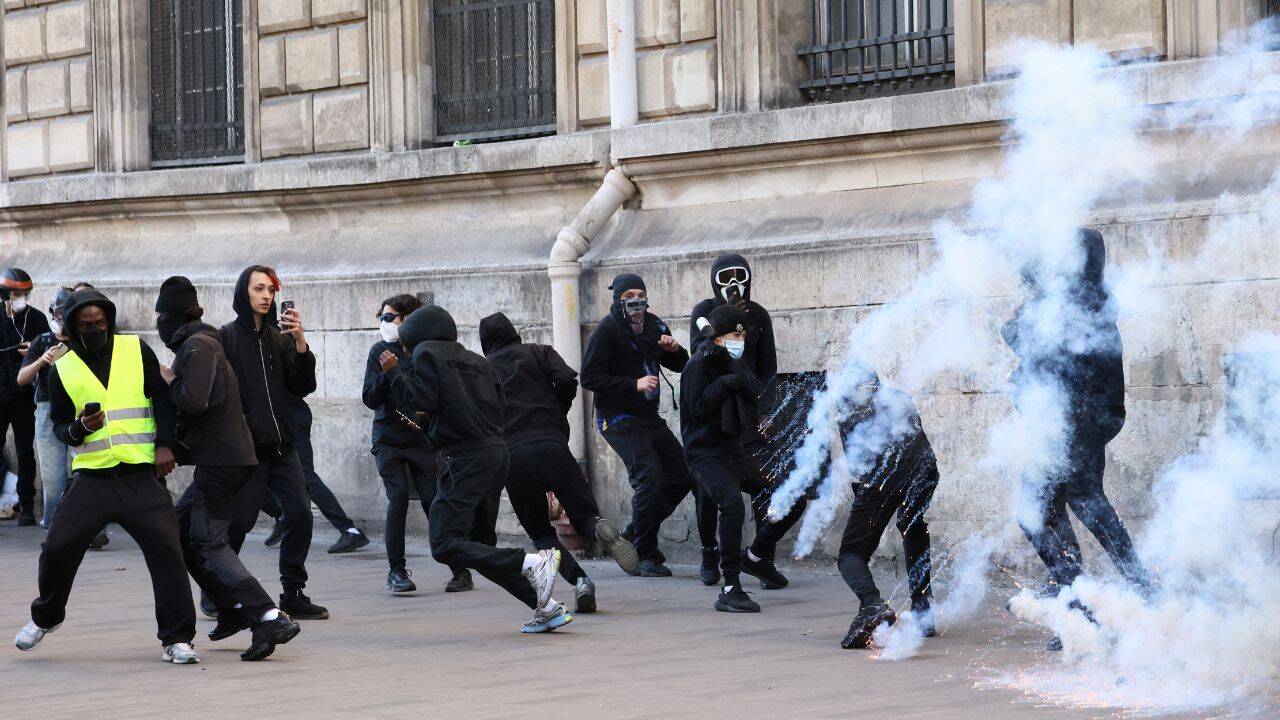
Tear gas in France protests is sold to the public as a simple equation. High prices go up. Wallets get squeezed. Crowds hit the streets. Riot police fire canisters. Officials wring their hands over unrest.
That story is lazy. It is also convenient for almost everyone in power. Don't forget to check out our earlier article on this related article.
When a headline reduces a clash in Paris, Lyon, or Marseille to "rising costs" and "fears of unrest," it treats politics like a vending machine. Insert inflation, dispense Molotov cocktails. Anyone who has spent real time studying urban contention, policing doctrine, and political legitimacy knows that cost-of-living grievances are rarely the match that lights the fuse on their own. Usually, they are the kindling piled up for months while the real spark comes from how institutions behave when people push back.
I have watched analysts, policy teams, and media desks blow credibility—and millions of euros in misallocated crisis planning—by mistaking a visible trigger for a structural cause. You cannot predict or govern street mobilization in France if you read every canister of CS gas as a symptom of grocery prices alone. If you want more about the history of this, NPR provides an in-depth summary.
The Lazy Consensus Around Street Clashes
Standard coverage loves clean villains and clean victims. In the usual framing, protesters are driven purely by economic pain—fuel, rent, utilities, stagnant wages—while authorities react mechanically to keep order.
That framing misses two critical mechanics.
First, economic pressure in France is chronic, uneven, and heavily mediated by policy. Household budgets feel stress over long stretches without producing nationwide street standoffs every week. When a cost-of-living issue suddenly mobilizes thousands of people and draws heavy police deployment, something else has shifted: trust in representation, perceived unfairness in who absorbs the pain, or a belief that normal channels—unions, ballots, courts, parliamentary debate—are dead ends.
Second, "authorities fear unrest" is often less a neutral observation than a framing device. State actors do not merely react to disorder; they shape its choreography. Crowd control tactics, pre-emptive bans, containment zones, and the visibility of riot units change the emotional temperature on the ground. A protest that starts with frustration over bills can turn into a pitched battle over state authority the moment the policing posture itself becomes the story.
Crowd Control vs. De-escalation
In public debate, people routinely conflate public order—the immediate absence of visible street disruption—with political stability, which is durable consent to institutional rules. CS gas and sting-ball grenades are tools of public order. Used carelessly or repeatedly in dense urban spaces, they can buy a quiet avenue at night while eroding legitimacy for years.
Political scientists who have studied contentious politics for decades—figures like Charles Tilly and Sidney Tarrow—documented long ago that protests are rarely just spontaneous outbursts of raw deprivation. They are structured interactions between challengers, authorities, and bystanders. Grievances supply motive; opportunity, perceived injustice, and state response shape how that motive escalates into confrontation.
Why People Ask the Wrong Questions About Unrest
When tear gas drifts across a boulevard, search feeds fill up with predictable questions. Most of them start from a flawed premise.
"Why do French protests turn violent over rising costs?"
They rarely turn violent because of rising costs. Economic strain explains why people show up grumbling; it does not explain why a march fractures into clashes.
Escalation happens at friction points. A protest route gets blocked. A small group of confrontational actors—often operating with different goals than ordinary marchers—tests a police line. Officers under pressure deploy area weapons like tear gas that affect peaceful demonstrators, residents, and journalists alongside anyone throwing projectiles. Once bystanders get gassed for holding a sign, anger shifts from the original policy grievance to the treatment on the street.
Blaming the price of bread or electricity for a clash with riot police skips the entire middle of the chain.
"How can authorities stop protests before they spiral?"
If officials treat every march as an imminent riot, they often manufacture the very polarization they dread. Heavy-handed containment can trap ordinary protesters next to agitators, turning a porous crowd into a pressure cooker.
Yet purely permissive policing carries its own risks. If authorities step back too far and property damage or violence goes unchecked, critics across the political spectrum attack the state for abdication, and businesses or commuters pay the price. There is no cost-free button to press once legitimacy is thin.
Imagine a scenario where a city bans a cost-of-living march at the last minute, deploys heavy riot formations along the main square, and fires tear gas within twenty minutes of a scuffle. Even if the streets are cleared by midnight, the government has turned a budget argument into a constitutional grievance about freedom of assembly and police force.
"Are rising costs enough to topple a government?"
History is unforgiving to anyone who assumes economic anger automatically unseats leaders. High living costs create durable headwinds, especially in elections and local races. They rarely force a regime or cabinet out on their own unless they fuse with a broader crisis of competence, institutional deadlock, or a miscalculation by the executive that alienates moderate allies.
Streets can signal fury. Ballots, coalitions, and legislative arithmetic decide who governs.
What Actually Drives the Flashpoint
To understand why a protest over living costs turns explosive, look at three variables that lazy reporting ignores.
- Perceived distributive fairness: People tolerate hardship far longer when they believe sacrifices are shared fairly than when they feel ordinary workers are squeezed while protected insiders or favored sectors face no pain.
- Institutional responsiveness: When citizens feel heard—even when they do not get everything they want—street pressure often stays expressive rather than confrontational. When doors feel bolted shut, confrontation starts to look like the only megaphone left.
- Tactical spillover: Tear gas is an area effect. Wind shifts. Crowds compress. A tactic meant to disperse one pocket can radicalize fifty people standing nearby who came only to march.
A government that mistakes a quiet street for a solved problem is usually just reading the wrong thermometer.
The Blind Spots in My Own Contrarian Take
Taking a contrarian stance against the "rising costs cause unrest" narrative does not mean dismissing economic pain. That would be its own kind of blindness.
Real financial stress is corrosive. When housing eats half a paycheck, energy bills spike, and real wages lag, households live with constant low-grade dread. Over time, that strain lowers people's tolerance for patronizing speeches, tone-deaf policy announcements, or heavy-handed policing. Economic pain sets the baseline mood even when another event sparks the clash.
There is also a risk of over-intellectualizing street anger. Sometimes people are simply exhausted, angry, and out of patience after years of promises that never materialized in their bank accounts. Treating every grievance as a grand strategic game can make an analyst sound clever while missing raw human frustration.
Practical Moves for Analysts, Operators, and Leaders
Whether you track political risk for a business, cover European affairs, or advise institutions dealing with public pushback, stop reading tear-gas headlines as simple price-index charts.
- Track the policing posture, not just the protest size. Watch whether authorities favor negotiation and clear corridors or early containment and chemical crowd control. Shifts in tactics often precede spikes in clashes.
- Separate core marchers from confrontational fringes. Do not treat a viral clip of a burning barricade as the mood of the entire crowd—and do not assume the entire crowd is immune to radicalization if gassed indiscriminately.
- Audit fairness narratives alongside inflation numbers. Look at who the public perceives as winning or losing from recent reforms, taxes, or subsidies. Unfairness accelerates mobilization faster than inflation alone.
- Plan operations around secondary disruption, not just the rally. Transit delays, shop closures, and neighborhood friction often drive public sentiment more than the speeches at the starting point.
Stop looking at a cloud of tear gas and seeing only a price tag. Look at the trust deficit underneath it.