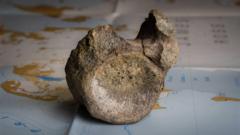
The discovery of historical specimens inside institutional storage is not an accident of fate but a predictable outcome of systemic resource misallocation. When news cycles highlight the extraction of a seminal fossil—such as the first recognized dinosaur bone from Antarctica—from a forgotten museum drawer, the public narrative frames it as a serendipitous rediscovery. A rigorous operational analysis reveals a different reality: museum archives function as data sinks where the rate of field acquisition far outpaces institutional processing capacity. This structural gap creates an archival backlog where critical scientific data remains functionally non-existent to the broader scientific community due to administrative and taxonomic invisibility.
Understanding this phenomenon requires breaking down the lifecycle of a fossil from its geological matrix to its peer-reviewed publication. The bottleneck rarely exists at the point of extraction. Instead, the failure point occurs within the post-expedition pipeline, governed by distinct institutional pressures, economic incentives, and morphological ambiguities. In similar developments, read about: The Cost of Mud and Silence in Venezuela.
The Archival Bottleneck Function
The accumulation of uncatalogued or misidentified specimens within research institutions can be modeled through a simple throughput equation. Total institutional throughput is limited by the curation capacity, which includes the availability of specialized preparators, taxonomic experts, and physical infrastructure.
Field expeditions operate on discrete fiscal cycles, often funded by high-visibility grants that incentivize the physical collection of raw material. A typical expedition to a high-latitude region like the Antarctic Peninsula requires substantial capital expenditure for logistics, transport, and survival gear. To maximize the return on this investment, field teams collect as much matrix and fossiliferous material as transport weight limits allow. NBC News has provided coverage on this critical topic in great detail.
Once the material arrives at the hosting institution, the funding mechanism changes. Grant capital rarely covers the multi-decade operational costs required to stabilize, prepare, and catalog every fragment. The specimen enters a curation bottleneck defined by three distinct variables:
- Preparation Friction: The ratio of hours required to mechanically or chemically extract a bone from its matrix versus the available labor hours of trained preparators. High-density matrices, such as the carbonate concretions common in certain Antarctic strata, require hundreds of hours of precision work per decimeter of bone.
- Taxonomic Expertise Deficits: The scarcity of morphologists qualified to identify fragmentary or novel taxa. A specimen may sit unexamined because the specific researcher capable of recognizing its diagnostic features is unavailable or underfunded.
- Data Indexing Inefficiencies: The reliance on analog, localized, or poorly cross-referenced database systems that prevent external researchers from identifying the contents of specific storage units.
When preparation friction and expertise deficits intersect with poor indexing, specimens enter a state of archival dormancy. They are physically secure but scientifically dead.
The Economics of Academic Capital Allocation
The structural neglect of museum collections stems from a fundamental imbalance in how academic prestige and funding are distributed. Institutional advancement rewards novelty and high-profile field discoveries over the maintenance of existing archives.
[Field Expedition Funding] ──> [High Media/Grant Yield] ──> [Resource Influx]
                                                                  │
                                                        (Structural Neglect)
                                                                  ▼
[Archive Maintenance]     ──> [Low Media/Grant Yield]   ──> [Resource Deficit]
Grants from major scientific bodies prioritize exploration and the testing of active hypotheses in the field. This creates an incentive structure where principal investigators must continually initiate new field seasons to sustain funding lines and support graduate students. The physical artifacts brought back from these trips are deposited in institutional repositories as a secondary priority, under the assumption that they will be processed during the off-season.
The off-season, however, introduces competing administrative and teaching demands. The labor required to process a drawer of fragmented, unidentified bone elements lacks the immediate professional payoff of publishing a new field-derived dataset. Archival curation yields low citation metrics relative to the time invested. A researcher who spends two years sorting through uncatalogued boxes in a basement repository will produce fewer papers than one who leverages fresh field data or runs computational models on existing digital datasets.
The result is a structural preference for accumulation over curation. Institutions measure their prestige by the gross size of their collections, yet lack the operational budget to maintain a functional ledger of their assets. This operational deficit ensures that landmark specimens remain hidden within the very walls built to preserve them.
Morphological Overlap and the Mechanics of Misidentification
The specific case of the first Antarctic dinosaur bone sitting unrecognized in a drawer highlights a precise taxonomic challenge: the morphological ambiguity of fragmentary elements.
Fossils collected during early or exploratory expeditions are frequently fragmentary. In high-latitude or marine-dominated settings, the vast majority of vertebrate remains belong to marine reptiles such as plesiosaurs and mosasaurs, which are common in Late Cretaceous strata. When a field team unearths a dense, partial limb bone or a weathered vertebral centrum in a challenging environment like James Ross Island, the baseline statistical probability heavily favors a marine origin.
This probabilistic bias influences the initial field identification. A worker labels the specimen based on the dominant fauna of the locality. Once a label is applied, it exerts a powerful cognitive anchoring effect on future handlers. The specimen is placed in a drawer dedicated to marine reptiles, effectively removing it from the view of dinosaur paleontologists.
Overcoming this misidentification requires a shift from superficial morphological assessment to microstructural or high-resolution geometric analysis. Dinosaurs and marine reptiles exhibit distinct histomorphological profiles:
- Fibrolamellar Bone: Highly vascularized, rapidly growing bone tissue characteristic of dinosaurs and homeothermic organisms.
- Lamellar-Zonal Bone: Slower-growing, dense bone tissue with prominent lines of arrested growth, more frequently observed in ecothermic or highly adapted aquatic reptiles.
Without thin-sectioning for histology or high-resolution micro-CT scanning, a partial, weathered bone shaft from an ankylosaur can appear virtually indistinguishable from the propodial element of a pliosaur to a non-specialist. The specimen remains misclassified until an expert in dinosaur osteology scrutinizes that specific drawer for an unrelated project, breaking the anchoring bias established decades prior.
Systematic Modernization of Institutional Repositories
Resolving the archival bottleneck requires moving away from reliance on sporadic, accidental discoveries toward a structured, tech-driven auditing framework. Institutions must treat their storage facilities not as passive warehouses, but as active data repositories requiring continuous optimization.
The first step involves deploying automated imaging pipelines. High-throughput surface scanning coupled with basic machine-learning classification models can rapidly catalog the geometry of unstudied bones. While an AI model cannot definitively identify a new species from a fragmented shaft, it can flag anomalies by comparing the specimen's geometric proportions against a verified database of marine reptile and terrestrial dinosaur elements. If a bone labeled as a plesiosaur exhibits a high geometric affinity for an ornithischian femur, the system flags that storage unit for manual review by a specialist.
The second intervention requires a fundamental shifting of grant structures. Funding agencies should mandate a Curation Compliance Ratio on all field exploration grants. A fixed percentage of any budget allocated for the collection of physical specimens must be held in escrow, matching funds specifically dedicated to the preparation, digitization, and open-access cataloging of those exact specimens within 36 months of collection. If an institution fails to clear the backlog within the window, their eligibility for subsequent field funding should be suspended.
Finally, decentralized digital ledgers must replace proprietary, internal museum databases. When collection data is siloed within local networks or legacy software, external researchers cannot query the holdings effectively. Universal, open-access indexing allows a global network of taxonomists to review collection manifests, spot potential anomalies in labeling, and target specific drawers for physical inspection.
The strategy must pivot from the continuous acquisition of raw geological matrix to the aggressive exploitation of existing archival holdings. The most cost-effective field season is one spent inside the climate-controlled storage facilities of the world's natural history museums, where the cost per discovery is measured in hours of analysis rather than hundreds of thousands of dollars in logistical overhead. The data is already collected; it merely awaits the transition from administrative artifact to documented fact.


:max_bytes(150000):strip_icc()/parts-of-a-swamp-cooler-2718628-a477e6f0787b4f8bb62ddf2def31d495.png)