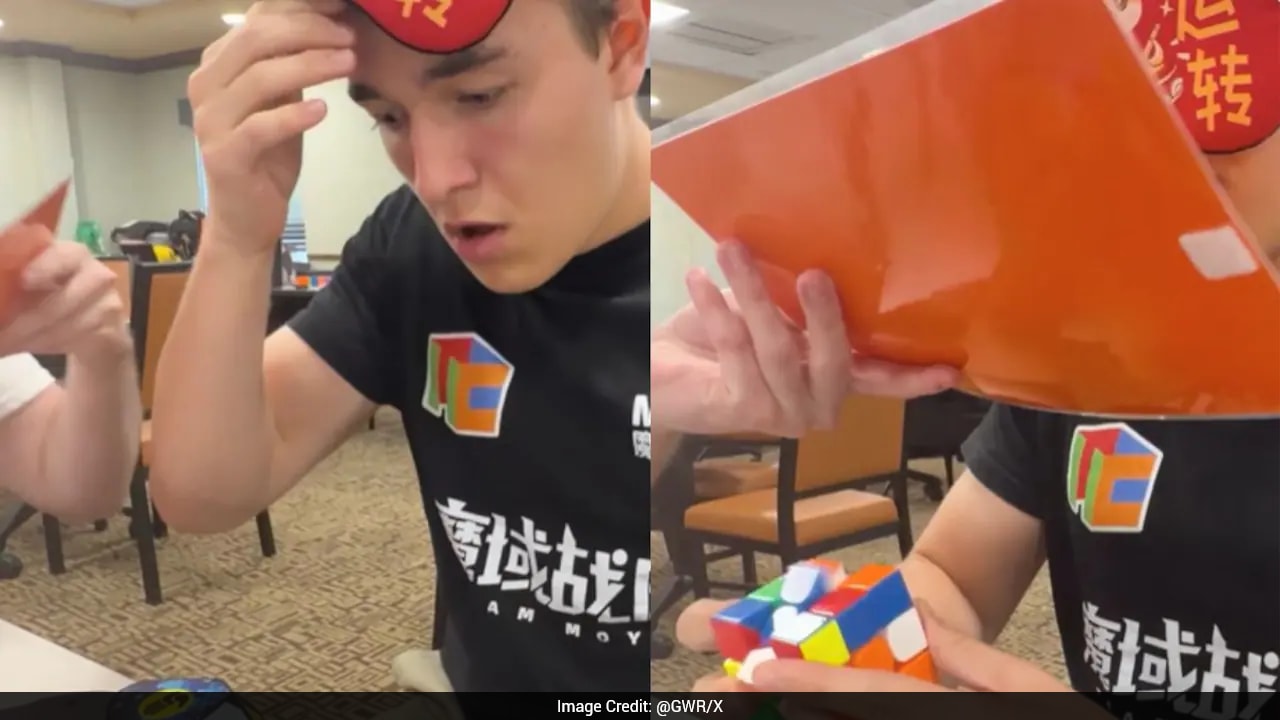
The room must be completely silent.
That is the first rule of the blindfolded speedcuber, but it is also a bit of a lie. True, the official rules of the World Cube Association require a hushed venue, free of the raucous cheers that usually accompany speedcubing finals. But for the person sitting at the table, there is no such thing as quiet.
Inside the mind of Tommy Cherry, there is a roar.
It is a cacophony of coordinate systems, spatial geometry, and phonetic codes. To the untrained eye, watching a human solve a Rubik’s Cube blindfolded looks like a magic trick. To those who live it, it is more akin to playing a complex piano sonata on a keyboard that is constantly shifting beneath your fingers, all while sprinting a hundred-meter dash.
On June 28, 2026, at the Mid-Atlantic Quiet Championship, Tommy sat before a scrambled 3x3x3 cube. He was not just playing for a title. He was trying to reclaim a piece of his own identity, a record he had held, lost, and chased again across thousands of hours of solitary practice.
The timer began. He did not put the blindfold on. Not yet.
First comes the "memo." This is the phase of the solve where the competitor memorizes the chaotic state of the plastic block. For standard cubers, this is an intuitive, visual process. For a blindfolded solver, visual memory is far too slow, far too fragile. Instead, they translate the physical orientation of the cube's pieces into letters.
Consider a hypothetical journey across the plastic face. Every corner and edge is assigned a letter. As Tommy’s eyes darted across the cube, his mind mapped the scrambled pieces into pairs of letters—say, K-O, N-S, P, Q-F.
To make these abstract letter pairs stick in a brain under immense pressure, solvers convert them into vivid, sometimes absurd mental images. K-O might become a boxing glove. N-S might become a compass needle pointing north-south. They string these images together into a rapid, surreal narrative—a micro-story told in the span of three seconds.
He memorized the edges. He memorized the corners. He closed his eyes.
The physical blindfold slipped down over his face. He was now entirely alone in the dark.
What happens in the mind during those next few seconds is a testament to the sheer, terrifying capacity of human spatial processing. With the blindfold secure, the hands must move instantly. There is no time to think, "Where is the green-orange edge?" If you think, you fail.
Instead, the hands rely on muscle memory and group theory. The human brain has to execute hundreds of sequential turns—known as algorithms—to swap individual pieces of the cube without disturbing the rest of the puzzle. It is a high-wire act where a single misplaced turn of a single layer, even by ninety degrees, cascades into immediate failure, resulting in a Did Not Finish (DNF) penalty.
Tommy's fingers blurred. The plastic clicked in a rapid, rhythmic staccato.
R-V. The boxing glove fell away.
K-O. The compass needle spun.
The speed of the turns is limited only by the friction of the plastic and the limits of human tendon movement. At this level, they use highly specialized, magnetic cubes where the tension is tuned to the fraction of a millimeter.
And then, the final turn.
Tommy slammed the cube onto the timing mat. The digital display froze.
Eleven point five six seconds.
To put that in perspective, the average person cannot even read this paragraph in eleven seconds. In that brief sliver of time, Tommy had analyzed the chaos of the scramble, mapped a path through the dark, executed dozens of precise finger tricks, and brought order to the universe of those six colored faces. He had shattered the world record.
But the real triumph isn't the number on the clock or the certificate from Guinness. The true victory is the mastery over the noise. It is the ability to step into the quiet, absolute dark of your own mind, and find your way back out, perfectly solved.