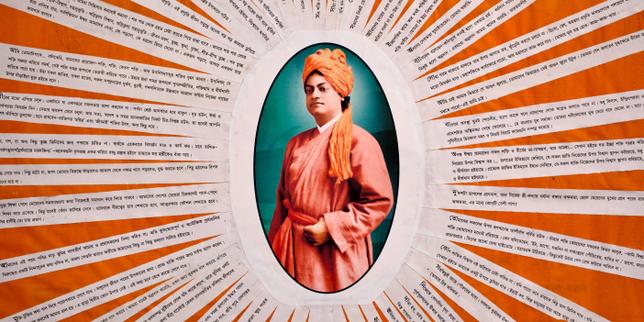
History often remembers dates as dry markers on a timeline, but September 11, 1893, was different. On that humid Chicago afternoon, a thirty-year-old monk in an orange robe and a massive turban walked onto the stage at the Parliament of Religions. He didn't start with a traditional Western greeting. He said, "Sisters and brothers of America." The auditorium erupted. People stood and cheered for minutes. Swami Vivekananda had just cracked open the rigid spiritual door of the Western world.
Most history books treat his journey as a polite cultural exchange. They frame it as an Indian mystic visiting the World's Columbian Exposition to share exotic ideas with curious Chicagoans. That narrative misses the raw disruption he actually caused. He wasn't there to entertain polite society. He was there to challenge the arrogance of religious imperialism.
The Shock Wave at the Parliament of Religions
Picture the scene. The Parliament of Religions was designed to showcase the supposed supremacy of Western Christian civilization, hosting representatives from global faiths to bow gracefully before the dominant religious paradigm of the day. Protestant Christianity sat comfortably at the top of the hierarchy. Everyone else was expected to play a secondary role.
Vivekananda completely shattered that script.
Instead of apologizing for Hindu pluralism, he weaponized it. He quoted the Bhagavad Gita and told the assembled crowd that sectarianism, bigotry, and fanaticism had long possessed this beautiful earth. They had filled the earth with violence, drenched it often with human blood, and destroyed whole civilizations.
It was a staggering blow to a Western audience raised on the idea that salvation belonged exclusively to their own church. He didn't come to convert anyone to Hinduism. He came to preach the eternal truth of the soul. He argued that every religion was a different path leading to the same divine destination, just as different streams all mingle their waters in the sea.
You have to understand the context of 1893 America to grasp why this hit so hard. Industrialization was roaring. Materialism was skyrocketing. People felt spiritually empty, trapped in rigid dogmas that couldn't survive the rising tide of modern science. Vivekananda offered an alternative. He gave them a non-dogmatic, psychological approach to spirituality that didn't demand intellectual suicide.
Why Yoga and Vedanta Weren't Just Fads
People love to blame modern wellness culture for turning yoga into a stretchy, commercialized aesthetic. But the groundwork for bringing Eastern philosophy to the West was laid by a monk who slept on floors and begged for his meals.
Vivekananda didn't just give one speech and catch a boat home. He spent years traveling across the United States and Europe, founding the Vedanta Society in New York in 1894. He gave hundreds of lectures. He wrote books that still sell today, breaking down complex Sanskrit metaphysics into accessible, practical frameworks.
His core message centered on practical Vedanta. He insisted that spirituality wasn't something you locked away in a temple or a church pew for one hour on Sunday. It was meant to be lived. If you see the divine in yourself, you must see the divine in everyone else. That meant social service wasn't just charity; it was worship.
He categorized the human spirit into four distinct paths of yoga:
- Bhakti Yoga: The path of emotional devotion and love for the divine.
- Jnana Yoga: The path of intellectual inquiry, wisdom, and discrimination.
- Karma Yoga: The path of selfless action without attachment to the results.
- Raja Yoga: The path of mental control, meditation, and psychological mastery.
This framework changed everything. It meant you didn't have to quit your job, shave your head, or abandon society to be spiritual. You could be a banker, a teacher, or a factory worker, and still practice yoga through how you treated people and how you approached your daily labor.
The Misunderstandings and the Backlash
Writing about Vivekananda honestly means acknowledging that his journey wasn't a fairy tale. Not everyone in 1893 America was ready for a brown-skinned monk telling them their dogmas were provincial.
Christian missionaries who had spent decades trying to convert people in India suddenly found their home turf invaded by a charismatic philosopher who turned the tables completely. They launched PR counter-attacks, trying to paint him as a heathen or a fraud. Newspapers ran sensationalized profiles, questioning his motives, his background, and his funding.
Vivekananda dealt with it through sheer intellectual force and wit. He didn't lose his temper. He pointed out the hypocrisy of nations that sent missionaries to feed starving people in India while millions starved in their own industrial slums. He held up a mirror to the West, and many people hated the reflection.
Yet, his supporters were fierce. Thinkers, writers, and scientists like William James and Nikola Tesla listened to him. Tesla was deeply fascinated by Vivekananda's attempts to map Vedic cosmology to modern physics, specifically how ancient concepts of matter and energy mirrored Western scientific breakthroughs.
What We Keep Getting Wrong Today
Modern internet culture loves to reduce figures like Vivekananda to motivational quote graphics on Instagram. You see his face next to lines about believing in yourself or waking up and chasing your dreams.
That trivializes a towering intellect.
Vivekananda wasn't a life coach. He was a fierce ascetic who believed that human beings were divine souls trapped in a dream of limitation. His message was heavy. It demanded radical self-responsibility. He famously stated that you are the creator of your own destiny, and if you are miserable, you have no one else to blame.
He didn't want blind followers. He spent his short life warning people against hero worship. He wanted independent thinkers who could test spiritual truths the way a scientist tests a hypothesis in a laboratory.
His health was fragile. Decades of intense travel, non-stop lecturing, and relentless public pressure destroyed his body. He died in 1902 at the age of thirty-nine. Yet, in less than a decade of active public life, he permanently rewired the global conversation about religion, philosophy, and human potential.
How to Apply His Teachings Right Now
If you want to move past the superficial history and actually use what Vivekananda taught, start with your own daily friction.
Stop treating your work as a trap and start treating it as a practice. Apply Karma Yoga to your job tomorrow. Do your tasks with excellence, but detach your self-worth from the applause or the paycheck.
Look at your mental habits. Raja Yoga isn't just about sitting cross-legged; it is about observing your thoughts without identifying with every single anxious story your brain spins up.
Read his actual words. Skip the modern interpretations and pick up Raja Yoga or his lectures on practical Vedanta. Let a nineteenth-century monk challenge your twenty-first-century assumptions about who you are and what you are capable of achieving.
The real monument to Swami Vivekananda isn't a statue in Chicago or a plaque in a museum. It lives in every person who looks past dogmatic boundaries to find a deeper, universal truth about human dignity. Read his books, question your assumptions, and stop outsourcing your spiritual growth to institutions that care more about control than liberation.