The air inside the Roman apartment tasted like wool. It was 3:00 AM, and the bedroom walls were still radiating the heat they had soaked up during the day, acting like a slow-burning clay oven. Giovanna sat on the edge of her mattress, her skin slick with sweat that refused to evaporate. Outside her window, the city was uncharacteristically quiet, stripped of its usual nocturnal energy. Even the Vespas were silent. The air was too heavy to move through.
For generations, southern Europe treated summer as a long, sun-drenched pause. You pulled down the heavy wooden shutters at noon, drank espresso over ice, and waited out the afternoon glare. But the heatwaves settling over the Mediterranean are no longer a seasonal guest. They are an occupying force.
When we read data about global temperature anomalies, our brains tend to glaze over. We see numbers—45 degrees Celsius in Spain, 48 in Sicily—and we categorize them as weather reports. But heat at this scale is not weather. It is a biological threat. It is the sound of ambulance sirens echoing through stone piazzas at midnight because elderly lungs cannot catch their breath. It is the buckling of train tracks and the smell of melting tarmac on a highway outside Athens.
The question is no longer whether our climate is changing. The question is how we survive the change that is already here.
The Illusion of the Natural Cycle
To understand how we arrived in this furnace, we have to look past the daily forecast. A common refrain among skeptics during any brutal summer is that Europe has always been hot. Romans wore togas for a reason, right?
But a team of international scientists operating under the World Weather Attribution banner recently ran the numbers on these European heatwaves. They did not just look at thermometers; they used advanced computer modeling to simulate two realities. In the first reality—our current world—greenhouse gas concentrations are at historic highs. In the second reality, they simulated a parallel Earth where humans never pumped billions of tons of carbon dioxide into the atmosphere.
The results were stark.
The extreme heat blinding the continent would have been statistically impossible without human-induced climate change. We are not talking about a slight shift in probability. In the simulated world without industrial emissions, a heatwave of this magnitude happens roughly once every ten thousand years. For context, ten thousand years ago, humans were just beginning to invent agriculture. Today, these events are projected to hit Europe every few seasons.
Think of the global climate system as a massive, intricate casino game. Naturally, the house has a slight edge, occasionally dealing a hot summer or a brutal winter. What we have done is not just play the game; we have weighted the dice, altered the felt on the table, and paid off the dealer. Every time the roulette wheel spins now, it lands on red. It lands on fire.
The Invisible Toll on the Human Machine
We often measure the cost of climate disasters in infrastructure damage, insured losses, and crop failures. We talk about the scorched olive groves in Puglia or the parched vineyards of Bordeaux. These are devastating, but they miss the most intimate casualty of a warming world: the human body.
The human body is essentially a sophisticated water-filled engine that requires a very narrow internal temperature range to function—right around 37 degrees Celsius. When the ambient air temperature surpasses that threshold, the engine has to work exponentially harder to cool itself down. It relies almost entirely on sweating.
But sweating requires evaporation. When the humidity rises alongside the temperature, the air becomes a saturated sponge, incapable of absorbing more moisture. The sweat stays on your skin. Your heart rate accelerates, pumping blood frantically to your extremities in a desperate bid to radiate heat away from your core.
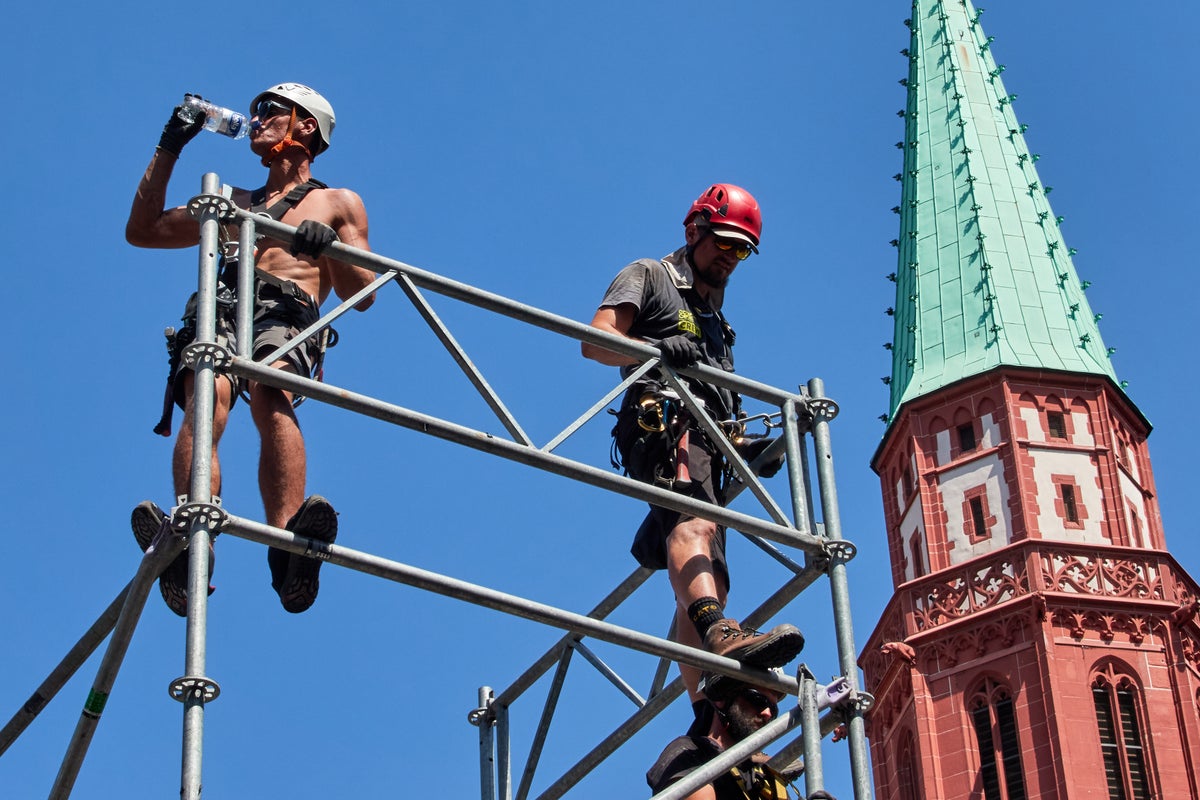
Consider a hypothetical citizen named Mateo, a fifty-year-old construction worker in Madrid. He is healthy, stubborn, and used to working under a blazing sun. But when the temperature hits 46 degrees Celsius, Mateo’s body stops adapting. His core temperature rises. His kidneys, deprived of adequate hydration as blood is diverted to his skin, begin to strain. He feels dizzy, a symptom he dismisses as simple fatigue.
By the time heat stroke sets in, the brain’s internal thermostat breaks down entirely. The body stops sweating altogether. Without immediate medical intervention, organs begin to fail like dominoes.
This is the hidden crisis playing out in emergency rooms across southern and central Europe. It is not an abstract environmental problem; it is a public health emergency that targets the vulnerable, the outdoor workers, and the elderly who live in top-floor apartments without air conditioning.
The Northward Migration of the Furnace
For a long time, northern Europe viewed extreme heat as a Mediterranean problem, a distant reality for holidaymakers to navigate during their August getaways. That illusion has vanished.
The jet stream—the high-altitude river of air that steers weather systems across the globe—is becoming sluggish and wavy. Instead of moving weather systems along briskly from west to east, it is getting stuck in massive, looping patterns. When a loop parks itself over Europe, it acts like a atmospheric dome, trapping hot air from North Africa and compressing it, heating the land further day after day.
This atmospheric blocking means that countries like the United Kingdom, Germany, and the Netherlands, historically built for cool, damp climates, are suddenly experiencing temperatures that break historic records.
- Houses in London are designed to trap heat, built with thick brick walls and minimal ventilation to survive bitter winters. In a 40-degree summer, these homes become dangerous heat traps.
- The infrastructure is fundamentally unprepared. Transport networks buckle because the steel rails were specified for a maximum temperature that belonged to the previous century.
- The psychological toll is profound. There is a specific kind of dread that comes when the places that always felt safe and temperate suddenly feel hostile.
We are watching the rapid homogenization of European weather. The cool, misty summers of the north are being replaced by the dry, punishing heat of the south, while the south edges closer to a desert climate.
Dismantling the Defense Mechanisms
When confronted with these realities, it is easy to default to a sense of paralysis. We look for technological saviors. Air conditioning is the most common answer. We assume we can simply retreat indoors, click a remote, and lower the temperature to a crisp 21 degrees.
But air conditioning is a deeply flawed defense mechanism. It is a classic example of solving a localized problem by worsening the systemic one. Air conditioners are energy hogs. Unless they are powered entirely by renewable energy, running them pumps more carbon into the atmosphere.
More ironically, they operate by removing heat from the inside of a building and dumping it directly onto the street. On a hot night in Paris, thousands of air conditioners humming simultaneously can raise the outside street temperature by several degrees, worsening the "urban heat island" effect for anyone who cannot afford the electricity bill to run their own unit. It is an individual solution that erodes collective survival.
The real solutions are less glamorous and far more demanding. They require us to rethink how we build, how we live, and how we relate to our environment.
Cities must be physically transformed. We need to replace dark asphalt with reflective surfaces. We need to plant urban forests that provide genuine shade and cool the air through evapotranspiration. We have to design buildings that breathe naturally, drawing on ancient architectural wisdom from the Middle East and North Africa, where builders mastered the art of passive cooling long before electricity existed.
The True Cost of Delay
The data provided by climate scientists is not a prophecy; it is a diagnostic tool. It tells us exactly what we have done to the atmosphere and what will happen if we continue on our current trajectory.
The argument that cutting emissions is too expensive has lost all credibility. The financial cost of rebuilding shattered infrastructure, managing health crises, and dealing with collapsing agricultural yields far outweighs the investment required to transition away from fossil fuels. But the financial argument still feels too detached, too clinical.
The true cost is measured in the loss of predictability, the erosion of safety, and the steady contraction of the spaces where human life can thrive. It is the realization that the summers of our childhoods—the ones defined by outdoor play, cool evening breezes, and a sense of abundance—are being replaced by a season of anxiety, confinement, and smoke.
The sun rises over Rome again, a pale, fierce disc climbing into an unblemished blue sky. By 8:00 AM, the stones of the Colosseum are already warm to the touch. Giovanna steps onto her small balcony, looking down at the empty street below. A lone street sweeper works in the shadow of a building, his movements slow, deliberate, and exhausted.
We have crossed a threshold. The climate of the past is gone, and the climate of the present demands a radical reckoning. We can no longer treat these summers as anomalies to be endured until autumn arrives. They are a mirror reflecting the world we have built, and the heat rising from the pavement is a silent, undeniable demand for change.