Flames don't need to touch a cave wall to erase tens of thousands of years of human history. That's the unsettling reality hanging over Sulawesi's ancient rock art as severe Indonesian wildfires push right up against protected limestone caves.
During a fierce dry spell fueled by a strong El Niño, fires swept across more than 270 hectares of Bantimurung-Bulusaraung National Park in South Sulawesi between late September and mid-October 2026. Firefighters battled blazes that burned for over a week near sensitive zones and came within roughly 800 meters of key cave sites.
Even if not a single ember crosses a cave threshold, the danger is immediate. Heat shifts and drifting smoke can speed up rock surface decay and coat fragile pigments in dark soot. When you're dealing with artwork that has already survived more than 67,000 years, even small shifts in microclimate or air quality matter.
Why Sulawesi Cave Paintings Matter So Much
For decades, textbooks treated European caves like Lascaux and Chauvet as the starting line of big, expressive prehistoric art. Sulawesi completely upended that story.
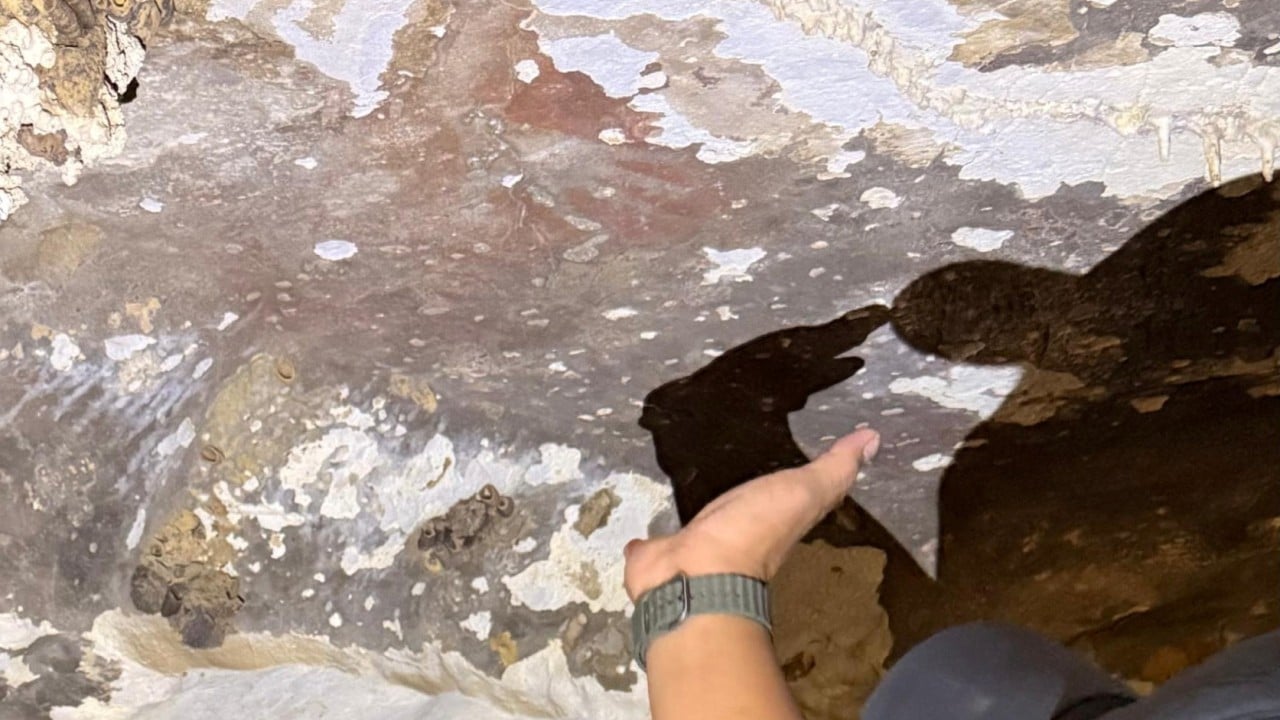
Researchers from institutions including Indonesia's National Research and Innovation Agency (BRIN) and Australia's Griffith University have pushed the timeline of known rock art back into the deep Pleistocene. In January 2026, scientists published dating results in Nature for a faded ochre hand stencil at Liang Metanduno on Muna Island, off southeastern Sulawesi, giving it a conservative minimum age of at least 67,800 years.
Let that sink in. Someone blew or sprayed reddish pigment around a hand—with fingers that appear narrowed or altered in a claw-like style documented so far in Sulawesi—tens of thousands of years before most of the famous European cave galleries were painted. And the artistic tradition here wasn't a one-off blip. Evidence from Liang Metanduno points to painting episodes separated by tens of thousands of years, while sites in the Maros-Pangkep karst of South Sulawesi—such as Leang Karampuang and Leang Bulu' Sipong 4—have yielded narrative scenes and depictions of wild pigs and human-like figures dating back roughly 43,900 to more than 51,000 years.
There's also a bigger migration clue tucked into these walls. Sulawesi sits in Wallacea, the island stepping-stone zone between mainland Southeast Asia and the ancient landmass of Sahul (which joined Australia, New Guinea, and Tasmania when sea levels were lower). Early art-makers here offer vital context for how people moved through island chains and how symbolic culture took root early in human history.
What Scientists Actually Date on Cave Walls
Here's a detail people often misunderstand: researchers usually don't date the pigment itself. Instead, they date tiny mineral crusts—like calcium carbonate or calcite—that form over or under the paint over millennia.
Using uranium-series dating on overlying mineral layers gives a minimum age. If a mineral crust formed at least 67,800 years ago on top of a hand stencil, the painting has to be at least that old—and could easily be older. It's painstaking work, and honestly, it shows how fragile these surfaces are. A thin layer of stone and mineral holds a message from the deep past, and losing the surface means losing the story.
How Wildfires and Heat Threaten Ancient Rock Art
When people picture fire damage, they usually imagine flames licking straight across a wall. In karst caves, the threat is often subtler and harder to spot right away.
Griffith University archaeologist Basran Burhan has warned that heat is a primary destructive force even without direct flames hitting the artwork. Raising ambient temperatures around a cave alters local heat and moisture dynamics, speeding up chemical and physical breakdown of the rock substrate. Smoke adds another headache: soot and airborne particles can settle onto surfaces and obscure already faint pigments, making early figures and stencils harder to read or photograph accurately.
Wildfires don't happen in a vacuum either. Indonesia's 2026 fire season has been severe, driven by a potent El Niño bringing hotter, drier weather alongside ongoing land-clearing pressures across parts of the country. Once dry vegetation and scrub build up around karst hills and national park boundaries, a spark can spread fast.
Wildfires Are Only Part of the Pressure
Blaming every flake of fallen pigment on a single wildfire season would miss the bigger picture. Conservationists studying Sulawesi's rock art have already flagged ongoing rock-surface flaking and exfoliation tied to shifting temperature and moisture patterns over recent decades.
Add in human and economic pressures around karst regions—such as nearby land use and limestone quarrying for construction—and the margin for error gets pretty thin. Maros-Pangkep is a UNESCO Global Geopark and an active national park landscape. Protecting it means juggling ecology, local livelihoods, tourism, and heritage preservation all at once.
What Experts Still Debate and Where Caution Matters
Good science doesn't pretend to have every answer tied up with a bow. While the minimum dates for Sulawesi's rock art are backed by rigorous geochemical analysis, researchers still debate big questions around authorship and meaning.
For instance, archaeologists discuss whether narrowed or claw-like finger shapes in Sulawesi hand stencils were deliberate symbolic choices by Homo sapiens, accidental quirks of technique, or possibly tied to other ancient human groups present in the wider region during the Pleistocene. Scholars like Paul Pettitt at Durham University have urged caution against over-interpreting ambiguous finger shapes or claiming exclusive behavioral complexity without checking alternative explanations. That kind of debate is healthy. It reminds us to separate hard measurements (like uranium-thorium dates on calcite) from educated interpretations (like what a 67,800-year-old hand stencil "meant").
Similarly, while reports from the September–October 2026 fire push in Bantimurung-Bulusaraung National Park highlight close calls—with fires coming within roughly 800 meters of a cave site—they haven't established that the famed cave paintings themselves were directly burned. Treating close calls as a wake-up call rather than sensationalizing total destruction keeps the focus where it belongs: prevention and rapid response.
Practical Steps to Protect Vulnerable Rock Art
If you care about cultural heritage, climate resilience, or responsible travel, there are concrete ways to support real protection rather than just doom-scrolling headlines.
- Back verified heritage and conservation collaborations: Look for ongoing research and preservation work involving Indonesian institutions like BRIN, regional cultural preservation agencies, and university archaeological teams working directly in Sulawesi.
- Support fire-prevention and buffer-zone management: Protecting caves starts outside the mouth of the cave. Firebreaks, early hotspot monitoring, community fire brigades, and restoring native vegetation buffers around karst parks help keep flames away from rock faces.
- Visit responsibly if you travel to karst sites: Stick strictly to authorized paths and guided visits in protected areas like Maros-Pangkep, never touch rock walls or mineral crusts, and respect local rules designed to keep cave microclimates stable.
- Follow primary scientific updates: When new dating studies or conservation assessments come out, check peer-reviewed findings and official geopark or research dispatches rather than relying on recycled social media claims.
Every year a wildfire season flares up in dry karst terrain, the clock ticks a little louder on tens of thousands of years of human expression. Acting early—with real fire buffers, steady funding, and sober science—is the only way to make sure these walls still speak to the next generation.